4.8Advance warning area#
Replace the entire Section 4.8 with the following:
The advance warning area is critical to the success of ‘through’ traffic management and aims to provide:
- no surprises to road users regarding traffic control
- a controlled release of relevant information (e.g. signs)
- repeated information where pertinent to emphasise danger.
It can also reduce traffic in the area by inducing road users to actively plan alternative routes where possible (refer to AGTTM Part 2). Advance warning signs and information also strengthen the delineation of a route and ensure that road users can safely and effectively navigate their way to their intended destinations. Note the following steps in conjunction with Figure 4.4, Figure 4.5 and Figure 4.6 examples when designing the advance warning area for ‘through’ methods:
- 1.Identify the PTCD or traffic controller position.
- 2.STOP HERE ON RED SIGNAL and STOP HERE WHEN DIRECTED must be installed where warranted in accordance with Queensland MUTCD Part 3. When used, they must be installed 6 m before the PTCD / traffic control position in the direction of travel. A temporary STOP line may be installed using temporary removable road marking tape.
- 3.Four cones should be placed on the centreline spaced 4 m apart starting from the STOP HERE ON RED SIGNAL or STOP HERE WHEN DIRECTED sign position (downstream). A Temporary Hazard marker (T5-7) or KEEP LEFT sign (R2-3-Q01) may be installed at the start of the row of four cones (on both ends of the four cones) to direct traffic to the correct travel path if needed.
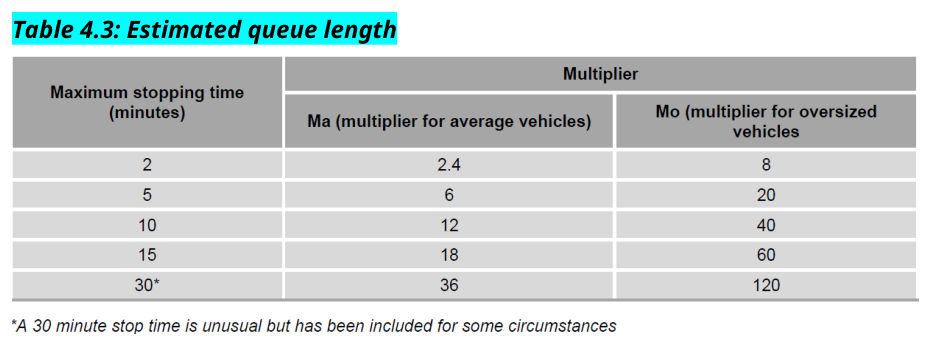
- 4.Estimate end-of-queue position (via the box instructions in Austroads Guide to Temporary Traffic Management Part 3 Section 4.8). A marker (for example, a cone or bollard) should be placed on the shoulder at the predicted end-of-queue to assist the traffic controller and traffic management implementer to monitor queue lengths.
- 5.A PREPARE TO STOP sign must be placed in conjunction with the Boom Barrier or Traffic Controller (symbolic) or Signals Ahead sign a minimum distance as shown in Table 2.3 from the predicted end-of-queue, not the PTCD / traffic controller position. This is the primary PREPARE TO STOP sign.
If the PREPARE TO STOP sign is more than 240 m from the traffic controller, an additional PREPARE TO STOP sign must be placed 120 m from the traffic controller (see Figure 4.4 and Figure 4.5). The primary purpose of this sign is to protect the traffic controller. This is the additional PREPARE TO STOP sign.
If visibility is lost or the distance from the PREPARE TO STOP sign to the PTCD / traffic controller is more than 300 m, the use of repeater PREPARE TO STOP signs should be considered as per Table 4.4(a).
Where these conditions are met and the additional or repeater PREPARE TO STOP signage is required, a Queued Traffic Ahead multi-message sign assembly may be used as the primary PREPARE TO STOP sign. If used, this multi-message sign assembly must include the Queued Traffic (symbolic) (TM1 47A), QUEUED TRAFFIC AHEAD (TM1 46A) and the PREPARE TO STOP (TM1-18B), see Figure 4.8(a) following.
The primary PREPARE TO STOP must be installed in advance of the predicted end-of-queue in accordance with Austroads Guide to Temporary Traffic Management Part 3 Table 2.3.
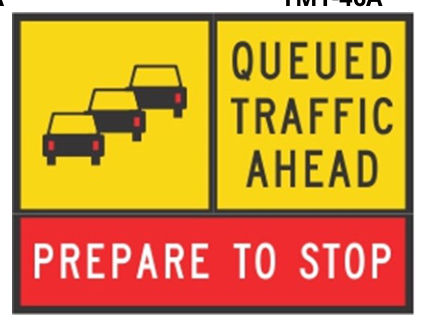
TM1-47A · TM1-46A · TM1-18B
Where this assembly is used, the preferred method of display is to locate the QUEUED TRAFFIC AHEAD text panel (TM1-46A) closest to traffic.
- 6.A ROADWORK AHEAD sign, or VMS must be placed as per Table 4.4(b) in advance of the primary PREPARE TO STOP sign position discussed in Step 5, except for advance signs on side roads, where the requirement of Step 9 will apply.
- 7.Surges in traffic demand can occur so adequate monitoring of the queue must be undertaken to minimise the risk of end-of-queue collision. If the end of queue extends beyond the estimated end-of-queue position, adequate warning of the end of queue must be provided. The options available include:
- a)initially, when traffic queues are approaching the estimated end-of-queue position, the traffic controllers should advise the site supervisor that traffic queues are approaching their maximum length and contingency planning may need to be implemented
- b)as an interim measure, the traffic controllers may adjust their timing or give priority to one approach to minimise queuing from the key direction
- c)if adjusting timings is not successful in managing queue lengths, implement a pre-designed contingency plan to cater for the longer queue lengths being experienced – this will need to be completed by the traffic management implementer while traffic controllers continue to control traffic, and d) if a pre-designed contingency plan is not provided, seek urgent advice from the traffic management designer for the works.
- 8.A 60 km/h speed zone shall be established at least one sign spacing in advance of the traffic control station where the speed zone on the approach to the traffic control station is higher than 60 km/h. Duplicate the speed limit signs and install any required repeater speed limit signs as per the requirements in Section 5.5.1. If the speed of traffic on approach to the traffic control station and the end of queue is less than 60 km/h through other controls (such as the traffic control station and end of queue is down a side road), a 60 km/h speed zone in advance of the primary PREPARE TO STOP sign (for example on the through road) may not be required. Where the speed limit on approach to the traffic control station is greater than 60 km/h, a 60 km/h speed zone must be commenced at least one sign does not apply to situations where the traffic control station is located down a side road and the speed of traffic on approach to the traffic control station and the end of the traffic queue is less than 60 km/h through other controls (such as the traffic needing to turn onto the side road at a lower speed). Speed signs may be required on the side road if the speed of traffic on the side road may exceed 60km/h prior to the traffic control station or the end of the traffic queue. See Section 4.8.1 for more information on the end of the traffic queue. See Section 4.8.1 for more information on speed limits for traffic control stations on a through road near a side road. Duplicate the speed limit signs on both sides of the road and install repeater speed limit signs as required in Section 5.5.1.
- 9.Where intersections are located within the advance warning area (between the traffic control station and the ROADWORK AHEAD or VMS sign), see Section 4.8.1 for the signing requirements for traffic on or entering from side roads.
- 10.Provide additional devices and methods for avoiding end-of-queue collisions as required in Section 4.8.3.
- 11.For shuttle flow operations, the traffic control taper must start a minimum of 6 m from the traffic control station.
As per AGTTM Part 7 Section 2.6.3, when used side by side in a multi-message situation, the PREPARE TO STOP panel must be placed closest to the travel way and that the 600 x 600 version of this sign is used as illustrated in Figure 4.8(b), excluding where the use of the 1200 x 300 version is specifically permitted by QGTTM.