
1Risk management and exception process for traffic control at road work sites#
1.1Background#
Variations in traffic management practices at work sites in Queensland and in the application of traffic control devices occur when those preparing Traffic Management Plans design the Traffic Guidance Scheme outside the parameters set in the Queensland MUTCD Part 3 and related documents.
The department’s current culture is to encourage innovation in the design of Traffic Management Plans and Traffic Guidance Schemes where that innovation leads to an improvement in the value for money solutions which may involve impacts outside the specified requirements, without compromising safety.
Such treatments may include:
- planning for greater network impacts through reducing the level of service (LOS) for the road user which typically enables works to be undertaken in a more time efficient manner –Chapter 2 Section 3 of this document provides guidance on assessing acceptable LOS for roadworks sites: this may include changes to the scheduling / programming of the work to occur during periods of lower traffic demand
- treatments for the deployment of devices, and
- alternative device layouts using new / improved devices.
It is also recognised that, in some cases, conditions specific to the site and proposed traffic management layout may result in it not being possible to implement the requirements as outlined in the Queensland MUTCD Part 3 and related documents.
Traffic Guidance Schemes which provide a lesser level of protection and guidance may lead to additional safety risks to road workers and an increased risk of driver error. Schemes which do not meet the optimal requirements of the Queensland MUTCD Part 3 and QGTTM can be considered but must be accompanied with a risk assessment and appropriate measures to ensure that the safety of workers and road users is not compromised.
Traffic Guidance Schemes with traffic management treatments in excess of that included in the Queensland MUTCD Part 3 and QGTTM are also considered as Exceptions and may potentially appear unnecessary to drivers and / or lead to increased driver frustration and reduced compliance with the regulatory requirements of the scheme. Traffic Guidance Schemes should not be developed with treatments in excess of that documented unless the risk assessment process identifies a clear need.
Where any alternative traffic management treatment or departure from standards is proposed, a risk assessment should be undertaken in accordance with this supplement. Both the risk assessment and Traffic Guidance Scheme shall be certified by a Registered Professional Engineer of Queensland (RPEQ).
1.2Risk management#
Risk Management shall generally be undertaken as per Section 2 – Risk Management for TTM, of Austroads Guide to Temporary Traffic Management Part 10: Supporting Guidance.
The following additional provisions shall apply:
Use of standard and site-specific Traffic Management Plans#
While the application of standard diagrams may be appropriate, they can be inappropriate if they are implemented without considering specific site conditions or the other requirements and options for deviation contained within the Queensland MUTCD Part 3 and QGTTM.
When considering the application of standard diagrams, practitioners should consider:
- the notes accompanying the diagrams
- the need for a risk assessment
- the hierarchy of control to assess whether the highest practical level of protection or separation is being applied, and
- site specific circumstances (for example, traffic characteristics, pedestrian facilities, public transport, vulnerable road users, road furniture, property access, crash history, probable weather conditions, site distance and so on) and adaptions of the plan as necessary to appropriately address these conditions.
Roles and responsibilities#
Exceptions to requirements of the Queensland MUTCD Part 3 and QGTTM must be certified by a Registered Professional Engineer of Queensland (RPEQ), who must ensure that the use of the design Exception is appropriate, compliant with reasonable engineering principles and that departmental processes have been followed, including Clause 1.9 of Queensland MUTCD Part 3.
1.3Exceptions process#
This process for Exceptions to traffic control standards is adapted from the department’s design Exception process included within the Road Planning and Design Manual 2nd Edition, Volume 3 Supplements to Austroads Guide to Road Design, Parts 1, 3 and 4A.
1.3.1General#
Traffic management officers must consider the following when contemplating Exceptions to traffic control standards:
- What is the safety performance of the standard arrangement?
- What is the expected safety performance of the arrangement that incorporates the Exception?
- What should the safety performance of the temporary traffic arrangement be?
- Is the difference acceptable?
The Exception process for traffic control standards is shown in Figure 1.3.3 of this chapter. The amount of work required to be put into each phase in the process will depend on the works and the extent of the proposed variations from the standards.
1.3.2Development and evaluation of alternatives#
An evaluation of the impacts of both the standard arrangement/s and that which incorporates the Exception/s must be undertaken. The evaluation should consider (and document) at least the following for all options:
- safety impact
- environmental impact
- community impact
- network impact (traffic operation and level of service), and
- value for money.
Other factors may also be considered depending on the particular circumstances of the site / project.
1.3.3Mitigation#
Specific treatments to mitigate identified risks associated with a proposed Exception must be considered and assessed on a case-by-case basis. An understanding of a site's crash history and crash reducing treatments will assist in the development of risk mitigation strategies.
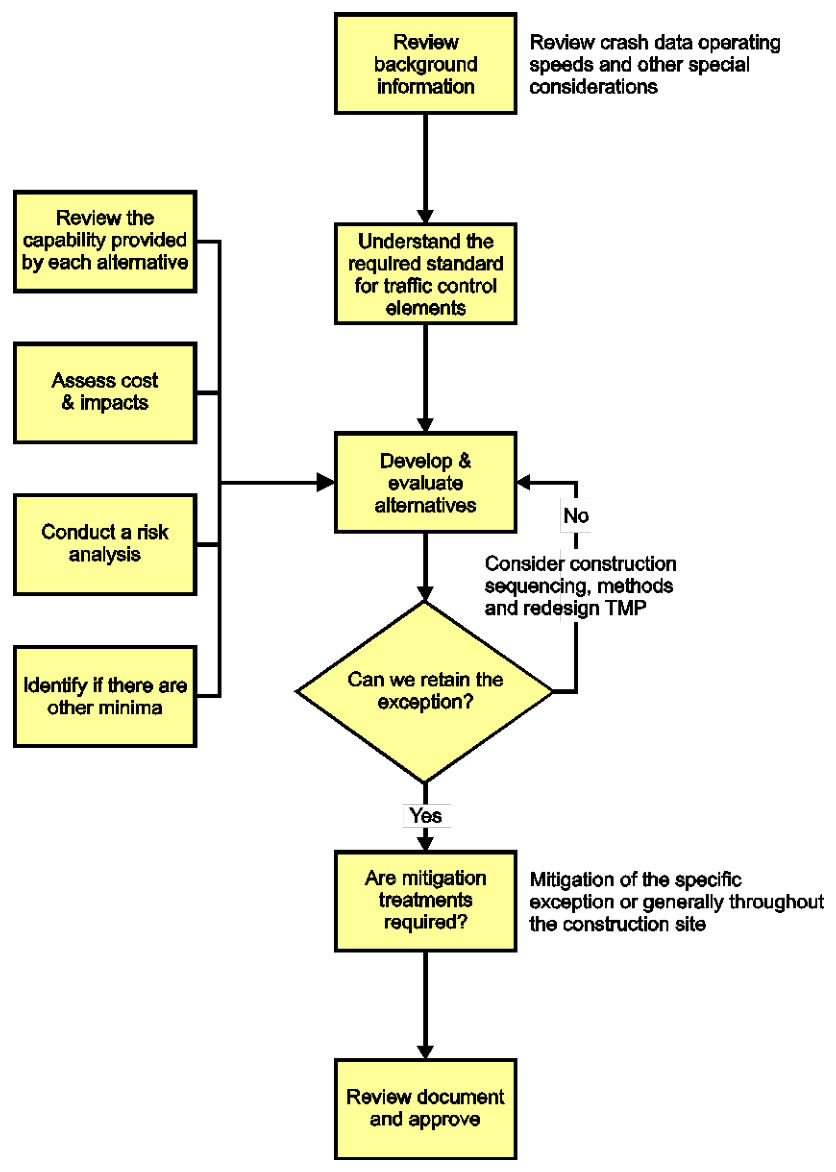
1.3.4Documentation#
Elements of the Exception report may include:
- the location of the works
- the site characteristics such as sign posted speed limit, traffic volume and composition
- the standard to which the Exception applies, including full details of the document it is contained within
- the proposed Exception and the reasons for its proposal including site constraints
- the costs and impacts of both the standard solution and the Exception (including impacts to the environment, community, traffic network, safety and so on)
- other alternatives considered
- the risk assessment and control measures considered
- any safety and other performance information of similar Exceptions applied at other work sites, and
- all reference material used in the evaluation of the Exception.
- The road is a four lane, two-way urban arterial with 1 m wide central median. Only one direction of traffic will be affected.
- The existing lane width is 3.3 m with a 0.5 m shoulder.
- The sign posted speed limit is 60 km/h.
- The AADT is 28,000 vehicles per day with 4.9% heavy vehicles.
- There have been no recorded crashes at the site in the last five years.
| Work Site Traffic Management Practice Exception Decision | ||||
| Location and Scheduled Dates | ||||
| Location | This Exception related to work site traffic management activities at Ch. Xxx on xxx Road | Dates | From: To: | dd / mm / yyyy dd / mm / yyyy |
| What is the standard that is to be departed from? | ||||
| QGTTM Part 3 Section 2.5.8, Table 2.5 requires a minimum lane width of 3 m for road works speed zones of 60 km/h or less. |
Table in words
- The work site traffic management practice exception decision is titled Work Site Traffic Management Practice Exception Decision.
- The location and scheduled dates section records the location as This Exception related to work site traffic management activities at Ch. Xxx on xxx Road and the dates as From: To: dd / mm / yyyy dd / mm / yyyy.
- The standard that is to be departed from is QGTTM Part 3 Section 2.5.8, Table 2.5 requires a minimum lane width of 3 m for road works speed zones of 60 km/h or less.