
2.4Planning#
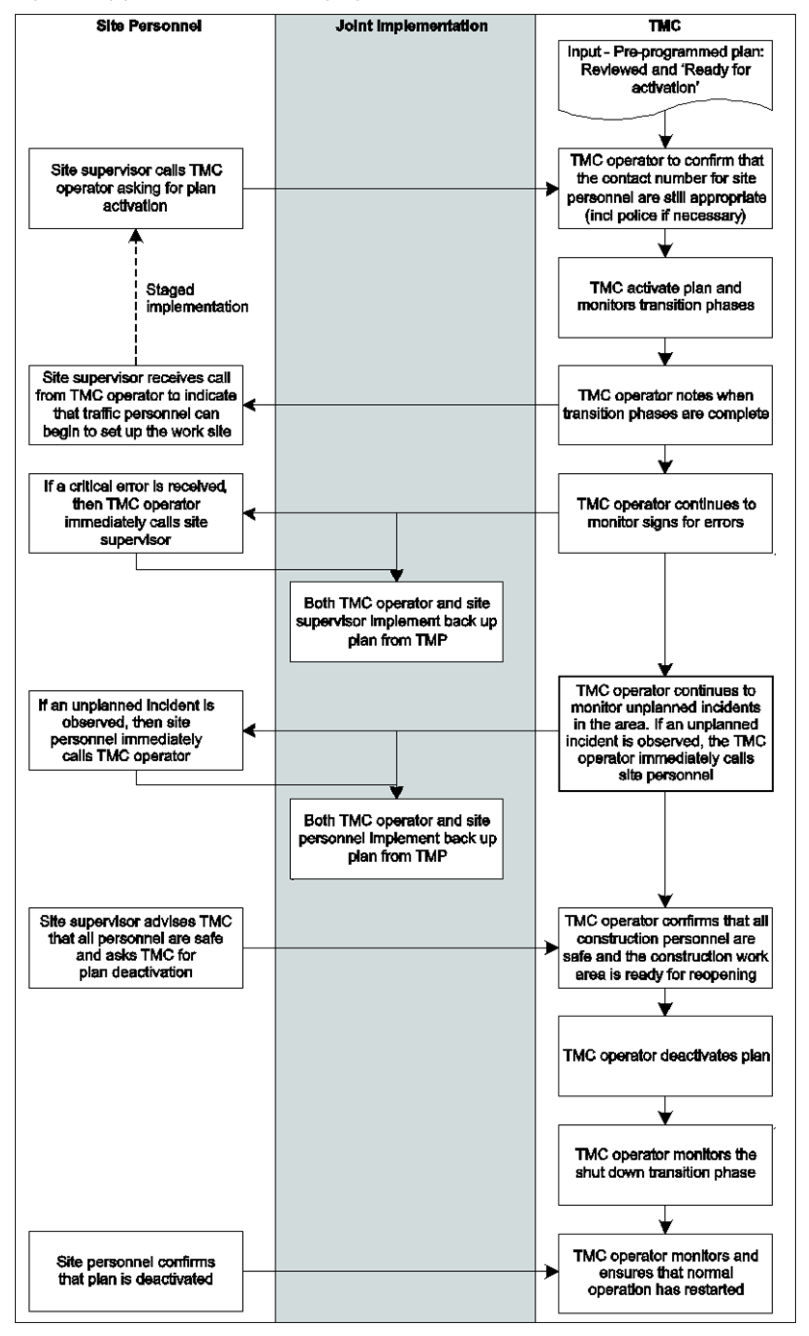
Detailed planning for the work will need to be commenced well in advance of construction to allow discussion with the Traffic Management Centre and Department of Transport and Main Roads Regional Director or his or her delegate or responsible authority and to allow for any refinements to the submitted Traffic Management Plan. This will ensure traffic operations are safe and efficient and will allow sufficient time for any system changes to be implemented by the Traffic Management Centre in an orderly manner. The Department of Transport and Main Roads regional office and / or asset owner / manager gives the approval for the proposed traffic control methodology for the lane closures using the VSL / LCS. These approvals are the final part of a process which includes assessment of the impacts of the works on traffic flows, formulation of Traffic Management Plans, making an application and finally, execution of the plans. For projects on state-controlled roads, a pre-start meeting with the Road Operations business unit (or relevant area) may be necessary in order to assess how the VSL / LCS can assist with traffic management of the work site. A representative from the Traffic Management Centre should also attend to discuss operational detail of the VSL / LCS. Part of this discussion should include a brief formulation of a back-up plan if a critical error occurs with any aspect of the execution of the VSL / LCS assisted Traffic Management Plans. The level of traffic management needed for particular construction and maintenance activities will determine the degree of support to be provided by the VSL / LCS. The suggested processes are summarised in Figure 2.4(a) and Figure 2.4(b) of this chapter, with the development of a Traffic Management Plan, approval and review procedures and work site operations detailed in Sections 2.4.1, 2.4.2 and 2.4.3 of this chapter.
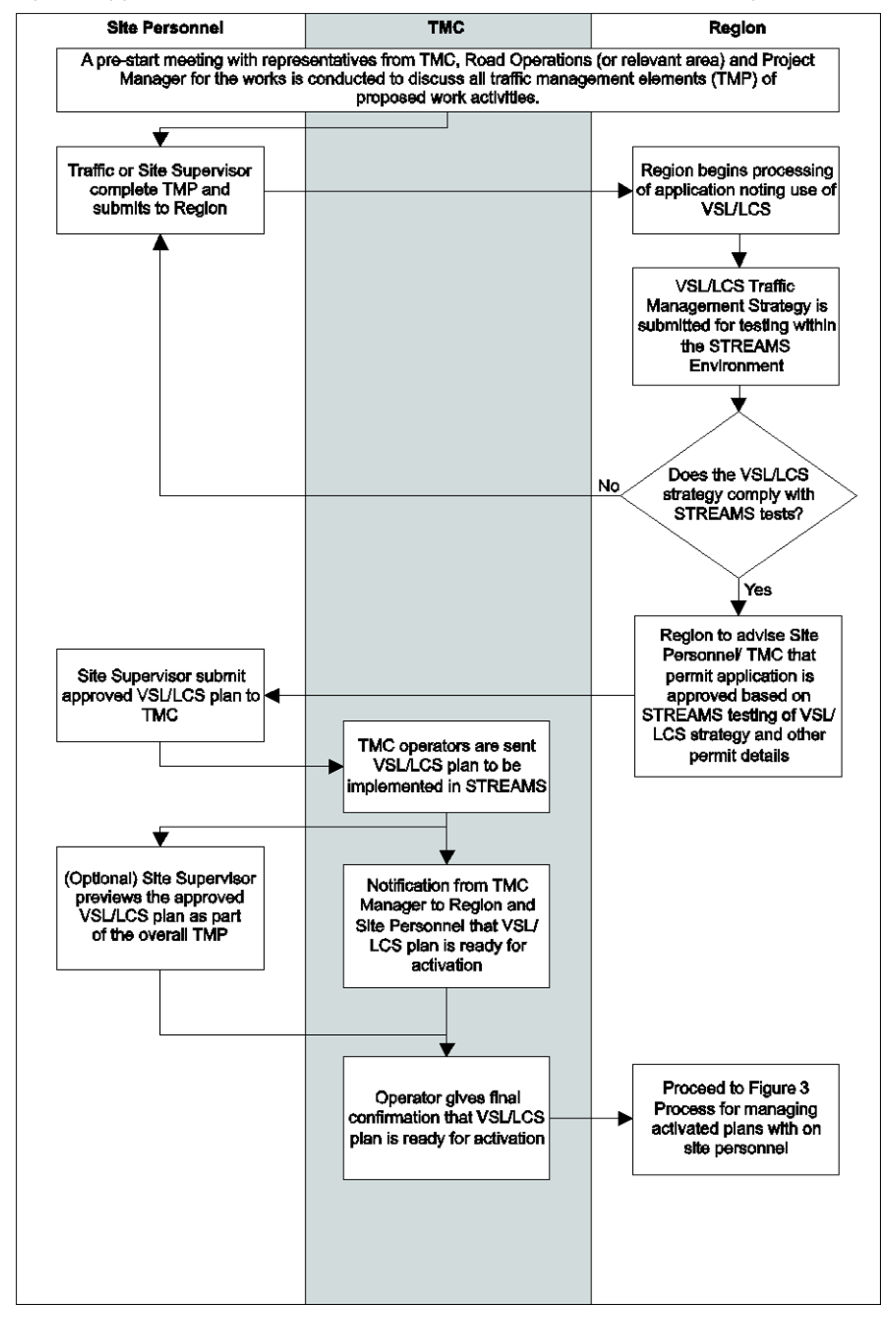
2.4.1Preparation of Traffic Management Plans#
Preparation of the Traffic Management Plan proposed for the works on the motorway includes a fully documented Traffic Guidance Scheme providing the following information:
- the limits of the work site
- defined lane closures
- types of signs and devices needed for the lane closure; for example, temporary static signs, bollards and so on
- proposals for lane closure and variable speed limits on integrated Variable Speed Limit / Lane Control Signals or Variable Speed Limit Signals only located on approach to, at, and departure from the work site. This will need to include consideration of the following:
- ensuring that there is no conflict between static signs, or the static lane closed signs and the overhead lane control signals
- ensuring that the principles described in Section 2.4 of this chapter are applied; for example, variable speed limit sign(s) on the entrance ramp show the same speed limit as the main motorway traffic lanes, and
- a staged implementation of the VSL / LC plan due to the work method or sign set out / retrieval.
- a sketch of the location of the signs and devices, including the variable speed limit / lane control signals proposed at each gantry or pole mounted variable speed limit sign
- the time, day and date expected for the start and finish of the work, and
- contact details of the Site Supervisor (primary contact), secondary contact (for example, traffic supervisor) and Queensland Police Service representative where applicable. Mobile phone numbers or details of radio communications should be provided.
Submission of the plan to the Regional Director or his or her delegate for approval shall occur prior to installation.
2.4.2Review of Traffic Management Plan by the Traffic Management Centre#
Following approval of the Traffic Management Plan (by Regional Director or his or her delegate); it is then forwarded to the Traffic Management Centre. This is to allow assessment of the plan in relation to the VSL / LC components of the plan. This allows the Traffic Management Centre to preview the changes needed to the variable speed limit and lane control signals before, during and after the temporary roadworks; and to detect any errors or anomalies in the system and correct them well in advance of the commencement of the works.
Assessment of the plan by the Traffic Management Centre will also include preparation of strategies for managing the work site with variable speed limits and lane control signs with regard to:
- the communication process for activating and deactivating plans, and managing critical / non-critical faults, and
- procedures needed should the variable speed limit and lane control signs fail critically (for example, failure of the communications link or power supply) during the management of the works in the event that an unplanned incident occurs near the roadworks, affecting traffic control at the temporary roadworks.
These issues and strategies proposed by the TMC should be discussed with and reviewed by the Site Supervisor prior to their finalisation.
Upon completion of the pre-approval process, the Site Supervisor and traffic supervisor are advised that the VSL / LC plan is ready for activation.
2.4.3Operation#
Good communication between site personnel and the Traffic Management Centre is essential before, during and upon completion of the works. It is important to note that only pre-approved VSL / LC plans that have been marked by the Traffic Management Centre as ‘Ready for Activation’ may be activated.
Before starting the work#
Prior to the commencement of temporary works on the motorway, the Site Supervisor requests the Traffic Management Centre to:
VSL/LC plan (Speed reductions only)
- i.Activate the speed reductions of the pre-approved plan.
Following activation of the plan, and when the transition from the normal speed limits to the pre-approved speed limits is completed, the Traffic Management Centre will then advise the Site Supervisor that the site traffic personnel can begin to set out advance roadwork signage and set up the work area. This shall ensure that Traffic Controllers are setting up in a safer, reduced speed environment.
Full implementation of the VSL / LC plan (speed reduction and lane control)
- ii.Activate the pre-approved VSL / LC plan.
Following activation of the plan, and when the transition from open lanes and normal speed limits to closed lanes and work zone speed limits on the integrated VSL / LC signals is completed by the Traffic Management Centre, the Traffic Management Centre will then advise the Site Supervisor that site traffic personnel can begin to set up the work site with static signs, bollards and so on.
The reduced speeds and lane control signs should assist in creating a safer environment for Traffic Controllers to set up signing for the work site.
Staged implementation of the VSL / LC plan* (speed reduction and lane control)#
- iii.Activate the speed reductions of the VSL / LC pre-approved plan if a staged implementation is considered necessary.
Following activation of the plan, and when the transition from the normal speed limits to the pre-approved speed limits is completed, the Traffic Management Centre will then advise the Site Supervisor that the site traffic personnel can begin to set out advance signage only. This shall ensure that Traffic Controllers are setting up in a safer, reduced speed environment. After all advance roadwork signage has been set out, the Site Supervisor shall request that the Traffic Management Centre activate the pre-approved lane control of the VSL / LC plan. Once lane control has been completed the site personnel may then begin setting up the work area with static signs, bollards and so on.
During the work#
The Traffic Management Centre continually monitors the activated plans. If there is an unplanned incident nearby, possibly requiring an even lower speed limit or closing an additional lane, the Traffic Management Centre will immediately contact the work site personnel to advise / discuss any changes needed to work site arrangements. Should a failure occur in the communications link or power supply associated with the variable speed limit / lane control signals, resulting in the variable speed limit and lane control signals being blanked, the Traffic Management Centre will immediately contact the work site personnel. Site personnel would then implement the appropriate strategy from the traffic management and VSL / LC plans.
At the end of the work#
At the end of the work – after all plant, equipment, workers and traffic management devices, for example, static signs, bollards and so on have been removed from the traffic lanes – the Site Supervisor, after verifying that all lanes are clear of obstacles, advises the Traffic Management Centre that the work has been completed and the motorway can be returned to normal operating conditions.
Consideration is required to determine if the VSL / LC plan is to be deactivated in a staged approach, that is, deactivate LC, and then deactivate speed reductions.