2.5Portable traffic signals#
2.5.1Introduction#
This section outlines the operational requirements for two different portable traffic signal systems (PTSS) that are approved for use in Queensland.
The requirements ensure that:
- PTSS are operated effectively and consistently by accredited Traffic Controllers trained and competent in their use, and
- the risk to road workers, Traffic Controllers and road users is minimised.
PTSS can be used for three types of traffic control:
- shuttle control
- plant-crossing control, or
- gating control.
There are four user selectable modes of operation:
- flashing yellow
- manual
- vehicle-actuated, or
- fixed time.
2.5.2Definitions#
| Expression | Definition |
|---|---|
| actuation | The electrical action produced by a vehicle (on a vehicle detector) to enable the controller to recognise its presence. |
| All-red time | A period of time during which only red aspects are illuminated for all movements. |
| approach | That section of road, consisting of one or more lanes, used by vehicles approaching an intersection or mid-block site. |
| aspect | A single optical system (circular, arrow or symbolic) on a single face capable of being illuminated at any given time. Red, yellow and green aspects are used for vehicle movements. |
| controller | The equipment (including the housing) that switches power to signal lanterns and controls the duration and sequence of signal displays. |
- Cycle length (cycle time)
- Time required for one complete sequence of signal displays. For a given movement, cycle time is the sum of the durations of red, yellow and green signal displays.
- flow rate
- Number of vehicles per unit time (normally per hour) passing (arriving or departing) a given reference point.
- Green time
- Duration of the green display for a phase or movement.
- Hand-held Remote Controller (HRC)
- A hand-held remote/device which can control and set the PTSS lanterns. This allows the Traffic Controller to control operations without being physically located at a PTS.
- Long-term
- The description which applies when a Traffic Guidance Scheme is required to operate both day and night and may be left unattended.
- Maximum green time
- The maximum duration of the green display that can continue to be illuminated after a demand for another phase had occurred.
- phase
- That part of a signal cycle during which one or more movements receive right-of-way subject to resolution of any vehicle conflicts by priority rules. A phase is identified by at least one movement gaining right-of-way at the start of it and at least one movement losing right-of-way at the end of it.
- Portable Traffic Control Devices (PTCD)
- A traffic control device that either operates without the need for a traffic controller or when operated in manual mode by a traffic controller, shall be operated by using a handheld remote control (wireless or wired) and the traffic controller shall be located a safe distance from traffic.
- Portable Traffic Signal Unit(s) (PTSU)
- An individual portable traffic signal that consists of the traffic signal lantern, battery, communications equipment, mounting assembly and base.
- Portable Traffic Signal System(s) (PTSS)
- Traffic light signals and associated equipment that provides signalling for temporary control of traffic at work sites.
- Red time
- Duration of the red signal for a phase or movement.
- Short-term
- The description which applies when a Traffic Guidance Scheme is required only while work personnel are in attendance. The time is generally limited to the duration of a single work shift or lesser period where road conditions are returned to normal when the shift or lesser period ends.
- Signal lantern
- A signal assembly of optical components (one or more aspects), together with the means of connecting them to power supply and facilities for mounting the complete assembly.
- Stop line
- A single continuous line marked across all or part of a road, behind which vehicles should stand when required to stop by traffic light signals or regulatory signs.
- Temporary traffic signal system
- An electrically operated signalling system that provides traffic signals for the temporary control of vehicular traffic at road works, bridge works or similar applications. The system is installed temporarily to the road using the same standard traffic signal equipment used at permanent sites.
- Traffic Controller / flag person
- A person who holds an appointment as an accredited person under section 21 of the Transport Operations (Road Use Management) Act 1995 to perform the functions of a Traffic Controller as prescribed by the Transport Operations (Road Use Management - Accreditation and Other Provisions) Regulation.
- Unattended operation
- Vehicle actuated operation and fixed time operation.
- Yellow time
- Duration of the yellow display for a phase or a movement.
2.5.3Types of portable traffic signal systems#
2.5.3.1General#
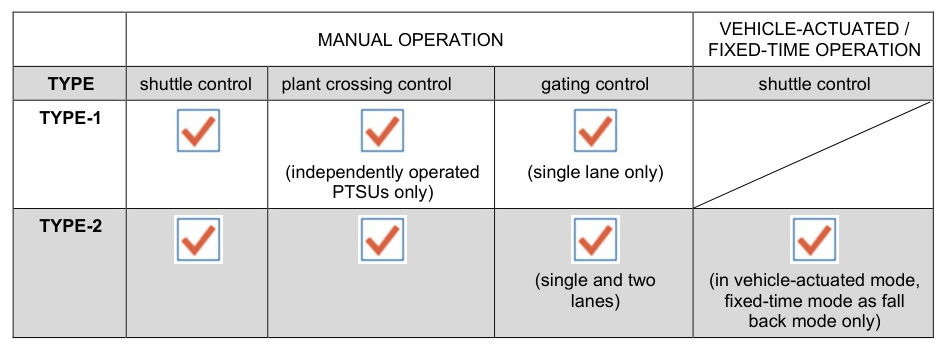
The technical requirements of Type-1 PTSS are defined in MRTS264 Type 1 Portable Traffic Signals and the requirements of Type-2 PTSS are defined in MRTS265 Type 2 Portable Traffic Signals. The Type-1 PTSS provides a simpler, easy to deploy system with reduced functionality compared to the Type-2 PTSS. The Type-1 units only work in manual mode and are used for shuttle flow, plant crossing and gating control.
A PTSS operating under manual mode may be used to control traffic at the approach legs to an intersection (signalised or unsignalised) under the same procedures as Traffic Controllers using STOP / SLOW bats. If all approaches are controlled by PTSUs, each approach may be independently controlled by a Traffic Controller (one TC with one HRC controlling a PTSU).
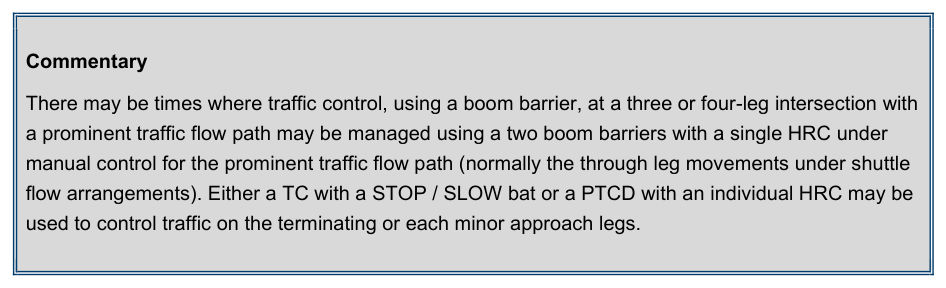
There may be times where traffic control at a three or four leg intersection with a prominent traffic flow path may be managed using two PTSUs paired with a single HRC under manual control for the prominent traffic flow path (normally the through leg movements under shuttle flow arrangements). A TC with a STOP / SLOW bat or a PTSU with an individual HRC is required to control traffic on the terminating or each minor approach legs.
PTSUs, when not in use, shall face away from traffic or be covered and all signs for the device shall be removed or covered.
PTCDs other than PTSS that accomplish the same outcome of removing Traffic Controllers from the road (for example, boom barriers) may also be used in lieu of Traffic Controllers. These alternative systems shall be approved for use by the Department of Transport and Main Roads (Engineering and Technology) and may be supported by approvals from the ARRB Transport Infrastructure Product Evaluation Scheme.
2.5.3.2Type-1 portable traffic signal systems#
Where used Type-1 PTSS shall consist of either one PTSU, or two PTSUs if paired, with a single HRC operated by a Traffic Controller. When paired, control is limited to shuttle flow operations.
Where the PTSS consists of one HRC paired with two PTSUs:
- Visibility to the PTSUs and approaching traffic shall be assessed before confirming the number of controllers required, noting that visibility can vary with weather condition, day light, local lighting, road geometry and the presence of roadside objects. Where visibility to both PTSUs and approaching traffic from both directions is available, traffic may be controlled using a single Traffic Controller.
- Visibility to both PTSUs and approaching traffic from both directions by one Traffic Controller is restricted:
- − two Traffic Controllers (one per PTSU) are required
- − the operating procedure is as per standard stop / slow arrangements
- − only one of the two Traffic Controllers will operate the PTSS with a fully functional HRC: the other Traffic Controller monitors the other PTSU and associated traffic and provides information to the operator, and
- − each Traffic Controller shall be equipped with radio communication.
A PTSS consisting of two or more PTSUs (not paired) with each PTSU being controlled by a single HRC may be used under the following conditions:
- Where visibility to both PTSUs and approaching traffic from both directions by one traffic controller is restricted.
- Where a single HRC cannot communicate effectively with both PTSUs.
- Where traffic control is required at intersections or for plant crossing.
In any of these cases the following will apply:
- traffic controllers (one per PTSU) are required
- each traffic controller has an HRC controlling a single PTSU
- the operating procedure is as per standard stop / slow arrangements, and
- each traffic controller shall be equipped with radio communication.
2.5.3.3Type-2 portable traffic signal systems#
Type-2 PTSS comply with MRTS265 Type-2 Portable Traffic Signals.
A Type-2 PTSS has the following features:
- three modes of operation
- manual
- fixed time, and
- vehicle actuated
- adjustable time settings, and
- minimum battery life of seven days without recharging.
During manual operation, the Traffic Controller controls the sequence and time for which the green signals are displayed. The Traffic Controller cannot override the configured minimum green time and all-red time after initial configuration and operation has commenced.
Two Type-2 PTSUs shall be used for gating control on a two-lane one-way road (refer to Section 2.5.5.3 of this chapter).
Vehicle-actuated mode shall be used when operating unattended shuttle control, except if the vehicle detectors fail.
A Type-2 PTSS can operate unattended. When operating unattended, a Type-2 PTSS shall be inspected at least once every 24 hours to confirm its correct operation or shall have remote error monitoring and reporting functionality.
When unattended, the contractor’s after hours contact details shall be displayed prominently on all PTSUs.
2.5.4Application guideline#
| MANUAL OPERATION | VEHICLE-ACTUATED / FIXED-TIME OPERATION | ||||||||
|---|---|---|---|---|---|---|---|---|---|
| TYPE | shuttle control | plant crossing control | gating control | shuttle control | |||||
| TYPE-1 | (independently operated PTSUs only) | (single lane only) | |||||||
| TYPE-2 | (single and two lanes) | ||||||||
| (in vehicle-actuated mode, fixed-time mode as fall back mode only) |
Table in words
- For manual operation, TYPE-1 is used for independently operated PTSUs only.
- For manual operation, TYPE-2 is used.
- For vehicle-actuated / fixed-time operation, TYPE-1 is used for shuttle control on a single lane only.
- For vehicle-actuated / fixed-time operation, TYPE-2 is used for shuttle control on single and two lanes.
- For vehicle-actuated / fixed-time operation, TYPE-2 is used in vehicle-actuated mode, with fixed-time mode as fall back mode only.
2.5.5Control types#
PTSS can be used in three forms of traffic control:
- shuttle control
- plant crossing, and
- gating control.
2.5.5.1Shuttle control#
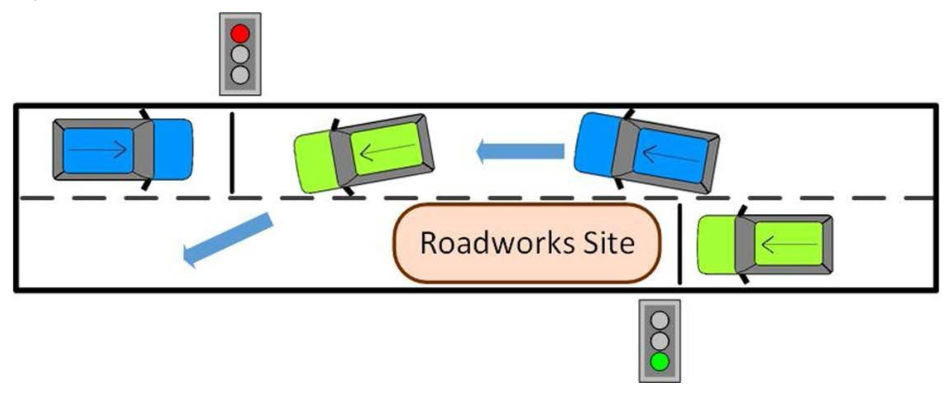
PTSS may be used in lieu of Traffic Controllers for shuttle control operations. This type of control is generally used on a two-lane two-way road, where one lane is closed for maintenance and the other is shared by traffic from both approaches.
Shuttle control uses two PTSUs.
Each PTSU indicates which direction of the traffic flow may proceed past the roadworks site. A PTSU is used at each end of the work zone, and only one PTSU can be green at a time. When there is a need for complete access to the roadway for a short period, both PTSUs can be red.
When using PTSS Type 1 or Type 2 devices, for manually controlled shuttle flow arrangements, they should be used in paired mode using a single HRC whenever possible / suitable. This will prevent a green signal being displayed to both approaches at the same time.
2.5.5.2Plant crossing control#
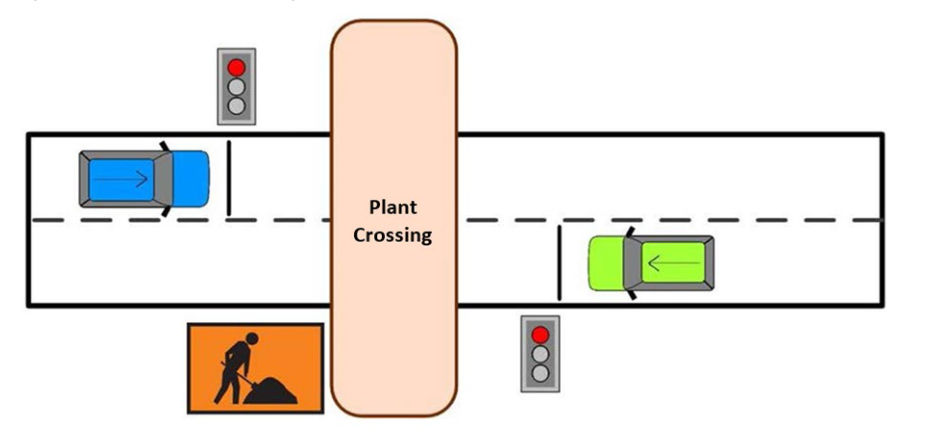
One PTSU shall be used on each road approach to temporarily stop traffic at a road work site where plant needs to cross the roadway.
This control type allows the signals on both approaches to display the same signal (that is, green, yellow and red simultaneously).
Appropriate measures to control traffic on the plant crossing shall be implemented.
Manual operation is safer and more effective in preventing delays to vehicles on both the road and plant crossing.
Plant crossing control may be undertaken with unattended vehicle actuated operation if the following conditions are met:
- A PTSU is used on each approach (both the road and the plant crossing).
- The PTSS used has the capability to hold a permanent call on the through road to allow the signals to dwell on green and the signals on the plant crossing are vehicle actuated as required.
- A site-specific risk assessment has been completed which addresses the operational details (for example, volumes of both the through road and plant crossing and vehicle types using the plant crossing).
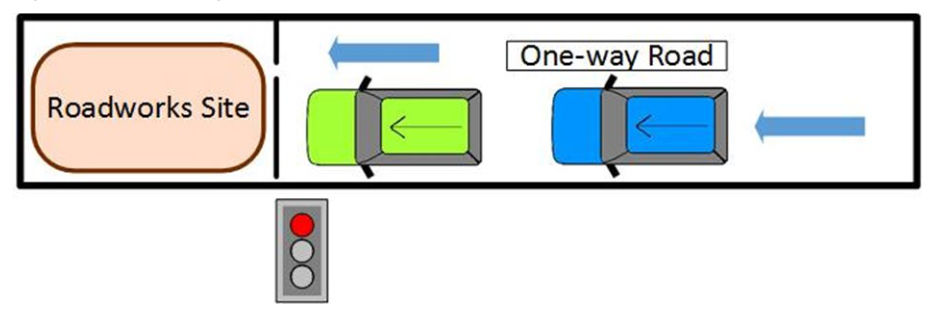
2.5.5.3Gating control#
Gating control is the control of traffic from a single approach. Gating control is permitted in accordance with Table 2.5.5.3.
| Approach | Type of PTSS | Number of PTSU |
|---|---|---|
| Single lane operation | Type-1 or 2 | 1 |
| Two lane operation | Type-2 | 2 |
2.5.6Modes of operation#
The permitted modes of operation for PTSS are outlined in Table 2.5.6.
| Shuttle control | Plant crossing control | Gating control | |
|---|---|---|---|
| Manual operation | |||
| Vehicle-actuated operation | (see Section 2.4.5.2) | ||
| Fixed-time operation | Fall-back mode only | ||
| Flashing yellow operations | See Section 2.4.6.1 |
2.5.6.1Flashing yellow operation#
In flashing yellow mode of operation, the yellow aspects on all PTSUs continually flash.
This operation mode occurs in response to:
- start-up conditions
- faults or failure conditions, and / or
- manual selection of flashing yellow mode (Type-2 PTSS).
2.5.6.2Manual operation#
In manual mode, the lantern signals are manually controlled remotely from a safe location.
Manual operation should be used when:
- traffic is required to be kept out of the live lane for an extended period (for example, to accommodate work vehicle movements)
- a vehicle detector fails when using vehicle-actuated operation, and it is not appropriate to switch to fixed-time operation, and
- other situations where optimal traffic flow is not being achieved by vehicle actuated mode.
Where manual operation is used, the operator shall ensure that all-red times are sufficient to clear the control area of opposing traffic
2.5.6.3Vehicle actuated operation#
Vehicle-actuated operation allows a variable sequence and variable duration of signal displays. In this mode, a PTSS operates automatically. It responds to actuations from vehicle detectors installed on each PTSU. For details of sequence and timing of signal displays, refer to AS 4191 Portable Traffic Signal Systems.
Vehicle-actuated operation should be the normal mode of operation for Type-2 PTSS.
2.5.6.4Fixed-time operation#
In this mode, the duration of the greens and all-reds are fixed, and the PTSS cycles through a fixed sequence. The operator sets the green and all-red times at the PTSS controller. These time settings operate until the signals are switched off or the timer is reset.
Type-2 PTSS shall not be operated in fixed time operation unless the vehicle detectors have failed.