
3Lookout protection method#
3.1Introduction#
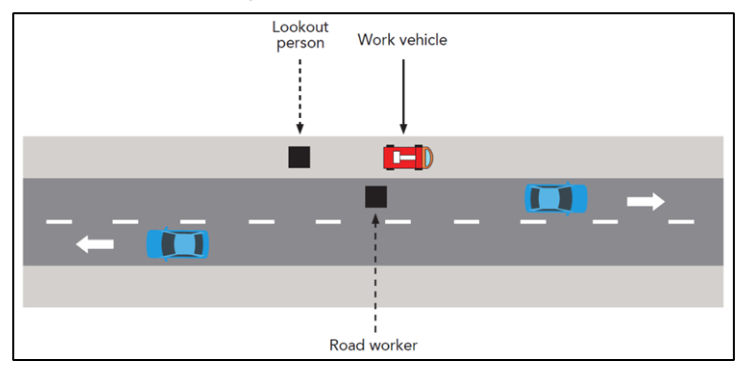
The use of the lookout protection method is discussed in the Queensland Guide to Temporary Traffic Management (QGTTM) Part 5. Lookouts are used as a safety protection measure to watch for approaching road traffic and alert workers to vacate the roadway before road traffic arrives.
Lookouts must keep a continuous watch for approaching road traffic for personnel carrying out work tasks. On sighting approaching road traffic, the lookout must be able to warn the workers in time to allow them to react to the warning and move themselves and their tools/materials to a safe position before the road traffic arrives. Please note that safety barriers or guardrails may block escape paths - a position of safety off the roadway must be available for both workers and the lookout.
As lookout protection relies solely on the lookout keeping watch for road traffic hazards, work on the roadway (high-risk zone) must only be done where sight distances can be met, and visibility allows. Daylight hours are recommended. Where lookouts are required to be used at night, the risk must be assessed, and precautions taken to ensure the lookout can identify the approach of vehicles accurately and clear workers from the road in a safe and timely manner.
Under lookout protection:
- a) The roadway will not be made unsafe for road traffic movement or obstructed by plant or equipment.
- b) Only tools and equipment that can be cleared quickly can be used by the worker/s under lookout protection. For example, survey rods, cameras, small hand tools.
- c) A position of safety off the roadway must be available and accessible for workers and lookouts (no barriers or other obstacles that may impede access).
- d) Minimum sight distance must be maintained at all times by the lookout and the distance confirmed through physical measurement for example, laser measure, car odometer or measuring wheel.
- e) The time taken to clear the high-risk zone (roadway) must be tested before work starts at the site. This should be tested off the roadway with any equipment/materials the worker will be using or carrying.
- f) Extra precautions must be taken when using lookouts at night (see Clause 2).
- g) Lookouts cannot do any other work while performing lookout duties.
- h) Lookouts must remain in close enough proximity to workers who require lookout protection to ensure warnings can be given effectively.
- i) Lookouts must warn workers immediately of the approach of traffic and in ample time to make sure workers and/or equipment are moved to a position of safety.
- j) Lookouts must use an appropriate warning method for the type of work being undertaken and the environment, for example, a verbal warning would not be suitable if the works are noisy, or the lookout is on the verge - a siren and/or vibrating device may be more appropriate.
- k) Workers must remain in a position of safety until the lookout gives the all-clear and the traffic has moved past the work area.
3.2Using lookouts at night#
It is important to remember that:
- a) Distances cannot be judged accurately in low light conditions.
- b) It is harder to judge the speed of approaching vehicles in low light conditions.
- c) Peripheral vision is severely compromised in low light.
- d) Vehicles become difficult to see as contrast is low.
- e) It is harder to identify the type of vehicle, for example a motorbike from a car, if only 1 headlight is working.
If lookouts are to be used at night, a risk assessment and other controls should be put in place to ensure the use of lookouts is appropriate for the site conditions, activities involved and the safety of workers (and lookouts).
Considerations for using lookout protection at night, should include the following:
- a) Traffic volume – low volume recommended.
- b) Traffic speed.
- c) Sight distances.
- d) Traffic noise (ability to hear approaching traffic).
- e) Ability to see vehicles / vehicle lights approaching on side roads.
- f) How will the lookout identify when vehicles have entered the danger zone for workers?
- g) Lighting of path to position of safety for workers and lookouts.
3.3Minimum warning time#
Table 3.3 shows an example to calculate the minimum warning time that can be used for determining the required minimum sight distance in Table 3.4 (e.g., 15 seconds).
The required minimum sight distance (Table 3.4) will vary depending on the time required to clear the roadway to a position of safety and the speed of approaching traffic.
The time required for workers and equipment to move to a position of safety MUST be tested and confirmed prior to workers entering the roadway.
| Time | Description | |
|---|---|---|
| 7 seconds | Time required for workers and equipment (and lookouts) to move to position of safety. This time will vary depending on width of roadway, work being carried out, the equipment being used, and the location of the position of safety. This time must be tested (off the road) prior to works commencing. | |
| 3 seconds | Reaction time (includes lookout and worker). 3 seconds is the minimum time allowance. | |
| 5 seconds | Workers and lookouts reach a position of safety before traffic arrives. 5 seconds is the minimum time allowance. | |
| = | 15 seconds | Total time required (minimum) |
It is important that the responsible person on site identifies the correct minimum warning time for workers to clear the roadway in conjunction with the lookout and tests this timeframe before lookout protection is endorsed for use and before workers move onto the roadway.
3.4Minimum sight distance#
The minimum sight distance required for the lookout and workers to react appropriately to the approach of traffic is identified in Table 3.4 below.
Various parts of the QGTTM include a table providing the minimum sight distance for a lookout person. However, the values provided within QGTTM are limited to situations where a worker travels up to a maximum of 3.5 m between their work location and a nearby shoulder or median. As a worker's position of safety may not always be the nearest shoulder or median, nor the escape distance be limited to 3.5 m or less, the provisions of this technical note have been published for use in Queensland to provide additional guidance for the use of lookout protection. Other requirements and considerations include the following:
- a) A clear line of sight MUST always be able to be maintained.
- b) A physical marker MUST be used to identify the sight distance.
- c) Weather conditions or visual obstructions may affect the ability to maintain sight distance.
- d) At night it is suggested a physical marker with working lights be used so lookouts can clearly see when a vehicle is within the required distance for the road to be cleared of workers.
| Speed limit (km/hr) | Minimum warning time (see Clause 3) | |||
|---|---|---|---|---|
| 15 seconds | 20 seconds | 25 seconds | 30 seconds | |
| Minimum sight distance (m) | ||||
| 40 | 185 | 245 | 310 | 370 |
| 50 | 230 | 310 | 385 | 460 |
| 60 | 275 | 370 | 460 | 550 |
| 70 | 325 | 430 | 535 | 645 |
| 80 | 370 | 490 | 615 | 735 |
| 90 | 415 | 550 | 690 | 825 |
| 100 | 460 | 615 | 765 | 920 |
| 110 | 505 | 675 | 840 | 1010 |
Table in words
- For a speed limit of 40 km/hr and a minimum warning time of 15 seconds, the minimum sight distance is 185 m.
- For a speed limit of 40 km/hr and a minimum warning time of 20 seconds, the minimum sight distance is 245 m.
- For a speed limit of 40 km/hr and a minimum warning time of 25 seconds, the minimum sight distance is 310 m.
- For a speed limit of 40 km/hr and a minimum warning time of 30 seconds, the minimum sight distance is 370 m.
- For a speed limit of 50 km/hr and a minimum warning time of 15 seconds, the minimum sight distance is 230 m.
- For a speed limit of 50 km/hr and a minimum warning time of 20 seconds, the minimum sight distance is 310 m.
- For a speed limit of 50 km/hr and a minimum warning time of 25 seconds, the minimum sight distance is 385 m.
- For a speed limit of 50 km/hr and a minimum warning time of 30 seconds, the minimum sight distance is 460 m.
- For a speed limit of 60 km/hr and a minimum warning time of 15 seconds, the minimum sight distance is 275 m.
- For a speed limit of 60 km/hr and a minimum warning time of 20 seconds, the minimum sight distance is 370 m.
- For a speed limit of 60 km/hr and a minimum warning time of 25 seconds, the minimum sight distance is 460 m.
- For a speed limit of 60 km/hr and a minimum warning time of 30 seconds, the minimum sight distance is 550 m.
- For a speed limit of 70 km/hr and a minimum warning time of 15 seconds, the minimum sight distance is 325 m.
- For a speed limit of 70 km/hr and a minimum warning time of 20 seconds, the minimum sight distance is 430 m.
- For a speed limit of 70 km/hr and a minimum warning time of 25 seconds, the minimum sight distance is 535 m.
- For a speed limit of 70 km/hr and a minimum warning time of 30 seconds, the minimum sight distance is 645 m.
- For a speed limit of 80 km/hr and a minimum warning time of 15 seconds, the minimum sight distance is 370 m.
- For a speed limit of 80 km/hr and a minimum warning time of 20 seconds, the minimum sight distance is 490 m.
- For a speed limit of 80 km/hr and a minimum warning time of 25 seconds, the minimum sight distance is 615 m.
- For a speed limit of 80 km/hr and a minimum warning time of 30 seconds, the minimum sight distance is 735 m.
- For a speed limit of 90 km/hr and a minimum warning time of 15 seconds, the minimum sight distance is 415 m.
- For a speed limit of 90 km/hr and a minimum warning time of 20 seconds, the minimum sight distance is 550 m.
- For a speed limit of 90 km/hr and a minimum warning time of 25 seconds, the minimum sight distance is 690 m.
- For a speed limit of 90 km/hr and a minimum warning time of 30 seconds, the minimum sight distance is 825 m.
- For a speed limit of 100 km/hr and a minimum warning time of 15 seconds, the minimum sight distance is 460 m.
- For a speed limit of 100 km/hr and a minimum warning time of 20 seconds, the minimum sight distance is 615 m.
- For a speed limit of 100 km/hr and a minimum warning time of 25 seconds, the minimum sight distance is 765 m.
- For a speed limit of 100 km/hr and a minimum warning time of 30 seconds, the minimum sight distance is 920 m.
- For a speed limit of 110 km/hr and a minimum warning time of 15 seconds, the minimum sight distance is 505 m.
- For a speed limit of 110 km/hr and a minimum warning time of 20 seconds, the minimum sight distance is 675 m.
- For a speed limit of 110 km/hr and a minimum warning time of 25 seconds, the minimum sight distance is 840 m.
- For a speed limit of 110 km/hr and a minimum warning time of 30 seconds, the minimum sight distance is 1010 m.
Source: Working in Proximity to Traffic Awareness Part 2 (Transport and Main Roads, 2018)
3.5Lookout responsibilities#
Lookouts must:
- a) Keep watch for traffic approaching the worksite from any direction – maintaining continual vigilance by monitoring / looking at all relevant approaches (for example, each way on a two-way road).
- b) If traffic approaches the worksite, warn workers immediately to get off the road to a position of safety.
- c) Give the all-clear signal for workers to move back onto the roadway - all traffic must be safely past the worksite before this occurs.
Responsible person on site:
The responsible person on site, is accountable for:
- a) Risk-assessing the use of lookouts.
- b) Deciding how many lookouts are needed to protect the workers.
- c) Assigning lookouts to the work site and advising workers of the lookouts who have been assigned.
- d) Telling workers and lookouts about the location/s of position/s of safety.
- e) Ensuring the time to clear the roadway is tested (in an off-road location) prior to implementation on the road.
- f) Deciding how lookouts will warn workers by use of one or more of the following: whistles, sirens, other suitable means.
3.6References and further information#
- a) Queensland Guide to Temporary Traffic Management Part 5: Short Term Low Impact Worksites.
- b) Working in Proximity to Traffic Awareness Part 2.