2End-of-queue risk control measures#
Additional advance warning shall be used to manage the risk of end-of-queue crashes when required by QGTTM Part 3, Section 4.8.3 or when specified in Clause 5.8 of Annexure MRTS02.1 Provision of Traffic.
In addition to the requirements above, end-of-queue risk control measures should be considered and implemented to address end-of-queue risks at any site.
The use of a combination of different end-of-queue risk control measures on approach to the end of a traffic queue is permitted. Different end-of-queue risk control measures may be applied on approach to different traffic queues at the one work site.
End-of-queue risk control measures (in order of preference) for managing the risk of end-of-queue crashes include:
- 1.managing speed on approach to the traffic queue (Clause 2.1)
- 2.use of enhanced queued traffic warning signs, TM1-46-Q01 (Clause 2.2)
- 3.use of an additional Traffic Controller (Clause 2.3)
- 4.use of signs to encourage the use of hazard lights by last vehicle in queue (Clause 2.4)
2.1Managing speed on approach to the traffic queue#
Traffic speeds on approach to the end-of-queue may be managed in accordance with the options and guidance of Chapter 1, Clause 1.
2.2Use of enhanced queued traffic warning signs (TM1-46-Q01)#
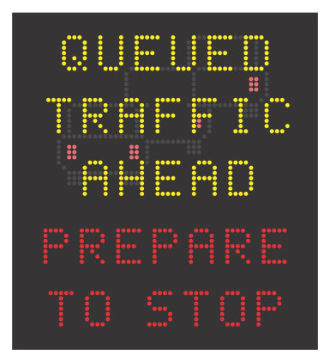
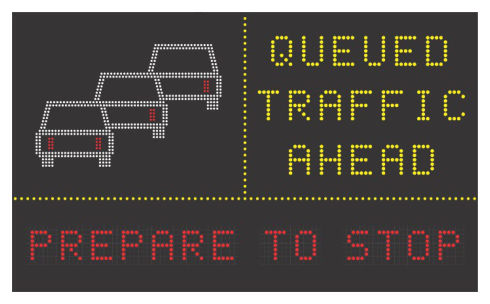
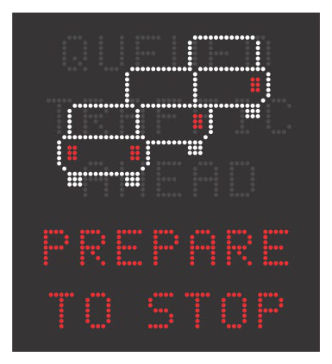
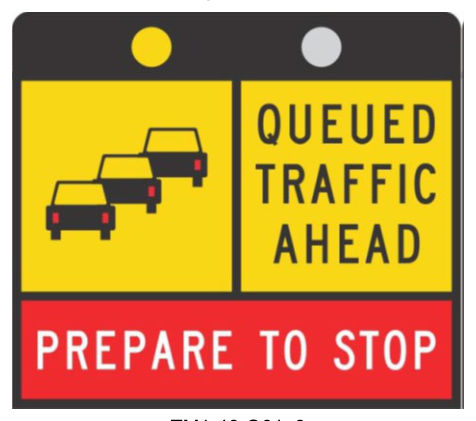
An enhanced queued traffic warning sign may be installed to supplement the treatment provided in the Queensland MUTCD Part 3 and QGTTM.
The Department of Transport and Main Roads has developed a suite of design drawings in TM1-46-Q01 (see Figures 2.2 below) that provide sign design details. A single sign is generally installed on the left-hand side of two-lane two-way roads, while a second sign may be installed on the right-hand side of multi-lane roads.
There are a number of activation options, including activation when queued traffic is detected, manual activation by the Traffic Controller or continuous operation. It is, however, considered that activation based on vehicle approach speeds is more effective as it provides a targeted message to drivers who are fatigued or have failed to anticipate the presence of queued traffic ahead. Alternative enhanced or active queue warning signs and activation methods may be developed. These shall be approved by Transport and Main Roads prior to installation at any work site.
TM1-46-Q01_1
Frame 1 · Frame 2 · TM1-46-Q01_2
TM1-46-Q01_3
2.3Use of an additional Traffic Controller#
The following requirements and recommendations apply to the provision of an additional traffic controller for end-of-queue protection where significant queues are expected to form:
- 1.an additional second Traffic Controller may be employed to shift the PREPARE TO STOP sign(s) and the ROADWORK AHEAD sign as necessary to maintain the minimum required distance in advance of the end-of-queue. The additional Traffic Controller may also display the SLOW bat at each location, in which case the 60 km/h temporary speed zone shall be extended to cover that position.
- 2.distant advance warning using variable message signs should also be used where practicable.
- 3.all other advance and position signs required for the work site shall be located at the distances otherwise specified from the start of the work area.
2.4Signs to encourage the use of hazard lights by last vehicle in queue#
Section 221 of the Transport Operations (Road Use Management – Road Rules) Regulation 2009 permits the use of hazard warning lights on a vehicle to warn other road users under the following conditions:
- a)the vehicle is stopped and is obstructing, or is likely to obstruct, the path of other vehicles or pedestrians, or
- b)the vehicle is a slow-moving vehicle and is obstructing, or is likely to obstruct, the path of other vehicles or pedestrians.
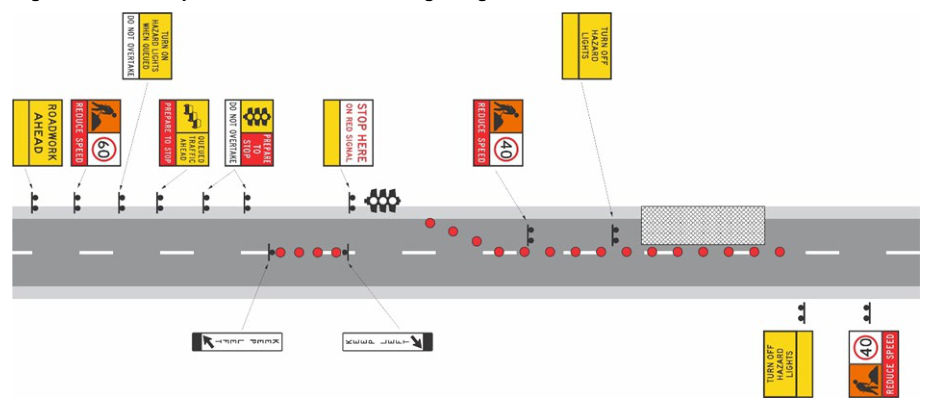
A TURN ON HAZARD LIGHTS WHEN QUEUED sign (TC1992_1) or MMS arrangement (TC2362_1) has been developed to encourage the driver of the last vehicle in the queue to activate the vehicle's hazard warning lights. This draws upon experience in Europe where drivers routinely activate their hazard warning lights in hazardous situations. The TURN ON HAZARD LIGHTS WHEN QUEUED sign shall be located at least a single sign spacing prior to the primary Prepare to Stop (PTS) sign.
If this is also the location of the speed reduction sign for the traffic control station, then relocate the speed limit reduction sign a further sign spacing away from the primary PTS sign. The TURN ON HAZARD LIGHTS WHEN QUEUED sign may be repeated if the anticipated queue lengths are long during certain periods of the day and shorter queues form at other times. When using the MMS arrangement, a DO NOT OVERTAKE panel should also be used.
The TURN OFF HAZARD LIGHTS sign (TC1992_2) or MMS arrangement (TC2362_2) shall be installed past the traffic control station (generally after the traffic control taper) to remind drivers to turn off their hazard warning lights. If there is a speed restriction sign (or other sign) at this location, locate the TURN OFF HAZARD LIGHTS sign a further sign spacing along the travel path away from the traffic control station.
The signs TURN ON HAZARD LIGHTS WHEN QUEUED and TURN OFF HAZARD LIGHTS signs shall be separated from other signs by at least a single sign spacing. See Figure 2.4 for example locations.