
3Around the worksite#
3.4Road Closures#
Replace the dot point:
- if the worksite blocks a side road a detour should be provided (see Section 3.8)
with the following:
- not all road closures will require a detour route to be installed, Section 3.8 includes the requirements and considerations when signing a detour route and the parameters for determining the need for signing a detour route.
3.6Safety buffer#
Replace the fourth paragraph:
A safety buffer must be provided immediately in advance of the work area where the speed is 60 km/h or higher. An area 20 m to 30 m in length is generally sufficient. However, if the work area is hidden from approaching traffic (e.g. by a crest or curve), the length of the safety buffer should be extended to a point which can be clearly seen by approaching traffic. On multilane roads, this may be increased up to 100 m.
with the following:
A safety buffer must be provided immediately in advance of the work area where the speed is 60 km/h or higher and either of the following apply:
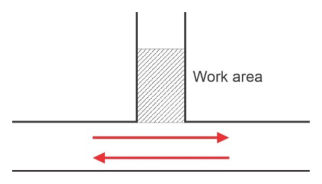
- local traffic may continue beyond the detour point towards the work area (as indicated by Figure 3.2), or
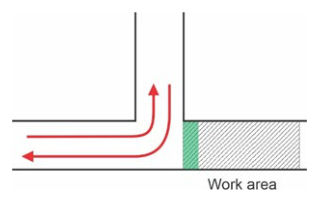
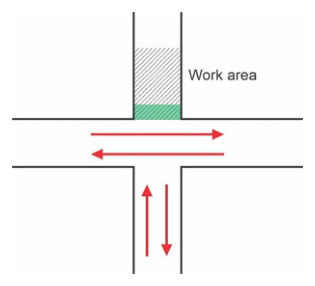
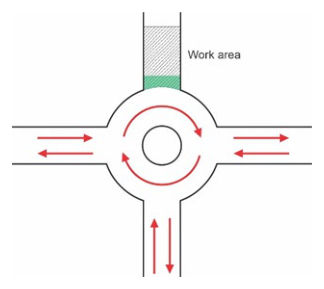
- the work area is within 50 m of traffic at the detour point and traffic is travelling toward the work area before being detoured (see Figures 3.6(a), 3.6(b), 3.6(c) and 3.6(d) with the green zone indicating a safety buffer).
An area 20 m to 30 m in length is generally sufficient: however, if the work area is hidden from approaching traffic (for example by a crest or curve), the length of the safety buffer should be extended to a point which can be clearly seen by approaching traffic. On multilane roads, this may be increased up to 100 m.
On roads with a permanent speed limit (prior to any reductions for the works) of less than or equal to 80 km/h, the safety buffer may be omitted where the works (including the work area, all workers, vehicles, equipment and materials) are at least 6 m clear of traffic and is supported by a risk assessment.
3.8Design and Traffic Management#
The need for a detour route should be considered for all road closures The following additional guidance is provided for determining the need for and signing detours (also see Section 3.8.1 for information on designing and signing a detour).
Detour routes may not be required for short road closures of local streets in a simple grid network or for side road closures of minor roads when an alternative route is available and obvious. When closing a road and determining the need for a detour route the TMD must consider several factors including:
- 1.The need for a detour is primarily dependent on:
- a.the type of road being closed
- b.the types of road users impacted by the closure, and
- c.the surrounding road network (availability and suitability of a detour route).
- 2.Other factors include consideration of the following:
- a.the length of the closure (both in terms of time frame and the overall length of the road section being closed)
- b.the length or complexity of any potential detour routes
- c.the surrounding road network and the ease to which the typical road user may locate a suitable alternative route without the need to fully or partially sign a detour route
- d.the risks versus benefits associated with installing the signs for a detour route, and
- e.the potential confusion for road users who encounter the signs for a detour route but are not impacted by or aware of the road closure requiring a detour (especially relevant when closing a local street and using a higher order road as part of the detour route).
In addition to the above, detour routes should be provided when closing major links such as tunnels or bridges or arterial roads, and the following options for detour routes and signs for these links should be considered:
- 3.Fully sign the closure and the various detour routes based on likely destinations to be sought by road users.
- 4.Fully sign the closure and allow road users to use the existing current signage if adequate to direct them to their chosen destinations.
- 5.Fully sign the closure and provide some VMS signs near the closure but allow road users to use the existing current signage if adequate to direct them to their chosen destinations.
- 6.Fully sign the closure and provide some VMS signs near the closure and some additional VMS or other direction signs at key decision points along the various detour routes to supplement the existing current signage to direct road users to their chosen destinations.
When closing major links such as tunnels or bridges or arterial roads, advance warning of the closure at a point where drivers can easily choose an alternative route should be provided.
For closures and detour routes that are to be in place for an extended period or are frequently used, the use of a diversion route signing approach as per TRUM Volume 3 Part 9 may be considered. The diversion route signing approach may also be considered for short term detours or to provide clarity where multiple different detour routes exist or overlap.
3.8.1Detours#
Replace:
Detour markers must be erected at all subsequent changes of direction and intersections along the route to reassure road users they are on the correct path (e.g. detour in a built-up area through side streets) and they can continue their journey using permanent road sign information. This usually involves directing road users back onto their original route of travel at a point past the worksite. Signs must be erected for each direction of travel affected by the closure and checked to ensure all detour signs are prominently displayed with clear sight distance (see Section 2.5.3 Table 2.3).
Detour markers must be erected at all subsequent changes of direction. Detour markers should also be installed at intersections along the route where drivers may consider turning or where they may require reassurance that they are on the correct detour path (e.g. detour in a built-up area through side streets) and they can continue their journey using permanent road sign information. This usually involves directing road users back onto their original route of travel at a point past the worksite. Signs must be erected for each direction of travel affected by the closure and checked to ensure all detour signs are prominently displayed with clear sight distance (see Section 2.5.3 Table 2.3).
Replace:
END DETOUR sign must be placed at the end of the detour, indicating to road users that they have returned to their original route and permanent signs can be followed.
with:
END DETOUR sign should be placed at the end of the detour, indicating to road users that they have returned to their original route and permanent signs can be followed.
For detour routes that include a U-turn requirement, these should only be used where a U-turn would normally be permitted (excluding signals which are not operating and are under other controls such as Police or Traffic Controllers who can manage the need for the U-turn movement). Where a U-turn would not normally be permitted, the turning paths and characteristics of the expected vehicle types should be reviewed in conjunction with advice from the RIM. A U-TURN NOT SUITABLE FOR LONGER VEHICLES (TC1972) sign may be required.
3.9Termination Area#
Additional guidance is provided in Section 5.12.
3.10Vulnerable Road Users#
3.10.1Pedestrians#
Replace the two dot points:
- Desirably, if footpaths or pedestrian crossings have been partially closed or temporarily relocated, a temporary footpath should be provided with minimum width of 1.8 m to allow for all pedestrians including those with mobility aids or on the same scale and to the same width as any facilities for pedestrian that existed prior to the works. This width should also be applied to any temporary ramps (e.g. kerb ramps). If these widths are not practicable, alternative routes must be provided with a firm smooth surface and no trip hazards in the following order of preference:
- 1 on the side of a road reserve away from traffic
- 2 between the work area and road but not in a traffic lane
- 3 onto the road either in a lane used for parking or a delineated and protected section of an existing traffic lane
- 4 across the road to a footpath on the opposite side with delineation at crossing points and kerb ramps. Consideration is required for persons with impaired vision, mobility, hearing or cognitive limitations. Only use this option if an appropriate crossing facility can be provided (see Austroads Pedestrian Facility Selection Tool).
- 5 a traffic controller to safely guide pedestrians around the operation. Only use this option if there is no safe temporary path available.
- Appropriate surfacing must be provided for prams, strollers, wheelchairs or any other mobility aids.
With these three dot points:
- Desirably, if footpaths or pedestrian crossings have been partially closed or temporarily relocated, a temporary footpath should be provided with minimum width of 1.8 m to allow for all pedestrians including those with mobility aids or on the same scale and to the same width as any facilities for pedestrian that existed prior to the works. This width should also be applied to any temporary ramps (e.g. kerb ramps). At localised constraints an absolute minimum width of 1m may be provided, where opposing pedestrian are able to recognise the short constraint and pass at wider areas. If these widths are not practicable, alternative routes should be provided in the following order of preference:
- 1 on the side of a road reserve away from traffic
- 2 between the work area and road but not in a traffic lane
- 3 onto the road either in a lane used for parking or a delineated and protected section of an existing traffic lane
- 4 across the road to a footpath on the opposite side with delineation at crossing points and kerb ramps. Consideration is required for persons with impaired vision, mobility, hearing or cognitive limitations. Only use this option if an appropriate crossing facility can be provided (see Austroads Pedestrian Facility Selection Tool).
- 5 a traffic controller to safely guide pedestrians around the operation. Only use this option if there is no safe temporary path available.
- Appropriate surfacing with a firm even surface and no trip hazards should be provided to footpaths or alternative routes to cater for prams, strollers, wheelchairs or any other mobility aids. Surfacing should be no worse than the existing path and should be suitable for use in all weather conditions and should not deteriorate or form ruts or be damaged from repeated use.
- The length of time a temporary footpath is required, would also need to be considered when selecting an alternative route and surface type.
Where pedestrians with vision impairment are expected or existing signs with tactile elements are provided at a location or in an area, refer to AS 1428.4.2 for consideration of tactile requirements for any temporary signs required.
3.10.2Cyclists#
Replace the sub-dot point:
− additional signage should be placed to alert road users of merging cyclists. This signage must be placed at the relevant stopping distance in advance of the closed section of the bicycle lane.
with:
− additional signage should be placed to alert road users of merging cyclists. This signage must be placed at the relevant distance (see Section 2.5.3) from the start of the closed section of the bicycle lane. Sufficient sight distance as per Table 2.3 must be provided for drivers and riders to sight the temporary signage on approach.