A.6 Example layouts # New
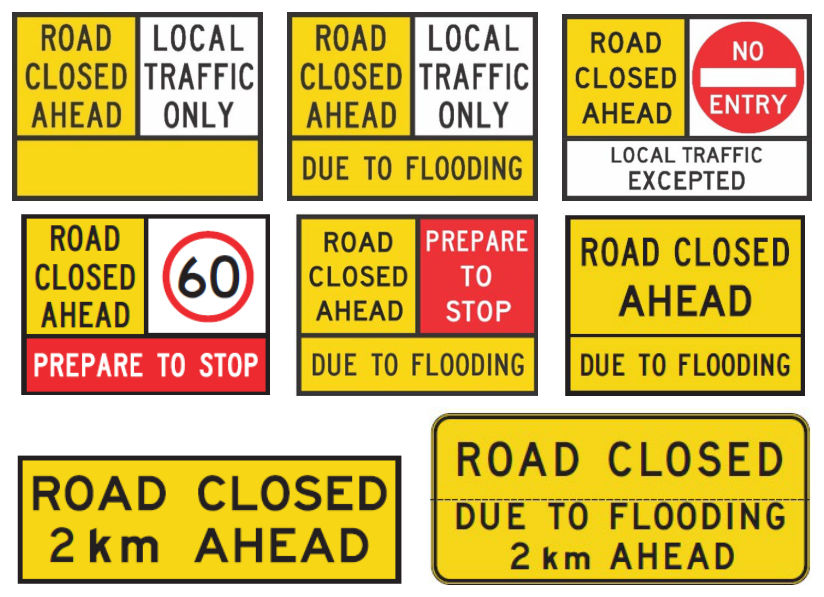
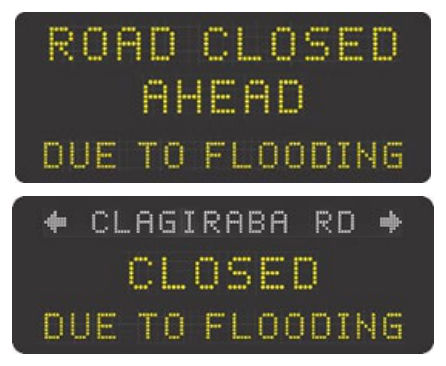
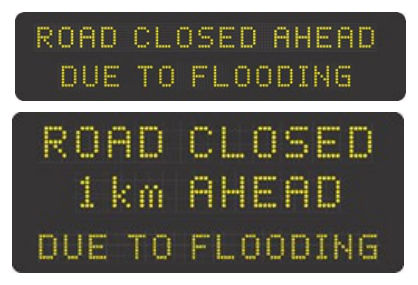
The following figures show some example sign arrangement options available for temporarily closing or restricting access to roads. These are examples only and many other sign combinations, arrangements and layouts are possible and will depend on the site-specific circumstances.
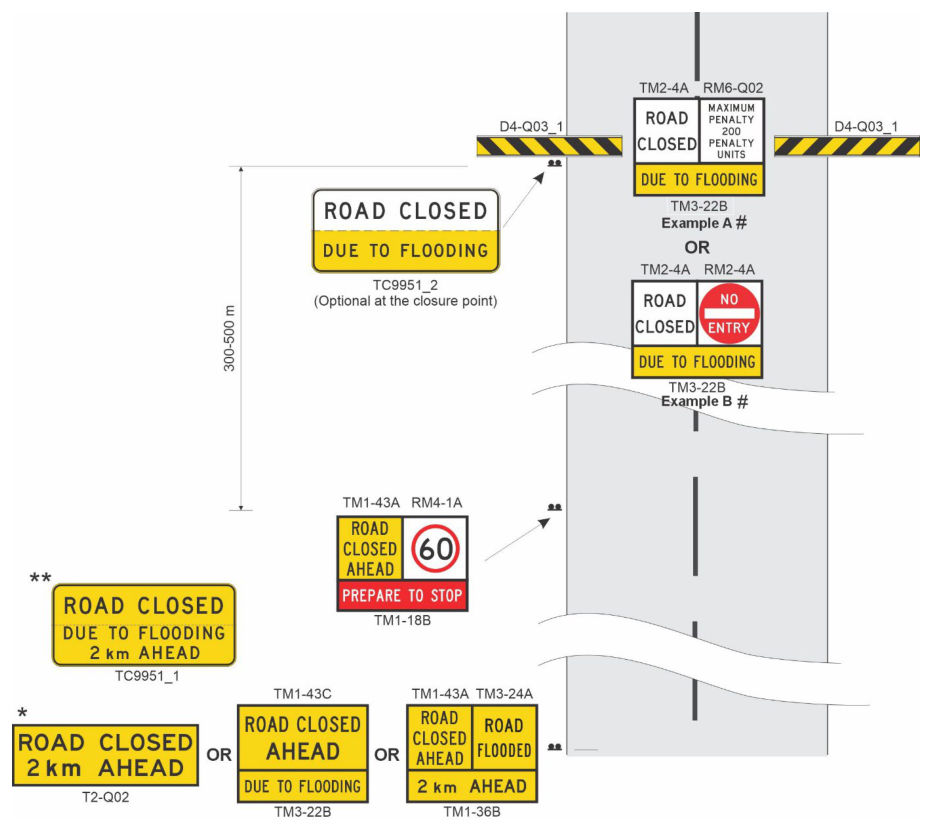
Figure A.6.1 – Example sign layout for closing a road due to flooding p. 122 Notes * May be used if there is a requirement to give more advanced warning. ** TC9951 hinged, permanent sign may be used in known flood locations to provide advance warning. # Examples A or B may be used to close a road; however, Example A can only be used on a state-controlled road. Signs may be installed in advance of the road closure to provide advance warning (1 or 2 km as shown) or may be installed some distance in advance of the closure where an alternative route may be taken. Regional staff should liaise with Transport Enforcement Officers and Queensland Police Service on sign locations prior to installation. Advance signs may be installed at the start of the road section and may be some distance from actual closure point. They should be installed at decision points, where areas exist to turn around the longest vehicles using that stretch of road or alternative routes are available. As an example, refer to page 3 for details.
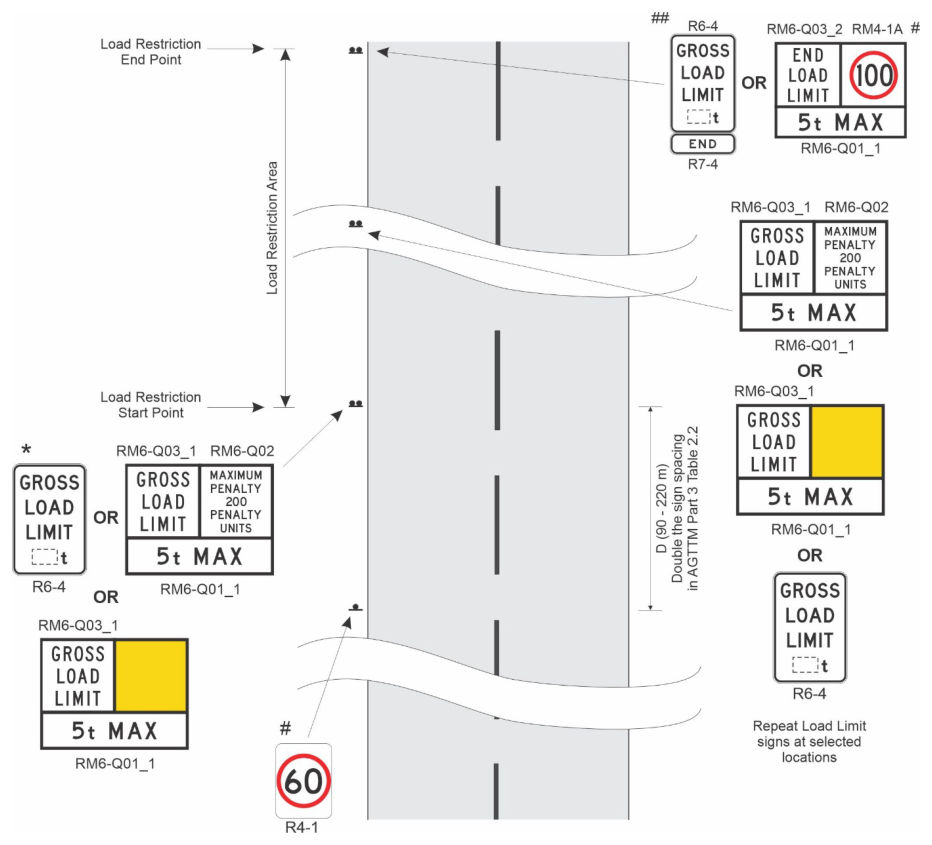
Figure A.6.2 – Example sign layout for restricting access on a road (weight limit ) p. 123 Notes Example of a temporary sign arrangement for a 5 tonne maximum limit. For other load limits refer RM6-Q01. * Either of these signs shall be located at the actual point road restrictions are to apply. MMS arrangement shown may only be used on a state-controlled road. Advance signs may be installed at decision points, where areas exist to turn around the longest vehicles using that stretch of road or alternative routes are available. As an example, refer to Figure A.6.3. # If the speed limit reduction is required in conjunction with a GROSS LOAD LIMIT sign, install R4-1 in advance of the load limit sign. Repeat R4-1 signs over the length of the reduction as required. ## The load restriction area must be terminated with a GROSS LOAD LIMIT sign (R6-4) showing the appropriate weight, combined with an END sign (R7-4) or the multi message frame as shown. Regional staff should liaise with Transport Enforcement Officers and Queensland Police Service on sign locations prior to installation. Load Limit signs should also be installed on the approach to all intersecting roads.
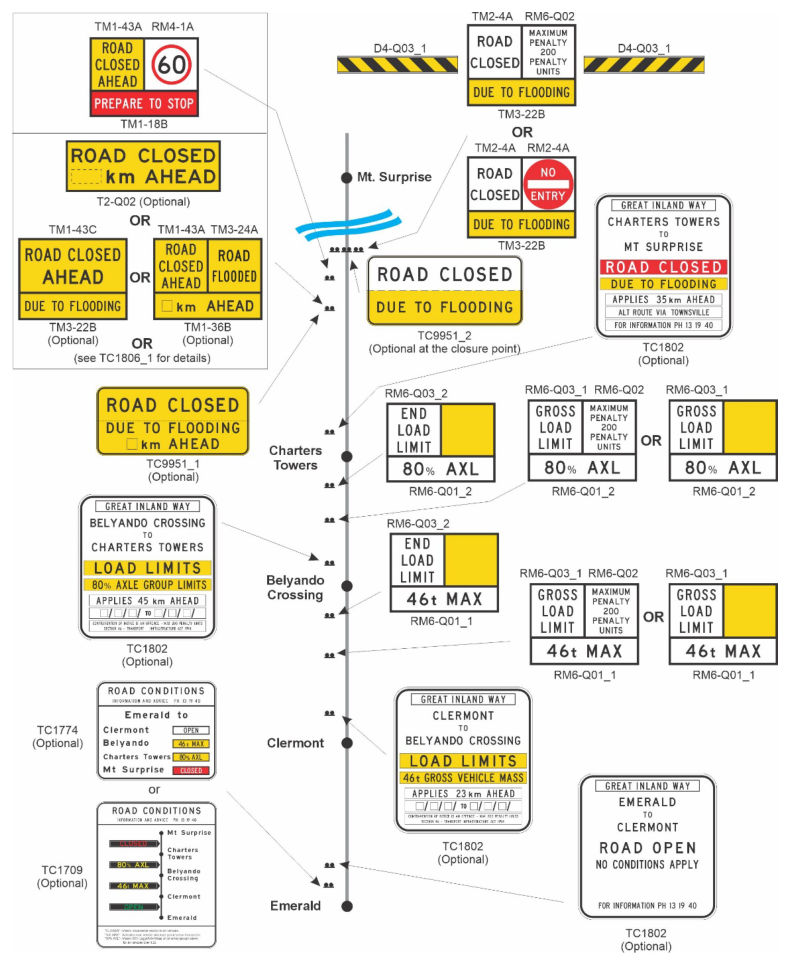
Figure A.6.3 – Example sign layout for a typical route with various restrictions and a closure due to fooding p. 124 Notes Sign TC1802 is not enforceable but may be used as an advance sign indicating a road restriction ahead. The actual point of the closure or restriction must also be signed, and it is this signage that enables enforcement to occur. TC1774 or TC1709 or similar route signs are not enforceable and are advisory traveller information signs used to indicate road restrictions on various sections of the route ahead. Unless signs are combined with a regulatory sign or meet the requirements of the TIA legislation, they are not enforceable. Signs that still meet the requirements of the TIA legislation but provide greater detail may still be used provided any and all the extra detail sections on the sign are completed, accurate and include the penalty requirements.
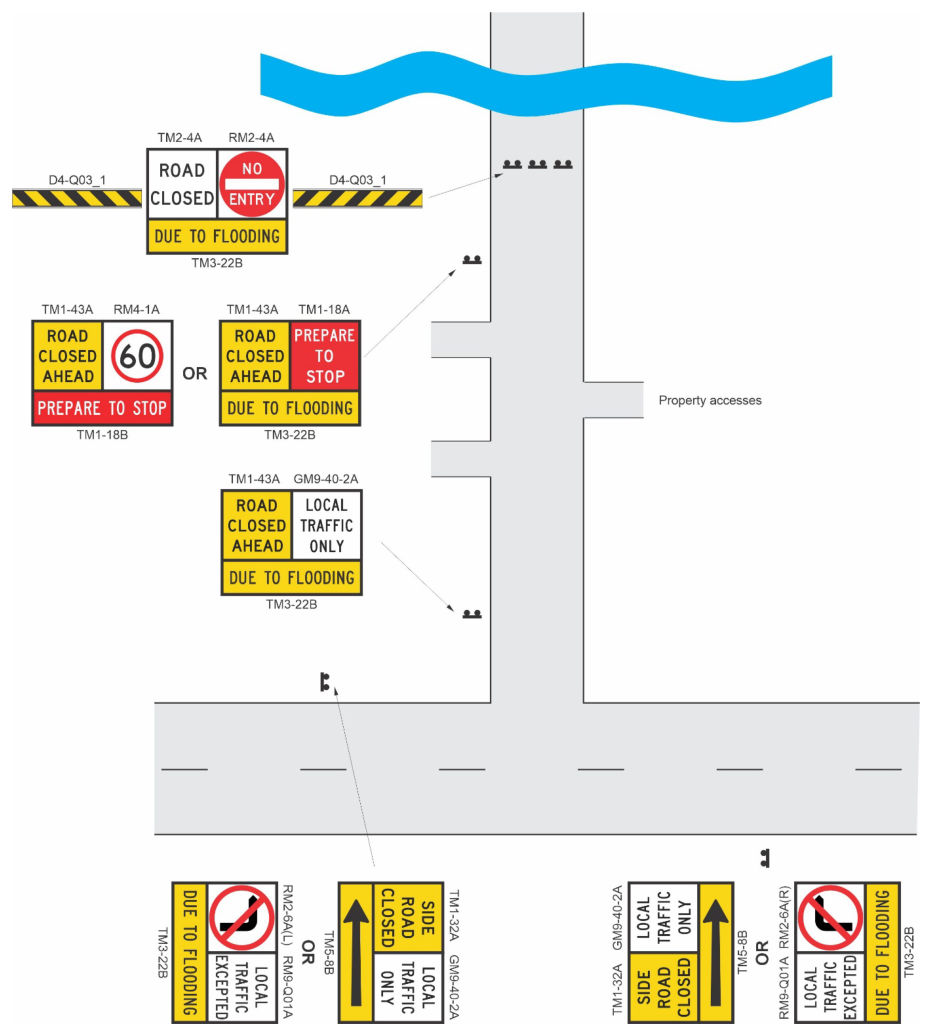
Figure A.6.4 – Example sign layout for closing a side road due to flooding while allowing locals to access properties. p. 125 Drawings from the original pages
← Previous A.5 Warning of a road closure ahead