
5.3Separate the work area#
5.3.1Road safety barrier system#
Replace the entire Section 5.3.1 with the following:
The road safety barrier system provides a physical barrier between the work area and moving traffic, designed to resist intrusion by errant vehicles and, as far as practicable, redirect errant vehicles back into the travelled path. While safety barriers can be considered for all projects, this method may be inappropriate due to physical space requirements and limited edge clearances.
If a road safety barrier is to be used, its design must be based on the speed of traffic past the barrier. In most cases, this will be a semi-permanent reduced speed limit posted at the site which generally applies 24 hours a day / 7 days a week, with other further temporary reductions only applicable when required for works which are occurring. Where a general reduction in speed limit past the site has not been implemented, the permanent posted speed limit must be used as the design speed for the road safety barrier design.
The requirements of Section 2.5.9 are applicable to the design speed. If the traffic speed is greater than 10 km/h higher or lower than the speed limit past the road safety barrier, the speed of traffic must be used as the design speed for the road safety barrier design.
Speed limits past the road safety barrier must be monitored throughout the completion of works to ensure compliance with the road safety barrier design speed.
Safety barriers are typically used to:
- separate road users from severe hazard (e.g. deep excavation, a bridge pier, stockpile)
- separate traffic travelling in opposite directions
- reduce delays by avoiding more restrictive speed limits
- protect road workers and vulnerable road users (e.g. road shoulder as a temporary footpath) from narrow lateral clearance to moving traffic (e.g. when the work area is closer than 3 m to the nearest edge of traffic and the speed limit is more than 60 km/h). For work areas located more than 6 m to the nearest edge of traffic see Section 3: Around the Worksite.
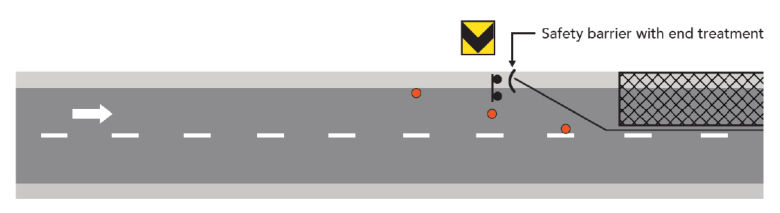
End treatments must be provided when installing road safety barrier systems, ensuring they are immediately operational as part of the barrier system. They are designed to absorb energy and reduce the severity of impacts, also assisting in reducing the risk of errant vehicles entering the work area and road users accidentally impacting the barrier. End treatment options include:
- starting or connecting the barrier to the end of a permanent barrier or guardrail
- securely attaching any approved end treatment as per the Austroads Guide to Road Design Part 6 (e.g. crash cushions).
The Austroads Safety Barrier Assessment Panel (ASBAP) expects products to conform to /NZS 3845. However, if a jurisdiction wants to deploy a product that has not been assessed by ASBAP, the jurisdiction will undertake its own risk assessment.
End treatments are not required if the temporary road safety barrier system is flared behind a permanent road safety barrier (or another temporary road safety barrier) and is outside the deflection zone requirements for that barrier system and therefore not regarded as a hazard.
The following elements apply when positioning road safety barrier systems:
- Adequate delineation of the road safety system must be provided to ensure road users are safely guided past the worksite.
- Fittings other than delineators (e.g. visibility screens) must not be fixed to the road safety barrier unless they are designed to accommodate the fitting.
- Screens designed to fit to barriers should also be approved by the relevant road authority relative to the work being done.
- Water runoff should pass unimpeded to avoid surface ponding.
- If positioned near high obstructions (e.g. power poles, fixed VMS, bridge piers, underpass scaffolding), the design should consider the extent of vehicle body roll (especially high vehicles) during impact.
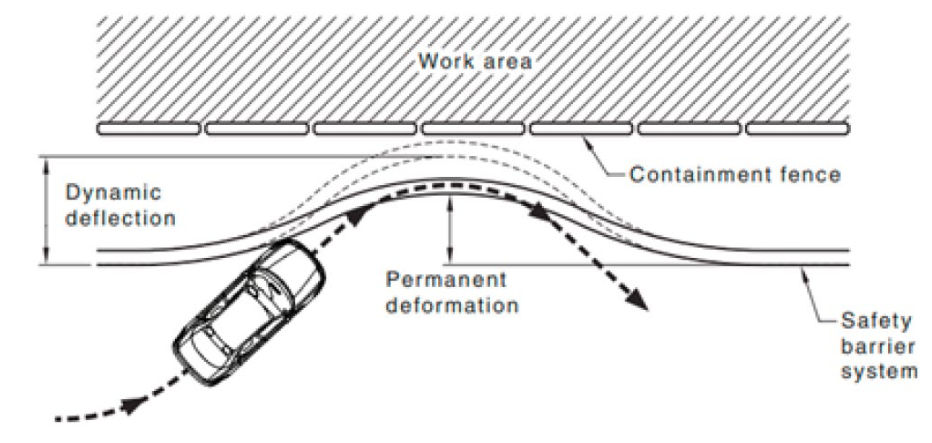
- Barrier deflection must be accommodated in the area immediately behind the road safety barrier system. A containment fence or longitudinal channelising barrier should be placed a clear distance equal to the likely dynamic deflection behind the road safety barrier system. Clearance in Table 5.1 is measured between traffic and the front of the barrier system and not behind the barrier system in the deflection zone. For example, see Figure 5.4 illustrating dynamic deflection. This example does not include all traffic control devices required and must not be used as a TGS diagram.
- A clearance between road safety barriers and traffic should be provided. The recommended minimum clearance between the road safety barrier system and the edge of the nearest traffic lane is shown in Table 5.1. When determining the appropriate speed to select in Table 5.1, consider the range of speed limits and vehicle speeds that may occur while the safety barrier is in place and the likelihood that road users often increase their travel speed during times the worksite is unattended.
For further guidance regarding road safety barrier systems, see Austroads Guide to Road Design Part 6.
Figure 5.3 illustrates an example of safety barrier placement around the work area. This diagram does not include all traffic control devices required and is not to be used as a TGS diagram.
| Speed (km/h) | Recommended minimum Distance (m)* |
|---|---|
| ≤ 40 | 0.3 |
| 41–60 | 0.5 |
| 61–80 | 0.5 |
| > 80 | 1 |
*Clearance is measured in front of the barrier system and not behind the barrier system in the deflection zone.
Figure 5.4 illustrates an example of dynamic deflection. Clearance in Table 5.1 is measured in front of the barrier system and not behind the barrier system in the deflection zone. This example does not include all traffic control devices required and is not to be used as a TGS diagram.
For additional guidance on road safety barriers in Queensland, see the Road Planning and Design Manual Edition 2: Volume 3, Supplement to Austroads Guide to Road Design Part 6: Roadside Design, Safety and Barriers, with Section 6.8 of this document detailing the requirements for temporary road safety barriers.
Only road safety barriers included on the current list of products in the Transport and Main Roads Accepted Road Safety Barrier Systems and Devices document must be used at roadwork sites in Queensland.
The Austroads Safety Hardware Training and Accreditation Scheme (ASHTAS) will, over time, offer courses for Safety Barrier Operative (Entry Level), Installers (Permanent and Temporary Safety Barriers), Designers (Permanent and Temporary Safety Barriers), and more. See QGTTM Part 8 Section 5.5.12 for more details.
For more ASHTAS details see the departmental web page Austroads Safety Hardware Training and Accreditation Scheme (ASHTAS).
5.3.2Containment fence#
Replace:
Note that metal star pickets should not be used in situations where they are directly exposed to traffic or any environment where they may be hit by a vehicle.
with:
The use of star pickets must be in accordance with Section 6.12.
5.3.3Visibility screens#
For additional guidance on anti-gawking screens, see the Guideline – Traffic Management at Works on Roads.