5.10Traffic control#
The advance warning area requirements, including estimating the end of queue position and calculation requirements in Section 4.8 (including subsections) also apply to the traffic control methods used in this section.
5.10.1Portable traffic control devices#
Replace Section 5.10.1 with the following:
PTCDs are used to enhance the safety and protection of road users and road workers, specifically traffic controllers.
When using PTCDs, and situations occur where vehicles can bypass the temporary traffic control station, the placement of additional cones along the centreline must be installed to provide a sufficient distance to prevent the vehicle passing the PTCD. Prior to including a PTCD in a TGS, a risk assessment must be undertaken to ensure the suitability and choice of PTCD. Other considerations that impact the choice of a PTCD are as follows:
- 1.impacts of equipment failure on road workers and road users; employ back-up traffic controllers in case of failure
- 2.background impacts on the visibility of the PTCDs for approaching road users
- 3.clear visibility and available sight distance (see Section 2.5.4); install PTCDs on the left-hand side of each approach – if they are not readily visible in that location, they should be placed in a more visible position
- 4.speed of traffic
- 5.traffic volumes
- 6.duration of works, and
- 7.whether or not the PTCD needs to be operated when unattended.
PTCD options include:
- 8.portable traffic signal systems (PTSS):
- a)intended for shuttle flow (see Section 5.4.4) or gating (all stop) operation
- b)available to provide control at intersections (see Guideline – Traffic Management at Works on Roads Chapter 5 Clause 2.5.3.1)
- c)signals automatically respond to traffic demands via vehicle actuated operation (unmanned)
- d)option of fixed time operation that used fixed timed cycles when traffic flow is relatively constant
- e)may be used in manual mode but require qualified operators (that is, traffic controller) – operators with two-way radio can monitor signal performance, warn the roadworks site and manage road users, and
- f)do not use where side roads intersect the roadworks site and are not controlled by a traffic controller or other PTSS.
- g)While PTSS devices may be operated in a few different modes, when using PTSS Type 1 or Type 2 devices, for manually controlled shuttle flow arrangements, they should be used in paired mode using a single HRC whenever possible or suitable. This will prevent a green signal being displayed to both approaches at the same time.
- 9.Portable boom barriers:
- a)are intended to stop traffic
- b)manage shuttle flow or gating (all stop) operation, and
- c)require qualified operators to operate in manual mode (that is, traffic controller).
When using PTCDs:
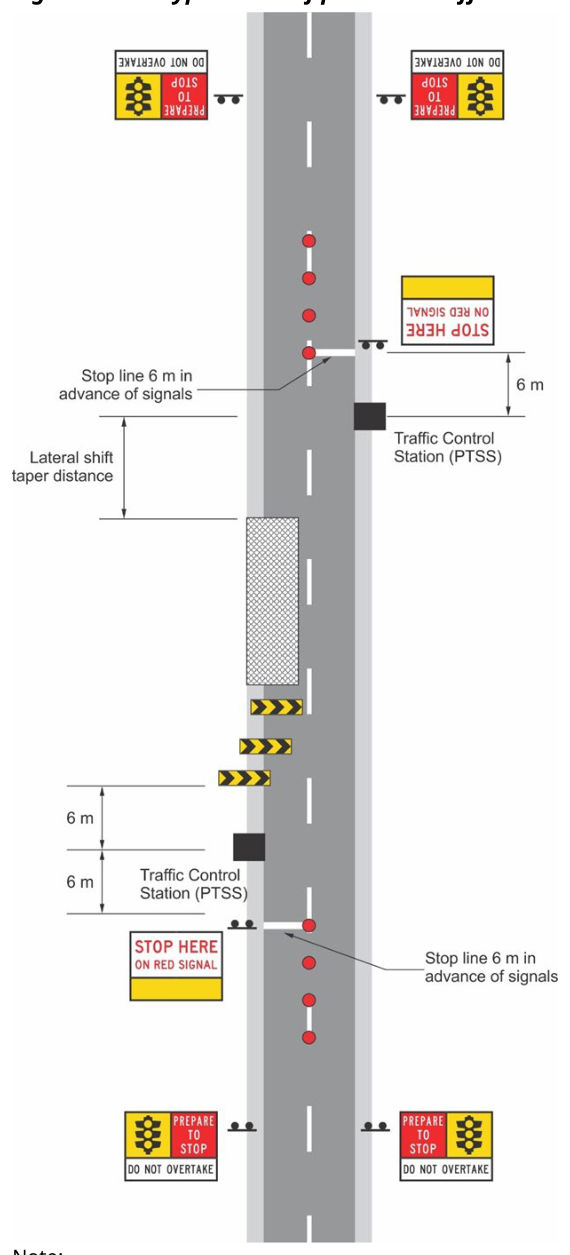
- 10.four cones should be placed on the centreline spaced 4 m apart starting from the STOP HERE ON RED SIGNAL or the STOP HERE WHEN DIRECTED sign position (downstream), and
- 11.undertake a risk assessment.
Consider the following when using PTCDs:
- 12.PTCDs must only be manually controlled by qualified operators (that is, traffic controllers).
- 13.They are intended for traffic control of relatively short duration: for roadworks sites that will continue for a longer period without work area location changes, consider installing temporary, rather than portable, traffic signals (see AS 1742.3).
- 14.Where traffic is required to stop, temporary road markings may be installed 6 m in advance of the PTCD to indicate a stop line. The STOP HERE ON RED SIGNAL or STOP HERE WHEN DIRECTED must be installed in accordance with the Queensland MUTCD Part 3.
- 15.Provide warning signs (for example, Signals AHEAD) an appropriate sight distance in advance of any PTCD as shown in Section 2.5.3 (see QGTTM Part 3 Section 4.8 for advance sign options).
Section 4.8 for advance sign options). For PTCD, the Traffic Controller (symbolic) sign must be replaced with the relevant PTCD (symbolic) sign.
- 16.Apply a temporary speed limit of 60 km/h or less if speed is above 60 km/h (see Section 5.5.1) on approach to the PTCD.
- 17.PTCDs must be regularly monitored to ensure they are operating effectively and safely by checking that:
- a)the time settings are appropriate
- b)the alignment of the signal displays is appropriate for the speed zone
- c)the associated signs are intact and properly displayed
- d)detectors are functioning correctly
- e)there are no burnt out lanterns, and
- f)batteries are charged.
Figure 5.23 illustrates an example of PTCD and sign placement. This diagram does not include all traffic control devices required and is not to be used as a TGS diagram (see Section 4.8 for avoiding end-of-queue collision options and placement of signs). The speed of traffic must be reduced to a maximum of 60 km/h on the approach to a PTCD and an advance warning sign (ROADWORK AHEAD) is to be located in accordance with Section 4.8.
PTCDs may be used on any road environment; however, PTCDs should be used in lieu of traffic controllers using a STOP / SLOW bat on all roads with an annual average daily traffic (total vehicle count in both directions of travel per day) of over 500 vehicles per day and a permanent posted speed limit of 70 km/h or greater.
Where a PTCD is not used as recommended here, a risk assessment in accordance with the requirements of Clause 1.9 of the Queensland MUTCD Part 3 must be undertaken. See also the risk assessments requirements for using TC’s in place of PTCDs, in the Guideline – Traffic Management at Works on Roads Chapter 5 Section 2.2.
Only PTCDs included on the current list of approved products in the Transport and Main Roads ITS Approved Products document must be used at roadworks sites in Queensland.
Additional guidance on the use, installation and operation of PTCDs, including Type 1 and 2 PTSS and boom barriers, is available in the Guideline – Traffic Management at Works on Roads.
5.10.2Traffic controllers#
Replace the entire Section 5.10.2 with the following:
Worksites are hazardous areas so use manual traffic control only where PTCDs are insufficient to provide the safety, capacity and efficiency required for effective traffic control. When traffic controllers are used, traffic controllers cannot direct a road user to contradict upcoming intersection signals. Traffic controllers are to coordinate activities with operating signals. If traffic controllers are operating within close proximity to a signalised intersection and the lights are flashing yellow or are off, a traffic controller must only control one lane and the approach to this intersection must be reduced to one lane of traffic. Where works cause delays to traffic flow, or a side road intersects the worksite, do not use an automated PTCD, a traffic controller using a STOP/SLOW bat or controlling a PTCD is required. The following requirements and recommendations apply when using traffic controllers:
- Only competent persons with appropriate certification must be appointed as a traffic controller (see AGTTM Part 7).
- Speed must be 60 km/h maximum. Provide a temporary speed limit of 60 km/h or less on the approach to a traffic controller if the speed is higher (see Section 5.5.1).
- An escape route must be identified for each traffic controller from their traffic control position.
- Traffic controllers must be positioned a clear sight distance from approaching road users (see Section 2.5.4) with no obstruction and where they are not obstructing visibility to traffic control devices (i.e. signs). No obstruction should be located in the area between the traffic controller and the end of the line of four cones.
- Ensure that a work vehicle is not parked in a way that impacts the visibility of the traffic controller or, limits the traffic controller’s escape route or, is parked between the traffic controller and the taper.
- Ensure that traffic controllers are visible at all times of the day, particularly at dawn, dusk, against low morning or evening sun, when in the shade on a sunny day or working in dusty conditions.
- The traffic control station and the area where traffic controllers are operating PTCDs from must be well illuminated at night. Where required, provide additional lighting. See Section 6.7 Night works for greater detail about working at night.
- Relieve traffic controllers from traffic controller duties at least every 2 hours for at least 15 minutes.
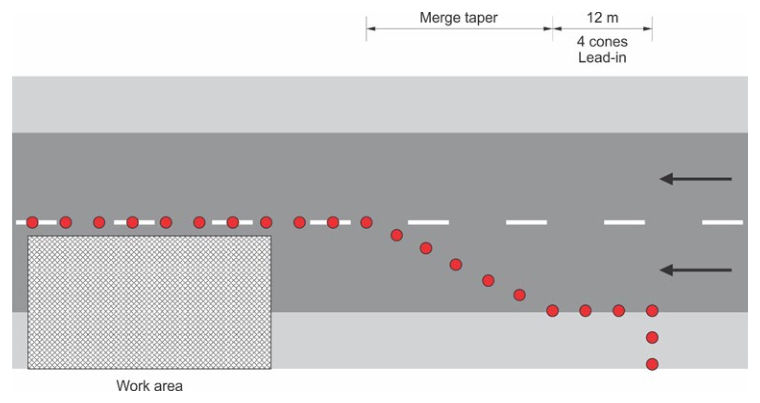
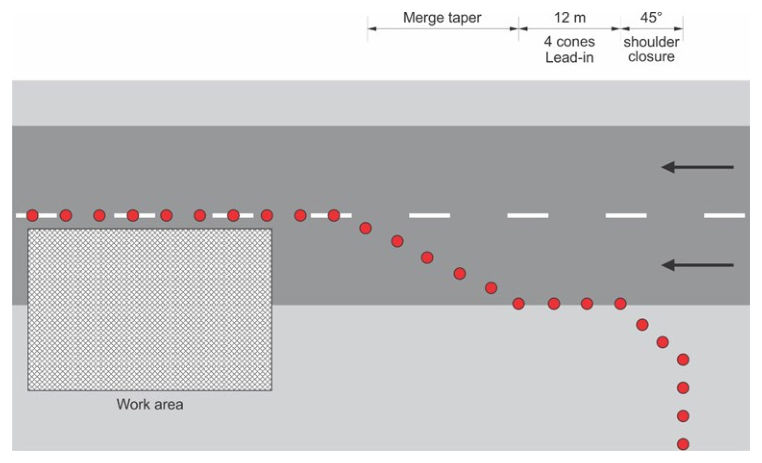
- If cone tapers are used, position the traffic controller 6 m in front of the taper on the left-hand shoulder or edge of the road and facing approaching traffic.
- Place four traffic cones spaced 4 m apart, on the centre-line 6 m in front of the traffic controller position.
- If there is a queue, traffic controllers can move to the driver’s side when safe to do so to remain visible to all road users.
- Under no circumstances are traffic controllers to stand or operate unprotected in a lane carrying traffic.
- Traffic controllers are to only communicate with a road user once the vehicle has stopped and is safe to do so.
- A single traffic controller must never control more than one lane of traffic or more than one approach when using a STOP/SLOW bat or a PTCD. This may only be varied where a traffic controller is using a PTCD which is capable of alternative arrangements and both the device and manner of operation is approved by the department. See Section 2.6.2 of AGTTM Part 7 for additional requirements and considerations when designing and using PTCDs for traffic control.
- Provide a traffic controller at intersections to guide road users entering from a side road.
- Some intersections require three or more traffic controllers. Where multiple traffic controllers are used they are required to:
- 1 ensure that road users are not seeing conflicting message from other traffic controllers at different locations of the worksite
- 2 be in continuous radio contact with each other when they are not visible to each other.
For detailed guidance on traffic controllers see AGTTM Part 7.
5.10.4Combining portable traffic control devices#
The Transport and Main Roads Technical Specification, MRTS267 Boom Barriers for Roadworks, permits the use of a boom barrier with a Type-1 or Type-2 PTSS and details the technical requirements for the device. The combination of a Type-1 or Type-2 PTSS with a boom may be used at any location a PTSS may be used but may be suited to locations where compliance with the PTSS has been poor. The following operational requirements apply when using a combination PTSS with boom:
- The primary device will be the PTSS, with the boom providing a visual support to the operation of the signals.
- The STOP sign must not be installed on the boom.
- As the signals will be the primary device, the advance warning signs will include the signals (symbolic) panel and not the boom barrier (symbolic).
- The STOP HERE ON RED SIGNAL sign must be installed 6 m in advance of the PTSS.
- The boom must be located such that in the raised position it is slightly behind the signals (no greater than 1 m behind) and must not interfere with the visibility of the signals. Traffic stopped at the boom must still be able to see and respond to the PTSS.
- The boom may be either freestanding or attached to the same support structure as the PTSS.
- The boom in the raised position must be at least 800 mm clear of the traffic lane.
- When in the lowered position, the boom must block the approaching traffic lane and extend to a point not further than 600 mm from the road centre line.
- Four cones should be placed on the centre line spaced 4 m apart starting from the STOP HERE ON RED SIGNAL sign and extending toward approaching traffic.
The advance warning area requirements, including estimating the end of queue position and calculation requirements in Section 4.8 (including subsections), also apply to the traffic control method used in this section. Only combination PTSS and boom barriers included on the current list of approved products in the Transport and Main Roads ITS Approved Products document must be used at roadwork sites in Queensland.