5.5Safe traffic speed#
Additional guidance on supplementary devices to reduce speed is provided in Chapter 1, Clause 1 of Guideline – Traffic Management at Works on Roads.
5.5.1Temporary speed limits#
Replace the entire Section 5.5.1 with the following:
Temporary speed limits can be used to regulate the speed of traffic due to roadworks, temporary hazards, emergencies or special events. Authorisation from the relevant road infrastructure manager needs to be obtained prior to works commencing, normally during the planning stage (TMP phase). Details of the temporary speed limit, approximate length of the temporary speed zone (e.g. temporary speed limit of 60 km/h for 150 m) and associated roadwork signing is submitted with the TMP. If alternative means of traffic control are adequate, there is no need to implement additional temporary speed zones.
Temporary speed limits are implemented for workplace safety and traffic safety requirements to protect workers from oncoming or passing traffic and road users from hazards within the static work site. To meet specified safe workplace requirements, including the protection of traffic controllers, reduction in traffic speeds to either 80 km/h, 60 km/h or 40 km/h must be required.
If the specified temporary speed limit is lower for site workplace safety requirements than traffic safety requirements, the temporary speed limit for workplace safety requirements takes precedence (e.g. high level of hazard for workers on foot in a worksite with reduced visibility – the required temporary speed limit is 40km/h or less).
Temporary speed zone conditions and lengths are outlined in Table 5.5.
The primary objective of temporary speed zones is to ensure that all workers operating in and around the work zone are safe. The secondary objective is to ensure the application of temporary speed zones are safe and convenient for road users. Sufficient warning of changes in speed limit due to surface condition and work zone layouts need to be communicated to all road users.
Where a decision has been made to create a temporary speed limit, the following apply:
- The temporary speed limit should be self-enforcing or will be enforced.
- The temporary speed limit must be realistic and reflect the condition of the worksite in real time. This will reduce the risk of road users ignoring the speed limit.
- The temporary speed limit must be obvious to all road users.
- The temporary speed limit should encourage uniform speed of travel.
- Speeds should be low enough to allow road users time to react to signs, directions, traffic control or unusual events.
- The temporary speed limit must not be so low that a significant number of road users disregard it.
- Temporary speed limits may be a compromise where conditions vary over a length of road.
- The length of the temporary speed zone should be as shown in Table 5.5.
- The speed limit applied to the zone must not exceed the maximum safe speed of travel at which traffic can safely traverse the site.
- The maximum safe speed of travel depends on a number of factors including:
- 6number and type of vehicles
- 7number of pedestrians / cyclists
- 8type of works undertaken
- 9extent of the works
- 10road characteristics
- 11number of incidences, conflicts or hazards on the road. Where the frequency of incidents, conflicts or hazards on a road increase, the maximum safe speed of travel needs to be reviewed.
The Designer should ensure reduced speed zones are as short as possible and that they are not commenced so far prior to the hazard (or workers) that drivers start to disregard them and speed up. There is a balance between ensuring drivers can reduce speed prior to a hazard and not making that distance so long that compliance becomes an issue.
Speed limits implemented to meet specified safe workplace requirements for the protection of workers in an active work area should commence a minimum of a single sign spacing in advance of the active work area. The 200 m zone requirements past a speed limit reduction apply when determining this sign spacing value.
When considering the extent of the reduced speed beyond the work area, the guidance in Section 5.12 should be used, while remembering that offset speed zone requirements and the need to reduce traffic speeds past the work area for the other direction of travel may dictate the speed sign locations.
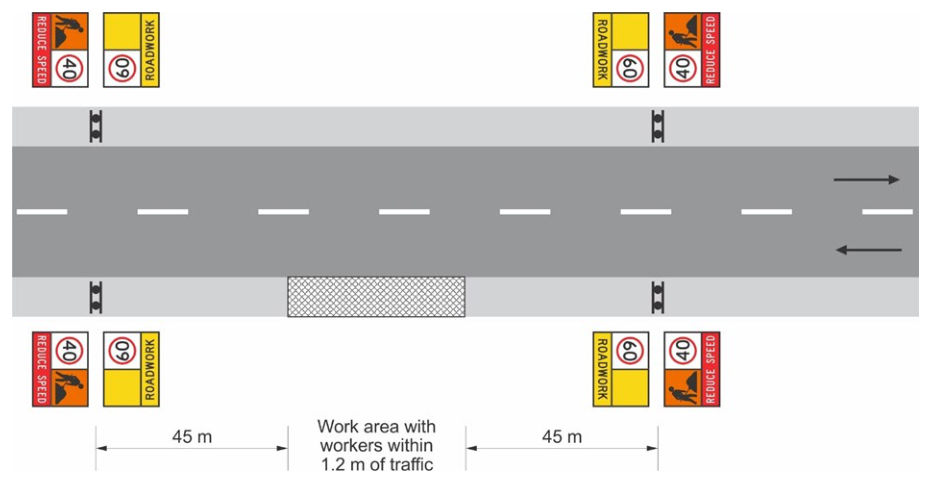
Figure 5.5.1 illustrates an example of a speed reduction arrangement for road worker safety on a 60 km/h road where road workers will be working within 1.2 m of the traffic lane and the speed past the workers is to be reduced to 40 km/h. The distance in advance of the workers for the start of the 40 km/h reduced speed zone is based on appropriate sign spacing in Table 2.2. As this spacing is within 200 m of a speed limit change (to 40 km/h), the speed value to use in Table 2.2 is 60 km/h which equates to a distance of 45 m. This Figure does not include all traffic control devices required and is not to be used as a TGS diagram.
Selecting the speed limit#
Selecting the temporary speed limit at works is dependent on workplace safety and traffic safety requirements. Temporary speed limits are a viable option for any of the following examples:
- shuttle flow
- contraflow
- temporary stopping
- temporary traffic signals and PTCD
- the number of lanes is reduced
- merges
- narrow lanes
- protecting traffic controllers
- visibility is restricted (e.g. dust, work equipment, construction materials, abnormal weather conditions)
- limited clearance between road workers or equipment and moving traffic
- the alignment or road surface is below standard
- loose material or stones
- works can be damaged by higher speeds
- emergencies (e.g. flooding, slips, crashes, fire)
- good technical reasons (e.g. the road might otherwise collapse).
A guide to selecting the required temporary speed zone is provided in Table 5.5.
| Temporary speed limit (km/h) | Length of zone (m) | Conditions |
|---|---|---|
| <40 | 100–200 | • unusually high level of hazard for workers on foot or road users (pedestrians or cyclists) • it is impractical to separate pedestrians or cyclists from vehicular traffic in the work area |
| 40 | 100 (minimum)–500 (maximum)* | • workers on foot within 1.2 m of traffic with no physical barrier • structural danger to bridges • high level of hazard for workers on foot or road users (pedestrians or cyclists) |
| 60 | 150 (minimum) | • workers on foot between 1.2 m and 3 m of traffic or plant within 3 m of traffic with no physical barrier (that is, road safety barrier) • on approach to the traffic controller or PTCD • 60 km/h buffer zone • reduced visibility (for example, dust or smoke) • reduced standard alignment • degraded pavement surface • newly laid bituminous seal |
| 80 | 500 (minimum) | • workers on foot or plant between 3 m and 6 m of traffic with no physical barrier • disturbance to alignment or pavement surface |
| 80 (buffer) | 300 (minimum) | • for advance warning of a 40 km/h or 60 km/h when speed is 100 km/h or more |
*Subject to a risk assessment, the maximum length for a 40 km/h temporary speed limit may be extended to 1000 m.
Designing the speed limit#
Speed limits may be reduced depending on the size of the reduction by one or a combination of the following:
- a speed limit sign a speed limit of intermediate value or a buffer zone
- a speed limit AHEAD sign.
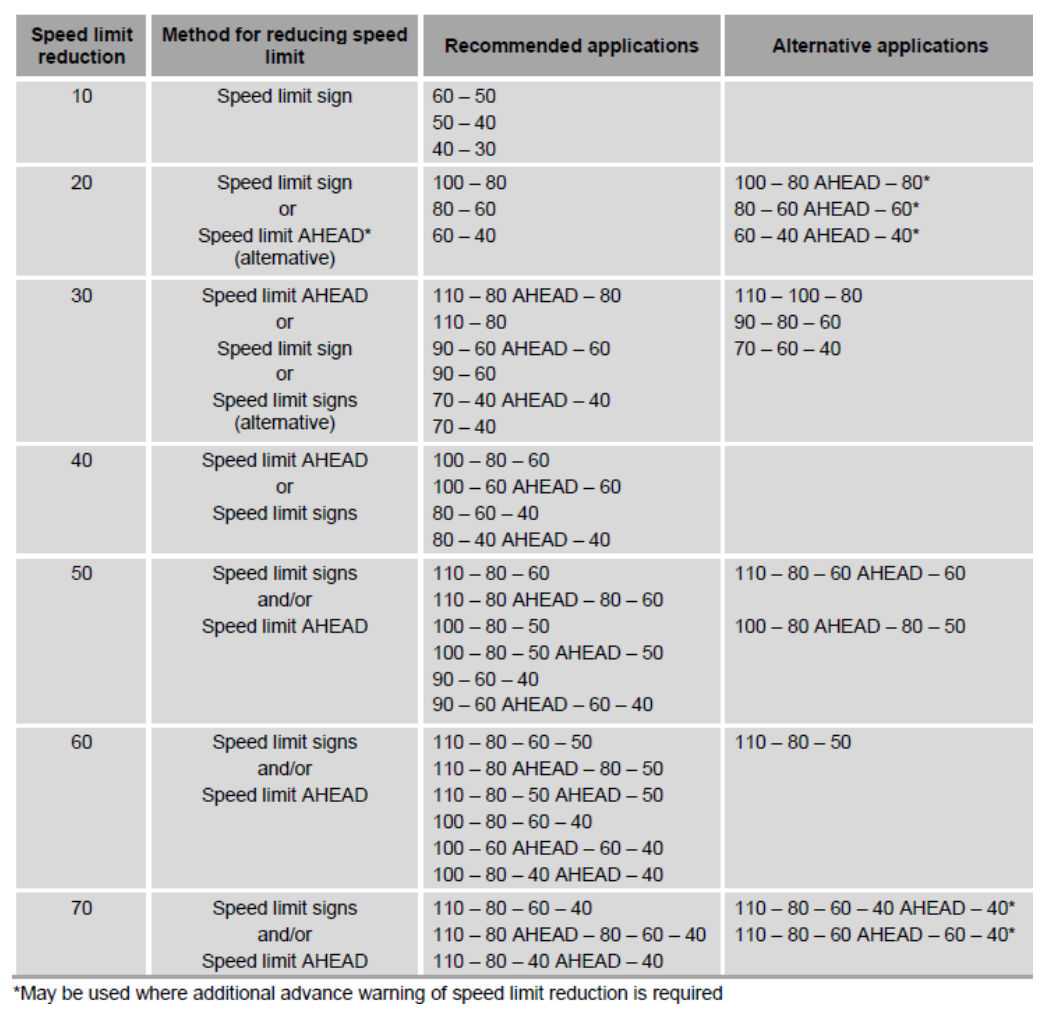
Speed limit reductions must be implemented as provided in Table 5.6.
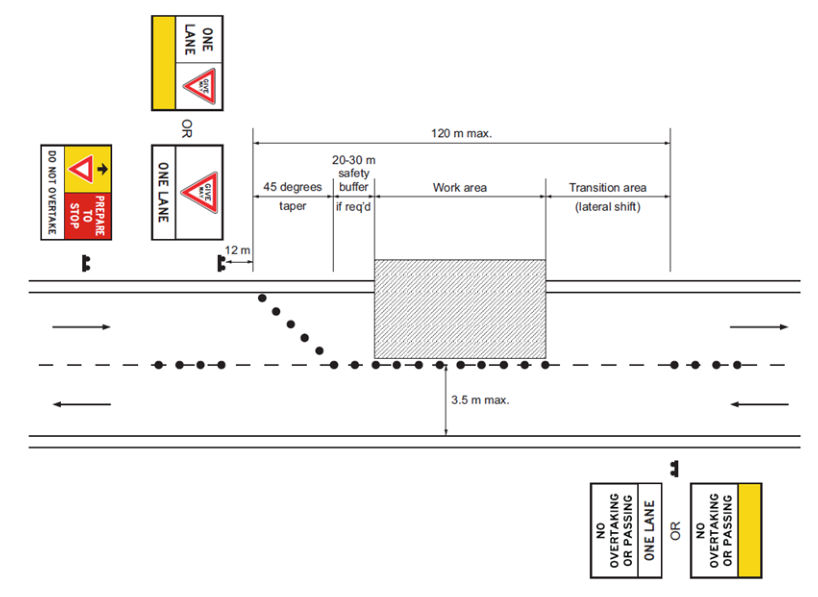
Where the need for a temporary speed limit occurs part way into a worksite, the temporary speed zone must be started at that point rather than the start of the worksite. For example, the short term need to localise a speed limit and accommodate workers on foot less than 1.2 m clear of a traffic. More than one localised speed zone is permitted within one worksite if the minimum distance between them is equal to the length of zone for the higher speed limit shown in Table 5.5.
Temporary speed zones that result in different speed limits for each direction of travel at a particular location (offset speed zones) may be used in the following conditions:
- on divided roads where works affect road users on one side of the median only
- on multilane undivided two-way roads that meet all of the following:
- more than one lane in the same direction of travel past the worksite
- works in the left lane and/or clear of the road
- conditions necessitating the temporary speed limit are confined to one direction of travel only
- there are no intersections or property access requirements within the temporary speed zone.
- where a speed buffer zone is provided. For example, advance warning of a 60 km/h speed limit is provided in an 80 km/h buffer zone, when the original speed was 100 km/h. This buffer zone speed limit is not needed for road users leaving the temporary speed zone because the buffer does not apply to the opposite direction of travel. The offset speed zone will only apply in the speed zone buffer area and not the whole worksite.
Temporary speed zones are communicated clearly to road users with the following traffic control devices in order for them to recognise the need to adjust their speed:
- a Speed Limit AHEAD sign must be located a distance double the speed in advance of the Speed Restriction sign and must be located on the left-hand side of the road and should be duplicated (placed on both sides of the roadway) where practicable on roads with an annual average daily traffic (total vehicle count in both directions of travel per day) of over 500 vehicles per day. Refer to Table 5.6 – Methods for reducing speed limit for the use of the Speed Limit AHEAD sign
- a Supplementary ROAD WORK and Speed Restriction sign or a Speed Restriction sign in a multi message panel at the start of temporary speed zone as follows:
- Speed Restriction signs must be placed on the left-hand side of the road at the start of a temporary speed zone (either a speed reduction or speed increase).
- Speed Restriction signs should be duplicated (also placed on the right-hand side of the road) where practicable in the following situations:
- At the start of a reduced temporary speed zone on a road with an annual average daily traffic (total vehicle count in both directions of travel per day) of over 500 vehicles per day and a permanent posted speed limit greater than 60 km/h, or
- On a multi-lane road (includes divided, undivided, one-way or ramps).
- In addition to the above, any Speed Restriction sign may be duplicated (also placed on the right-hand side of the road).
- an END Speed Limit sign to terminate the temporary speed zone must be placed as per the requirements for a Speed Restriction sign above. In this case, the speed limit beyond the END Speed Limit sign will revert to the default speed limit.
- an END ROADWORK sign may be placed beyond the termination of the temporary speed zone or concurrent with a Speed Restriction sign or the END Speed Limit sign.
- If sign duplication is not practicable or possible (due to for example, vegetation, safety barrier, inadequate width), the designer must document an alternative to ensure all road users are able to see the speed limit signs (refer to Section 2.5.3 for options).
Repeater speed limit signs must be used to confirm and remind users of the speed limit where the zone is long and there are locations which could seem like the temporary speed limit no longer applies (for example, between work areas in an extended worksite), or to advise road users entering the temporary speed limit. Repeater speed limit signs may be used as required above, and must be placed on the left-hand side of the road at a maximum spacing of 500 m. On multi-lane road (including divided, undivided, one-way or ramps), repeater speed limit signs should also be placed at a maximum spacing of 500 m on the right-hand side of the roadway where practicable.
At the end of the temporary speed zone, the following requirements apply:
- Speed Restriction or END speed limit signs must be used to end the temporary zone.
- When using these signs at the end of the roadworks, the ROAD WORK supplementary signs must not be used in conjunction.
- Speed Restriction and END speed limit signs must be placed as per the requirements for a Speed Restriction sign above.
If it is not practicable or possible to terminate the temporary speed limit beyond the temporary speed zone by the above methods, the END Speed Limit sign (R4-12) may be used. An example of this is where the default speed limit (typically on rural roads), road surface, alignment or other conditions will not allow the road user to travel safely at that speed. It is a legal requirement that a speed zone is terminated by:
- another regulatory speed control sign or END Speed Limit sign
- other means of traffic regulation imposed by the State.
Operational#
The following apply when installing speed signs:
- Any permanent speed signs that contradict the temporary speed limit in the required zone must be covered or removed.
- Any advisory speed signs higher than the temporary speed limit in the required zone must be covered.
- Speed Restriction signs where required to be duplicated in the 'Designing the speed limit' section should be placed on both sides of the roadway where practicable to ensure road users have clear visibility of speed limit signs.
- Temporary speed limit signs should be used together with other appropriate devices already required by other site conditions. For example, display temporary speed limit signs used for.
- worksite protection and safety in conjunction with the Workers (symbolic) sign.
- All speed limits related to road worker safety must be removed or covered when road workers, traffic controllers or plant are not on site.
- Speed limits when road workers, traffic controllers and plant are not on site should be determined with consideration of the safe passage of road users. If no hazard to road users exists, the speed limit should be returned to the permanently posted speed limit.
- Any gantries within the worksite with Variable Speed Limit or Lane Control signs must be programmed to display the temporary speed limit or turned off. Check the TMP for guidance on other large permanent signs and variable speed limit signs.
- A record of dates and times temporary speed limits are in operation must be kept, including any changes made, the name of personnel installing, changing or removing signs (see Section 2.5.3).
- Workplace safety must be considered during set-up and dismantling of signs.
Temporary speed limits should only apply while the condition that makes them necessary exists, so remove temporary speed limit signs as soon as the necessity passes. For further details on signs see Section 2.5.3.
Guidance on the use of temporary variable speed limit signs in construction and maintenance work areas on motorways is given in the Guideline – Traffic Management at Works on Roads.
5.5.2Temporary speed humps#
Guidance on the use of temporary speed humps and associated signage is given in the Guideline – Traffic Management at Works on Roads.
5.5.3Rumble strips#
Guidance on the use of rumble strips and associated signage is given in the Guideline – Traffic Management at Works on Roads.
5.5.4Speed enforcement#
Requirements for planned speed enforcement are included in Technical Specification MRTS02 Provision for Traffic. Projects not subject to the requirements of MRTS02 may adopt the requirements in MRTS02.
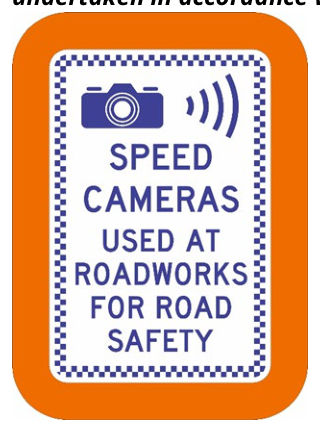
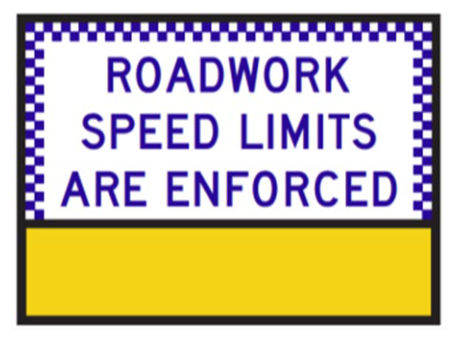
Speed enforcement planned and undertaken in accordance with MRTS02 must include the TC sign SPEED CAMERAS USED AT ROADWORKS FOR ROAD SAFETY (TC2320_1, see Figure 5.5.4(c)) and must include an orange target board to the speed limit signs as per TC2320_2 for camera enforcement, or TC2320_3 for enforcement by a Roadways Behaviour Monitoring System (RBMS) camera. The orange target board must be added to all speed limit signs (including repeater and speed limit AHEAD signs) on approach to the enforcement location. The ROADWORK AHEAD sign (T1-1 or equivalent, such as a VMS) must be installed in advance of the site. The multi-message sign arrangements in Figures 5.5.4(a) and 5.5.4(b) must not be used for speed enforcement in accordance with MRTS02.
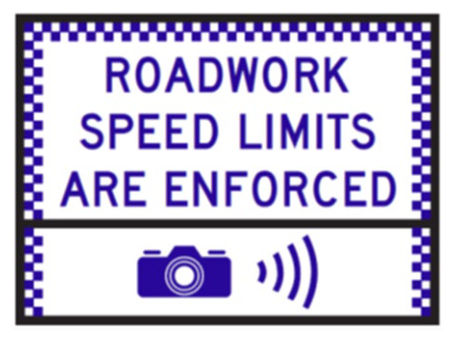
When speed enforcement is planned and undertaken outside the requirements of MRTS02, TC sign TC2361 must be used as follows:
- For enforcement by camera, use the multi-message sign arrangement in Figure 5.5.4(a).
- For enforcement other than by camera, use the multi-message sign arrangement in Figure 5.5.4(b).
The multi-message sign arrangement in Figure 5.5.4(b) may be used at roadworks sites where there is no active speed enforcement; however, in this case, the installation of this arrangement must be limited to locations which meet all the following criteria:
- the roadworks site has known or expected low speed compliance, and
- it is not feasible or practicable to implement other engineering treatments to reduce vehicle speeds (or where the treatments in Chapter 1, Clause 1 of the Guideline – Traffic Management at Works on Roads have been ineffective), and
- the location should have a permanent speed limit of 70 km/h or greater (prior to any speed reductions for the works).
When used, the enforcement signs SPEED CAMERAS USED AT ROADWORKS FOR ROAD SAFETY (TC2320_1 – see Figure 5.5.4(c)) and the multi-message sign arrangements in Figures 5.5.4(a) and 5.5.4(b):
- must be located in advance of any enforcement device
- must be located in the advance warning area as an additional sign
- must be separated from other signs and devices by a minimum of at least one sign spacing
- must be duplicated in accordance with the requirements in Section 2.5.3, and
- ideally should be located one sign spacing in advance of a speed restriction sign within the advance warning area.
- Where enforcement is occurring, and this is not the speed limit which is being enforced and if space is available, a repeater enforcement sign may be installed one sign spacing in advance of the lower speed restriction sign (this repeater enforcement sign may be outside the advance warning area).
There are no requirements for the special enforcement style signs to be in place for police to conduct unplanned speed enforcement.