Division 2Application of traffic control devices to lengths of roads and areas#
324Purpose of division#
- (1)This division contains rules explaining when traffic control devices apply to lengths of road and areas.
- (2)Other relevant rules are found elsewhere in this regulation.
325References to traffic control devices—application to lengths of road and areas#
In applying this regulation to a length of road or an area, unless the contrary intention appears, a reference to a traffic control device is a reference to a traffic control device applying to the length of road or area.
326When do traffic control devices apply to a length of road or area—the basic rules#
- (1)A traffic control device applies to a length of road or an area if—
- (a)the device applies to the length of road or area under 1 or more provisions of this regulation; or
- (b)the device, the position of the device, or information on or with the device indicates that the device applies to the length of road or area.
- (2)A traffic control device does not apply to a length of road or an area if information on or with the device expressly indicates that it does not apply to the length of road or area.
- (3)Subsection (2) applies despite any other provision of this division.
- (4)In subsection (1)(b)—
- the device
- the device includes another traffic control device.
327Length of road to which a traffic sign (except a parking control sign) applies#
The length of road to which a traffic sign on a road (except a parking control sign) applies is worked out in the direction driven by a driver, or travelled by a pedestrian, on the road who faces the sign before passing it.
328References to a traffic control device applying to a length of road#
If, under this regulation, a traffic control device on a road applies to a length of road, the device applies only to a length of road on that road, unless otherwise expressly stated.
329Traffic control devices applying to a marked lane#
- (1)A traffic control device (except a road marking) applies to a marked lane if—
- (a)it is above the marked lane; or
- (b)it is near the marked lane and the device, the position of the device, or information on or with the device indicates that it applies to the marked lane.
- (2)A road marking applies to a marked lane if it is on the surface of the lane.
However, a traffic control device does not apply to a marked lane if information on or with the device expressly indicates that the device does not apply to the marked lane.
In subsection (1)(b)—
the device includes another traffic control device.
330Traffic control devices applying to a slip lane#
- (1)A traffic control device (except a road marking) applies to a slip lane if—
- (a)it is above the slip lane; or
- (b)it is near the slip lane and on the left side of the slip lane; or
- (c)it is near the slip lane and the device, the position of the device, or information on or with the device indicates that it applies to the slip lane.
- (2)A road marking applies to a slip lane if it is on the surface of the slip lane.
- (3)However, a traffic control device does not apply to a slip lane if information on or with the device expressly indicates that the device does not apply to the slip lane.
- (4)In subsection (1)(c)—
the device includes another traffic control device.
331Traffic control devices applying to an intersection#
A traffic control device—
- (a)applies to an intersection if it is at the intersection; and
- (b)does not apply to a slip lane at the intersection, unless information on or with the device expressly indicates that the device does not apply to the intersection.
332Parking control signs applying to a length of road#
- (1)If a parking control sign displays an arrow and is at the side of a road, then, unless information on or with the sign indicates otherwise, the sign applies to the length of road between the sign and the nearest (in the direction indicated by the arrow) of the following—
- (a)a parking control sign at that side of the road that displays an arrow indicating the opposite direction;
- (b)a yellow edge line on the road;
- (c)if the road ends at a T-intersection or dead end—the end of the road.
- (2)If a parking control sign displays an arrow and is at the centre of a road or on a dividing strip, then, unless information on or with the sign indicates otherwise, the sign applies to the length of road between the sign and the nearest (in the direction indicated by the arrow) of the following—
- (a)a parking control sign at that side of the road that displays an arrow indicating the opposite direction;
- (b)a yellow edge line on the road;
- (c)if the road ends at a T-intersection or dead end—the end of the road.
333Parking control signs applying to a length of road in an area to which another parking control sign applies etc.#
- (1)If a parking control sign applying to a length of road is in an area to which another parking control sign applies in accordance with section 335, the first parking control sign applies in the same way as it would apply if it were not in that area, and the second parking control sign does not apply to the length of road.
If the area indicated by a people with disabilities road marking is in an area to which a parking control sign applies in accordance with section 335, the road marking applies in the same way as it would apply if it were not in that area, and the parking control sign does not apply to the area indicated by the road marking.
334How parking control signs apply to a length of road#
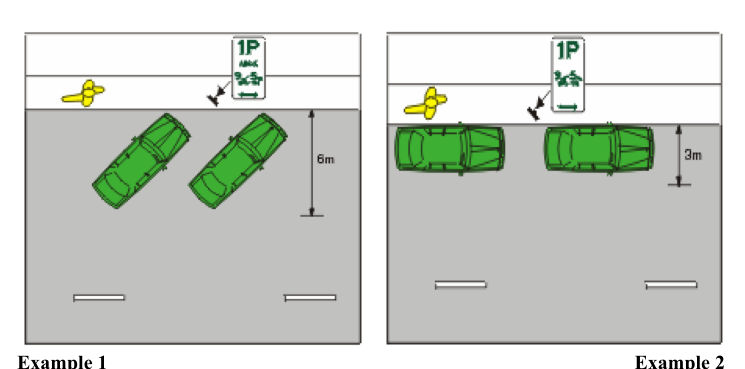
- (1)If a permissive parking sign, bicycle parking sign, motorbike parking sign, or a parking control sign for a zone mentioned in part 12, division 5, applies to a length of road and there are parking bays on the length of road, the sign applies only to the parking bays, unless information on or with the sign indicates otherwise.
- (2)If a parking control sign applies to a length of road, the sign is at the side of the road, and there are no parking bays to which the sign applies, then, unless information on or with the sign indicates otherwise, the sign applies to—
- (a)any shoulder of the road on that side of the road; and
- (b)the part of the road on the length of road extending from the far side of the road (excluding any road-related area) on that side of the road for—
- (i)if the sign, or information on or with the sign, includes the words ‘angle parking’ or ‘angle’—6 metres; or
- (ii)in any other case—3 metres.
- (3)If a parking control sign applies to a length of road, the sign is at the centre of the road or on a dividing strip, and there are no parking bays to which the sign applies, then, unless information on or with the sign indicates otherwise, the sign applies to—
- (a)if the sign is at the centre of the road, but not on a dividing strip—the part of the road on that length of road extending 3m from the centre of the road on each side of the road; or
- (b)if the sign is on a dividing strip—the dividing strip on that length of road and the part of the road on that length of road extending 3m from each edge of the dividing strip.
335Traffic control devices applying to an area#
- (1)A traffic control device (except a road marking) applies to an area if—
- (a)it is in the area; and the device, the position of the device, or information on or with the device indicates that the device applies to the area.
- (2)A traffic control device (except a road marking) also applies to an area if—
- (a)there is an identical kind of traffic control device (the first traffic control device) on each road into the area; and
- (b)the traffic control device is a traffic control device applying to an area, or information on or with the device indicates that it applies to an area; and
- (c)information on or with a traffic control device on each road out of the area indicates that the first traffic control device no longer applies or that the area has ended.
- (3)A road marking applies to an area if—
- (a)it is on the surface of the area; and
- (b)the road marking, the position of the road marking, or information in or with the road marking indicates that the road marking applies to the area.
- (4)However, a traffic control device does not apply to an area if information on or with the device expressly indicates that the device does not apply to the area.
- (5)A parking control sign that applies to an area applies to parking bays on each length of road in the area, and to other parts of each length of road, as if it were a parking control sign applying only to that length of road.
- (6)In this section—
- road
- in subsection (2)(a) and (c) and for an area of road, does not include a road-related area.
- the device
- in subsection (1)(b), includes another traffic control device.
- the road marking
- in subsection (3)(b), includes another traffic control device.
336How separated footpath signs and separated footpath road markings apply#
- (1)A separated footpath sign, or separated footpath road marking, on a footpath applies in the way set out in this section.
- (2)The part of the footpath to the left of the centre of the footpath is designated—
- (a)if a pedestrian symbol is on the left side of the sign or the path—for the use of pedestrians; or
- (b)if a bicycle symbol is on the left side of the sign or the path—for the use of bicycles.
- (3)The part of the footpath to the right of the centre of the footpath is designated—
- (a)if a pedestrian symbol is on the right side of the sign or the path—for the use of pedestrians; or
- (b)if a bicycle symbol is on the right side of the sign or the path—for the use of bicycles.