Part 5Change of direction and stop signals#
Division 1Change of direction signals#
44Division does not apply to entering or leaving a roundabout, lane filtering or repositioning#
This division does not apply to—
- (a) a driver entering, in or leaving a roundabout; or
- (b) the rider of a motorbike while lane filtering in compliance with section 151A; or
- (c) the rider of a motorbike while repositioning the motorbike within the same lane in order to avoid a hazard or reduce the risk of a crash.
45What is changing direction#
- (1)A driver changes direction if—
- (a)the driver changes direction to the left; or
- (b)the driver changes direction to the right.
- (2)A driver changes direction to the left by doing any of the following—
- (a)turning left;
- (b)changing marked lanes to the left;
- (c)diverging to the left;
- (d)entering a marked lane, or a line of traffic, to the left;
- (e)moving to the left to, or from, a stationary position;
- (f)turning left into a marked lane, or a line of traffic, from a median strip parking area;
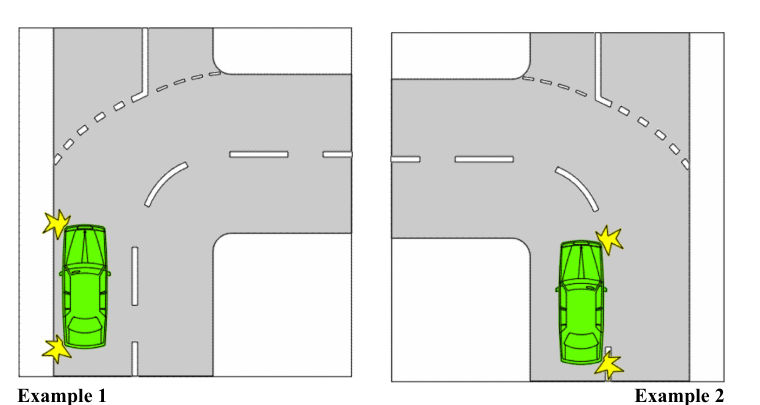
- (g)at a T-intersection where the continuing road curves to the right—leaving the continuing road to proceed straight ahead onto the terminating road.
- (3)A driver changes direction to the right by doing any of the following—
- (a)turning right;
- (b)changing marked lanes to the right;
- (c)diverging to the right;
- (d)entering a marked lane, or a line of traffic, to the right;
- (e)moving to the right to, or from, a stationary position;
- (f)turning right into a marked lane, or a line of traffic, from a median strip parking area;
- (g)making a U-turn;
- (h)at a T-intersection where the continuing road curves to the left—leaving the continuing road to proceed straight ahead onto the terminating road.
Examples for subsections (2)(g) and (3)(h)—
Driver indicating change of direction at a T-intersection where the continuing road curves to the right and the driver is proceeding straight ahead onto the terminating road
Driver indicating change of direction at a T-intersection where the continuing road curves to the left and the driver is proceeding straight ahead onto the terminating road
46Giving a left change of direction signal#
- (1)Before a driver changes direction to the left, the driver must give a left change of direction signal in accordance with section 47 for long enough to comply with—
- (a)subsection (2); and
- (b)if subsection (3) applies to the driver—subsection (3).
Maximum penalty—20 penalty units.
- (2)The driver must give the change of direction signal for long enough to give sufficient warning to other drivers and pedestrians.
- (3)If the driver is about to change direction by moving from a stationary position at the side of the road or in a median strip parking area, the driver must give the change of direction signal for at least 5 seconds before the driver changes direction.
- (4)The driver must stop giving the change of direction signal as soon as the driver completes the change of direction.
Maximum penalty—20 penalty units.
- (5)This section does not apply to a driver if the driver's vehicle is not fitted with direction indicator lights.
47How to give a left change of direction signal#
The driver of a vehicle must give a left change of direction signal by operating the vehicle's left direction indicator lights.
48Giving a right change of direction signal#
- (1)Before a driver changes direction to the right, the driver must give a right change of direction signal in accordance with section 49 for long enough to comply with—
- (a)subsection (2); and
- (b)if subsection (3) applies to the driver—subsection (3).
Maximum penalty—20 penalty units.
- (2)The driver must give the change of direction signal for long enough to give sufficient warning to other drivers and pedestrians.
- (3)If the driver is about to change direction by moving from a stationary position at the side of the road or in a median strip parking area, the driver must give the change of direction signal for at least 5 seconds before the driver changes direction.
- (3A)Subsection (3) does not apply to the rider of a bicycle or a personal mobility device that is stopped in traffic but not parked.
- (4)The driver must stop giving the change of direction signal as soon as the driver completes the change of direction.
Maximum penalty—20 penalty units.
- (5)This section does not apply to—
- (a)the driver of a tram that is not fitted with direction indicator lights; or
- (b)the rider of a bicycle or a personal mobility device making a hook turn.
49How to give a right change of direction signal#
- (1)The driver of a vehicle must give a right change of direction signal by operating the vehicle’s right direction indicator lights.
- (2)However, if the vehicle’s direction indicator lights are not in working order or are not clearly visible, or the vehicle is not fitted with direction indicator lights, the driver must give the change of direction signal by—
- (a)giving a hand signal in accordance with section 50; or
- (b)using a mechanical signalling device fitted to the vehicle.
50How to give a right change of direction signal by giving a hand signal#
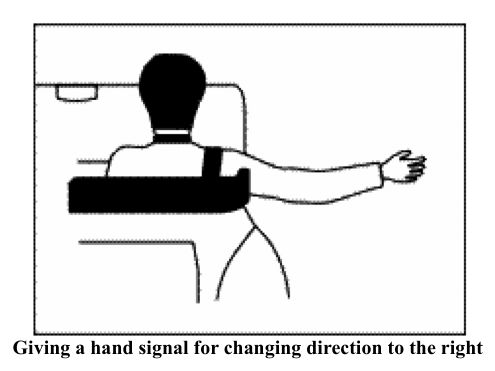
To give a hand signal for changing direction to the right, the driver must extend the right arm and hand horizontally and at right angles from the right side of the vehicle, with the hand open and the palm facing the direction of travel.
51When use of direction indicator lights permitted#
The driver of a vehicle must not operate a direction indicator light except—
- (a)to give a change of direction signal when the driver is required to give the signal under this regulation; or
- (b)as part of the vehicle’s hazard warning lights.
Maximum penalty—20 penalty units.
Division 2Stop signals#
52Division does not apply to bicycle or personal mobility device riders or certain tram drivers#
This division does not apply to—
- (a)the rider of a bicycle or a personal mobility device; or
- (b)the driver of a tram that is not fitted with brake lights.
53Giving a stop signal#
- (1)A driver must give a stop signal in accordance with section 54 before stopping or when suddenly slowing.
- (2)If the driver is stopping, the driver must give the stop signal for long enough to give sufficient warning to other road users.
- (3)If the driver is slowing suddenly, the driver must give the stop signal while slowing.
Maximum penalty—20 penalty units.
54How to give a stop signal#
- (1)The driver of a vehicle must give a stop signal by means of the vehicle’s brake lights.
- (2)However, if the vehicle’s brake lights are not in working order or are not clearly visible, or the vehicle is not fitted with brake lights, the driver must give the stop signal by—
- (a)giving a hand signal in accordance with section 55; or
- (b)using a mechanical signalling device fitted to the vehicle.
55How to give a stop signal by giving a hand signal#
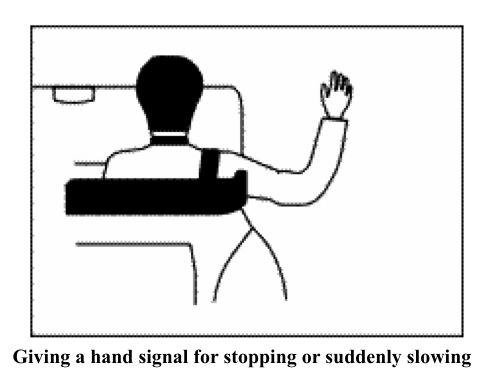
- (1)To give a hand signal for stopping or suddenly slowing, the driver must extend the right arm and hand at right angles from the right side of the vehicle with—
- (a)the upper arm horizontal and the forearm and hand pointing upwards; and
- (b)the hand open and the palm facing the direction of travel.
- (2)However, the rider of a motorbike may give the hand signal by extending the left arm and hand at right angles from the left side of the motorbike with—
- (a)the upper arm horizontal and the forearm and hand pointing upwards; and
- (b)the hand open and the palm facing the direction of travel.