Part 15Additional rules for bicycle and personal mobility device riders#
245Riding a bicycle#
The rider of a bicycle must—
- (a)be astride the rider’s seat facing forwards (except if the bicycle is not built to be ridden astride); and
- (b)ride with at least 1 hand on the handlebars; and
- (c)if the bicycle is equipped with a seat—not ride the bicycle seated in any other position on the bicycle.
Maximum penalty—20 penalty units.
246Carrying people on a bicycle#
- (1)The rider of a bicycle must not carry more persons on the bicycle than the bicycle is designed to carry.
Maximum penalty—20 penalty units.
- (2)A passenger on a bicycle that is moving, or is stationary but not parked, must sit in the seat designed for the passenger.
- (3)The rider of a bicycle must not ride with a passenger unless the passenger complies with subsection (2).
Maximum penalty—20 penalty units. Maximum penalty—20 penalty units.
246ACarrying people on a personal mobility device#
The rider of a personal mobility device must not carry another person on the device. Maximum penalty—20 penalty units.
247BGiving way while entering or in a bicycle storage area#
- (1)A rider of a bicycle, a personal mobility device or a motorbike must, when entering a bicycle storage area, give way to—
- (a)any vehicle that is in the area; and
- (b)if the area is before any green or yellow traffic lights, any motor vehicle that is entering or about to enter the area, unless the motor vehicle is turning in a direction that is subject to a red traffic arrow; and
- (c)if the area forms part of a lane to which traffic arrows apply, any motor vehicle that is entering or about to enter the area at a time when those arrows are green or yellow.
- (2)A rider of a bicycle, a personal mobility device or a motorbike that is in a bicycle storage area that extends across more than 1 lane of a multi-lane road must, if the area is before any green or yellow traffic lights, give way to a motor vehicle that is in any lane other than the lane that the bicycle, the personal mobility device or the motorbike is directly in front of, unless the motor vehicle is turning in a direction that is subject to a red traffic arrow.
Maximum penalty—20 penalty units.
248Riding a bicycle or personal mobility device across a road on particular crossings#
- (1)This section applies to the rider of a bicycle or a personal mobility device who is at—
- (a)a children’s crossing; or
- (b)a marked foot crossing; or
- (c)a pedestrian crossing.
- (2)The rider may ride across the crossing only in accordance with this section.
- (3)The rider may ride across a children’s crossing or pedestrian crossing only if the rider stops as near as practicable to the crossing before riding across the crossing.
- (4)The rider may ride across a marked foot crossing only if—
- (a)for a crossing with bicycle crossing lights—the rider is allowed, under this regulation, to ride across the crossing; or
- (b)for a crossing without bicycle crossing lights—a pedestrian is allowed, under this regulation, to cross the crossing.
- (5)The rider may ride across the crossing only if the rider—
- (a)proceeds slowly and safely; and
Maximum penalty—20 penalty units.
gives way to a pedestrian on the crossing; and keeps to the left of an oncoming rider of a bicycle or a personal mobility device.
However, if the rider is crossing the road at an intersection with traffic lights and a pedestrians may cross diagonally sign, the rider may cross the road diagonally at the intersection.
249Riding a bicycle or personal mobility device on a separated footpath#
The rider of a bicycle or a personal mobility device must not ride on a part of a separated footpath designated for the use of pedestrians unless the rider—
- (a) is crossing the separated footpath by the shortest safe route; and
- (b) does not stay on the separated footpath for longer than necessary to cross the separated footpath safely.
Maximum penalty—20 penalty units.
250Riding a bicycle or personal mobility device on a footpath or shared path#
Subject to subsection (1A), the rider of a bicycle or a personal mobility device riding on a footpath or shared path must—
- (a) keep to the left of the footpath or shared path unless it is impracticable to do so; and
- (b) give way to any pedestrian on the footpath or shared path.
Maximum penalty—20 penalty units.
Subsection (1) does not apply to a person riding a bicycle or a personal mobility device on a footpath if a local law otherwise provides.
In this section—
- footpath
- footpath does not include a separated footpath.
250ARiding an electrically power-assisted cycle or a personal mobility device past a pedestrian on a shared path#
This section applies to the rider of an electrically power-assisted cycle or a personal mobility device riding on a shared path.
The rider must not ride past a pedestrian on the shared path at a speed over 12km/h.
Maximum penalty—40 penalty units.
251Riding bicycles and personal mobility devices to the left of oncoming riders on a path#
The rider of a bicycle or a personal mobility device riding on a bicycle path, footpath, separated footpath or shared path must keep to the left of any oncoming rider of a bicycle or personal mobility device on the path.
Maximum penalty—20 penalty units.
252No bicycles signs and markings#
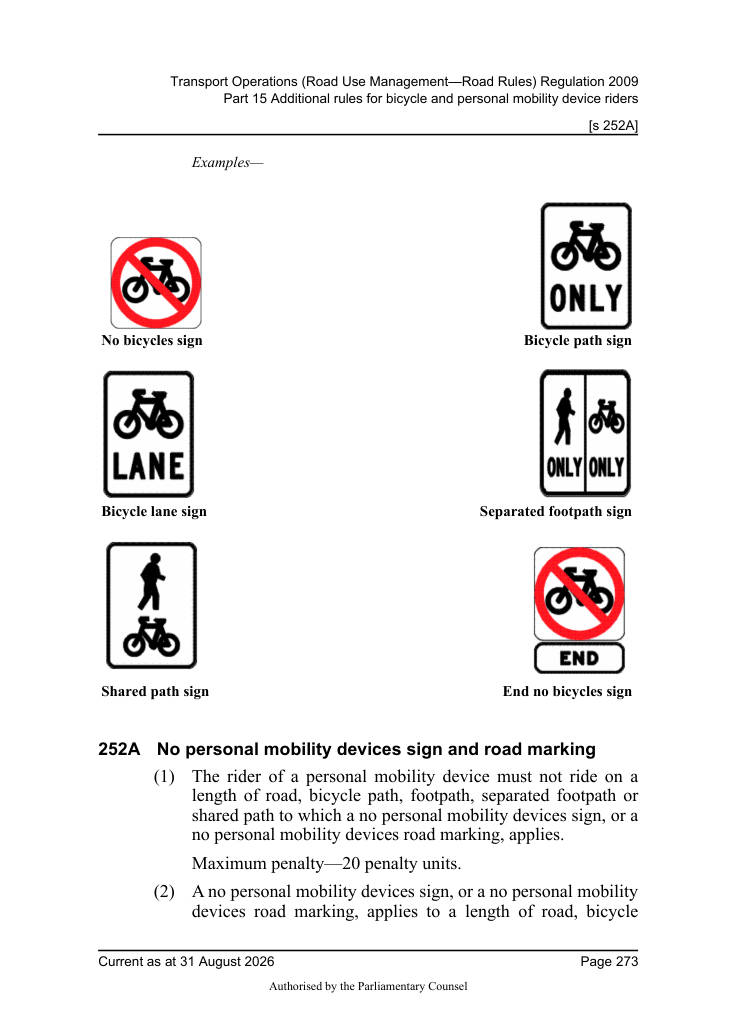
The rider of a bicycle must not ride on a length of road or footpath to which a no bicycles sign, or a no bicycles road marking, applies.
Maximum penalty—20 penalty units.
A no bicycles sign, or a no bicycles road marking, applies to a length of road or footpath beginning at the sign or marking and ending at the nearest of the following—
- (a) a bicycle path sign or bicycle path road marking;
- (b) a bicycle lane sign;
- (c) a separated footpath sign or separated footpath road marking;
- (d) a shared path sign;
- (e) an end no bicycles sign;
- (f) the next intersection.
252ANo personal mobility devices sign and road marking#
The rider of a personal mobility device must not ride on a length of road, bicycle path, footpath, separated footpath or shared path to which a no personal mobility devices sign, or a no personal mobility devices road marking, applies.
Maximum penalty—20 penalty units.
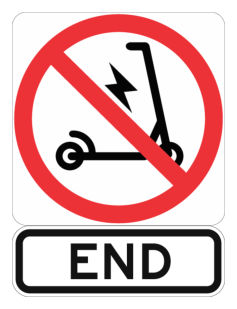
A no personal mobility devices sign, or a no personal mobility devices road marking, applies to a length of road, bicycle path, footpath, separated footpath or shared path beginning at the sign or marking and ending at the nearest of the following—
- (a) a bicycle lane sign on a PMD-permitted bicycle lane;
- (b) a separated footpath sign or separated footpath road marking;
- (c) a shared path sign;
- (d) an end no personal mobility devices sign;
- (e) the next intersection.
In this section—
- no personal mobility devices road marking
- no personal mobility devices road marking means a road marking consisting of a personal mobility device symbol with a diagonal line across it, or the words 'no personal mobility devices', or both the symbol and the words.
252BPersonal mobility devices not to be ridden on roads with speed limit of more than 60km/h#
Subject to sections 252C and 252D, the rider of a personal mobility device must not ride on a length of road for which the speed limit applying to a driver is more than 60km/h.
Maximum penalty—20 penalty units.
(2) In this section—
- road
- road does not include a road-related area, but includes any shoulder of a road.
252CException to offence against s 252B—PMD-permitted bicycle lane#
- (1)The rider of a personal mobility device does not commit an offence against section 252B(1) if the rider—
- (a)is riding in a PMD-permitted bicycle lane; or
- (b)is riding on a road mentioned in section 252B (a prohibited road) to enter or leave a PMD-permitted bicycle lane by the shortest safe route; or
- (c)is in a bicycle storage area at the end of a PMD-permitted bicycle lane; or
- (d)is riding through an intersection from a PMD-permitted bicycle lane, a bicycle storage area at the end of a PMD-permitted bicycle lane, or a road (other than a prohibited road) to—
- (i)a PMD-permitted bicycle lane adjacent to the intersection; or
- (ii)a road (other than a prohibited road) adjacent to the intersection; or
- (iii)a place on a road adjacent to the intersection where the rider reasonably believes there is a PMD-permitted bicycle lane or a road (other than a prohibited road).
(2) A bicycle lane is a PMD-permitted bicycle lane if the bicycle lane is physically separated from other lines of traffic on the road by a structure including, for example, a dividing strip, traffic island, row of bollards or separation kerb.
252DOther exceptions to offence against s 252B#
- (1)The rider of a personal mobility device does not commit an offence against section 252B(1) if the rider—
- (a)is crossing a road on the device; and
- (b)crosses the road by the shortest safe route or in accordance with section 248(6); and
- (c)does not stay on the road longer than is necessary to cross the road safely.
- (2)Also, the rider of a personal mobility device does not commit an offence against section 252B(1) if—
- (a)there is an obstruction—
- (i)on a bicycle path, footpath, separated footpath, shared path or nature strip adjacent to the road; or
- (ii)in a PMD-permitted bicycle lane; and
- (b)because of the obstruction, it is impracticable to ride on the path, nature strip or PMD-permitted bicycle lane; and
- (c)the rider rides less than 50m along the road to avoid the obstruction.
- (3)In this section—
- obstruction
- obstruction does not include a pedestrian.
252EPersonal mobility device rider crossing a road on or near a crossing for pedestrians#
- (1)The rider of a personal mobility device must not cross a road, or part of a road, within 20m of a crossing on the road, except at the crossing or another crossing, unless the rider—
- (a)is crossing to or from a safety zone; or
- (b)is crossing at an intersection with traffic lights and a pedestrians may cross diagonally sign; or
- (c)is crossing in a shared zone; or
- (d)is crossing a road, or a part of a road, from which vehicles, other than bicycles and personal mobility devices, are excluded (either permanently or temporarily); or
- (e)is crossing at a bicycle crossing.
Maximum penalty—20 penalty units.
(2) In this section—
- crossing
- crossing means a children’s crossing, marked foot crossing or pedestrian crossing.
252FPersonal mobility device rider crossing a level crossing#
- (1)The rider of a personal mobility device must not cross a railway line, or tram tracks, at a level crossing unless—
- (a)there is a pedestrian facility at the crossing and the rider uses the facility; or
- (b)there is no pedestrian facility at, or within 20m of, the crossing.
Maximum penalty—20 penalty units.
- (2)The rider of a personal mobility device must not cross a pedestrian level crossing at a level crossing if—
- (a)warning lights (for example, twin red lights or rotating red lights) are flashing or warning bells are ringing; or
- (b)a gate, boom or barrier at the pedestrian level crossing or level crossing is closed or is opening or closing; or
- (c)a train or tram is on or entering the pedestrian level crossing or level crossing; or
- (d)a train or tram approaching the pedestrian level crossing can be seen from the pedestrian level crossing or is sounding a warning, and there would be a danger of the rider being struck by the train or tram if the rider entered the pedestrian level crossing; or
- (e)the pedestrian level crossing, or a footpath or shared path beyond the pedestrian level crossing, is blocked.
Maximum penalty—20 penalty units.
- (3)If any of the following events occurs after the rider of a personal mobility device has started to cross a pedestrian level crossing, the rider must finish crossing the pedestrian level crossing without delay—
- (a)warning lights start flashing, or warning bells start ringing;
- (b)a gate, boom or barrier starts to close;
- (c)a train or tram approaches the pedestrian level crossing.
Maximum penalty—20 penalty units.
(4) In this section—
- pedestrian facility
- pedestrian facility means a footpath, bridge or other structure designed for the use of pedestrians.
252GPersonal mobility device rider crossing a pedestrian level crossing that has a red pedestrian light#
- (1)If the rider of a personal mobility device approaches a pedestrian level crossing that has a red pedestrian light, the rider must not start to cross the crossing while the light is red.
- (2)If a red pedestrian light at a pedestrian level crossing appears after the rider of a personal mobility device has started to cross the crossing, the rider must finish crossing the crossing without delay.
Maximum penalty—20 penalty units.
253Bicycle and personal mobility device riders not to cause a traffic hazard#
The rider of a bicycle or a personal mobility device must not cause a traffic hazard by moving into the path of a driver or pedestrian.
Maximum penalty—20 penalty units.
253AUnreasonably obstructing bicycle paths, footpaths etc.#
A person must not park an electrically power-assisted cycle or personal mobility device on a bicycle path, footpath, separated footpath, shared path or nature strip in a way that unreasonably obstructs the path of pedestrians or other vehicles.
Maximum penalty—20 penalty units.
254Bicycles or personal mobility devices being towed etc.#
- (1)A person must not ride on a bicycle or a personal mobility device that is being towed by another vehicle.
- (2)The rider of a bicycle or a personal mobility device must not hold onto another vehicle while the vehicle is moving.
Maximum penalty—20 penalty units.
255Riding a bicycle or personal mobility device too close to the rear of a motor vehicle#
The rider of a bicycle or a personal mobility device must not ride within 2m of the rear of a moving motor vehicle continuously for more than 200m.
Maximum penalty—20 penalty units.
256Bicycle rider and passenger required to wear helmet#
- (1)The rider of a bicycle must wear an approved bicycle helmet or approved motorbike helmet securely fitted and fastened on the rider’s head.
- (2)A passenger on a bicycle that is moving, or is stationary but not parked, must wear an approved bicycle helmet or approved motorbike helmet securely fitted and fastened on the passenger’s head, unless the passenger is a paying passenger on a three- or four-wheeled bicycle.
- (3)The rider of a bicycle must not ride with a passenger on the bicycle unless the passenger complies with subsection (2).
- (4)A person is exempt from wearing a helmet under subsection (1) or (2) if the person is carrying a current doctor’s certificate stating that, for a stated period— (a) the person can not wear a helmet for medical reasons; or (b) because of a physical characteristic of the person, it would be unreasonable to require the person to wear a helmet.
- (5)A person is also exempt from wearing a helmet under subsection (1) or (2) if— (a) the person is a member of a religious group; and (b) the person is wearing a type of headdress customarily worn by members of the group; and (c) the wearing of the headdress makes it impractical for the person to wear a helmet.
- (6)If, for any reason, a person can not wear an approved motorbike helmet, the person is not exempt from the requirement to wear an approved bicycle helmet under subsection (1) or (2) unless subsection (4) or (5) also applies to the person in relation to a bicycle helmet.
256APersonal mobility device rider required to wear helmet#
- (1)The rider of a personal mobility device must wear an approved bicycle helmet or an approved motorbike helmet securely fitted and fastened on the rider’s head.
- (2)A person is exempt from wearing a helmet under subsection (1) if the person is carrying a current doctor’s certificate stating that, for a stated period— (a) the person can not wear a helmet for medical reasons; or (b) because of a physical characteristic of the person, it would be unreasonable to require the person to wear a helmet.
- (3)A person is also exempt from wearing a helmet under subsection (1) if— (a) the person is a member of a religious group; and (b) the person is wearing a type of headdress customarily worn by members of the group; and (c) the wearing of the headdress makes it impractical for the person to wear a helmet.
- (4)If, for any reason, a person can not wear an approved motorbike helmet, the person is not exempt from the requirement to wear an approved bicycle helmet under subsection (1) unless subsection (2) or (3) also applies to the person in relation to a bicycle helmet.
257Riding a bicycle or personal mobility device with a person on a bicycle or PMD trailer#
- (1)The rider of a bicycle or a personal mobility device must not tow a bicycle or PMD trailer with a person in or on the trailer, unless—
- (a)the rider is at least 16 years; and
- (b)the person in or on the trailer is under 10 years; and
- (c)the trailer can safely carry the person; and
- (d)the person in or on the trailer is wearing an approved bicycle helmet or approved motorbike helmet securely fitted and fastened on the person’s head.
Maximum penalty—20 penalty units.
- (1A)A person is exempt from wearing a helmet if the person is carrying a current doctor’s certificate stating that, for a stated period—
- (a)the person can not wear a helmet for medical reasons; or
- (b)because of a physical characteristic of the person, it would be unreasonable to require the person to wear a helmet.
- (1B)A person is also exempt from wearing a helmet if—
- (a)the person is a member of a religious group; and
- (b)the person is wearing a type of headdress customarily worn by members of the group; and
- (c)the wearing of the headdress makes it impractical for the person to wear a helmet.
- (1C)If, for any reason, a person can not wear an approved motorbike helmet, the person is not exempt from the requirement to wear an approved bicycle helmet under subsection (1) unless subsection (1A) or (1B) also applies to the person in relation to a bicycle helmet.
- (2)In this section—
- bicycle or PMD trailer
- means a vehicle that is built to be towed, or is towed, by a bicycle or personal mobility device.
258Equipment on a bicycle or personal mobility device#
- (1)A person must not ride a bicycle that does not have—
- (a)at least 1 effective brake; and
- (b)a bell, horn or similar warning device in working order.
Maximum penalty—20 penalty units.
- (2)A person must not ride a personal mobility device that does not have an effective stopping system controlled by using brakes, gears or motor control.
Maximum penalty—20 penalty units.
- (3)A person must not ride a personal mobility device that is steered by handlebars unless the device has a bell, horn or similar warning device in working order.
Maximum penalty—20 penalty units.
258APersonal mobility devices with sharp protrusions#
A person must not ride a personal mobility device that has sharp protrusions.
Maximum penalty—20 penalty units.
259Riding bicycles or personal mobility devices at night#
The rider of a bicycle or a personal mobility device must not ride at night, or in hazardous weather conditions causing reduced visibility, unless the bicycle, personal mobility device or rider displays—
- (a)a flashing or steady white light that is clearly visible for at least 200m from the front of the bicycle or device; and
- (b)a flashing or steady red light that is clearly visible for at least 200m from the rear of the bicycle or device; and
- (c)a red reflector that is clearly visible for at least 50m from the rear of the bicycle or device when light is projected onto it by a vehicle’s headlight on low-beam.
Maximum penalty—20 penalty units.
260Stopping a bicycle or personal mobility device for a red bicycle crossing light#
- (1)The rider of a bicycle or a personal mobility device approaching or at an intersection, or another place on a road or road-related area, with bicycle crossing lights must comply with this section.
Maximum penalty—20 penalty units.
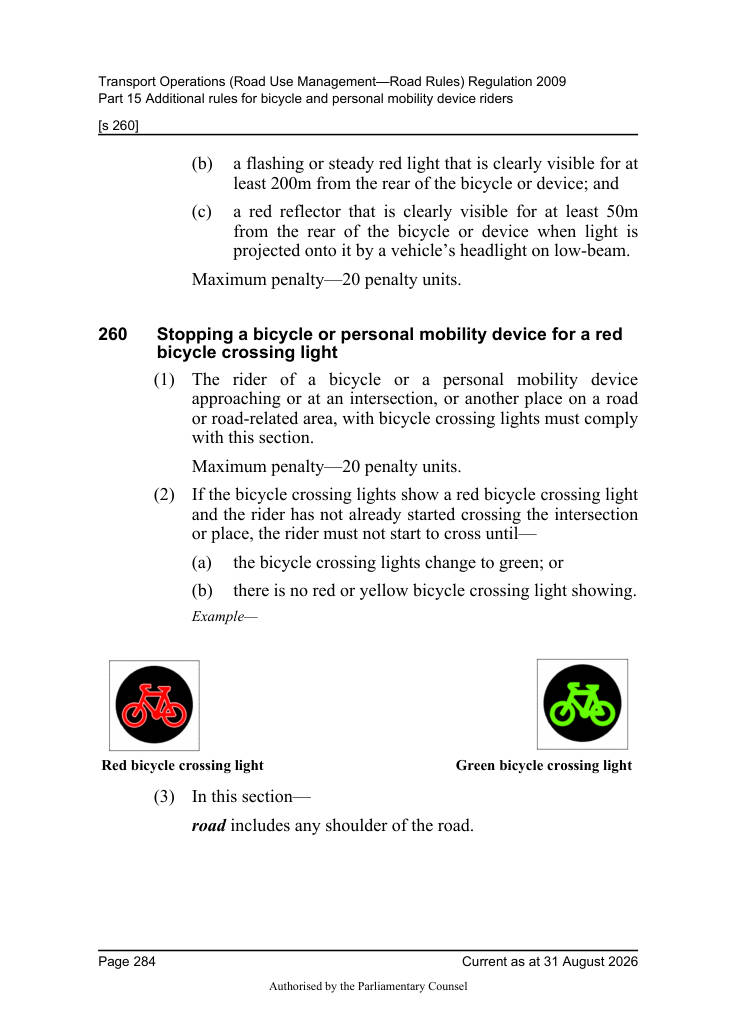
- (2)If the bicycle crossing lights show a red bicycle crossing light and the rider has not already started crossing the intersection or place, the rider must not start to cross until—
- (a)the bicycle crossing lights change to green; or
- (b)there is no red or yellow bicycle crossing light showing.
- (3)In this section—
- road
- includes any shoulder of the road.
261Stopping a bicycle or personal mobility device for a yellow bicycle crossing light#
- (1)The rider of a bicycle or a personal mobility device approaching or at an intersection, or another place on a road or road-related area, with bicycle crossing lights must comply with this section.
Maximum penalty—20 penalty units.
- (2)If the bicycle crossing lights show a yellow bicycle crossing light and the rider has not already started crossing the intersection or place, the rider must not start to cross until—
- (a)the bicycle crossing lights change to green; or
- (b)there is no red or yellow bicycle crossing light showing.
- (3)In this section—
- road
- includes any shoulder of the road.
262Proceeding when bicycle crossing at an intersection or another place on a road#
- (1)The rider of a bicycle or a personal mobility device who is crossing at an intersection, or another place on a road, with bicycle crossing lights and traffic lights must comply with this section.
Maximum penalty—20 penalty units.
- (2)If the bicycle crossing lights change from green to yellow, flashing yellow, red or flashing red while the rider is crossing the road, the rider must not stay on the road for longer than necessary to cross safely to the nearer (in the direction of travel of the rider) of the following—
- (a)a dividing strip, safety zone, or traffic island, forming part of the area set aside or used by riders of bicycles or personal mobility devices to cross the road at the intersection or place (a safety area);
- (b)the far side of the road.
- (2A)Despite subsection (2), the rider may instead return to the side of the road, or a safety area, that the rider has just left, but only if—
- (a)at the time the lights change, that side or safety area is closer to the rider than the side or safety area the rider was approaching at the time; and
- (b)the rider does not stay on the road for longer than is necessary to return to that side or safety area.
- (3)If, under subsection (2) or (2A), the rider crosses, or returns, to a safety area, the rider must remain in the safety area until the bicycle crossing lights change to green.
- (4)However, if the rider can not operate the bicycle crossing lights from the safety area, the rider may cross to the far side of the road when—
- (a)the traffic lights change to green or flashing yellow, or there is no red traffic light showing; and
- (b)it is safe to do so.
- (4A)If the bicycle crossing lights show a green bicycle crossing light, the rider may cross at the intersection, or another place on the road, even though the traffic lights show a red traffic light or yellow traffic light.
- (5)In this section—
- road
- does not include a road-related area, but includes any shoulder of the road.