Division 5Crossings and shared zones#
80Stopping at a children’s crossing#
- (1)A driver approaching a children’s crossing must drive at a speed at which the driver can, if necessary, stop safely before the crossing.
- (2)A driver approaching or at a children’s crossing must stop as near as practicable to, but before reaching, the stop line at the crossing if—
- (a)a hand-held stop sign is displayed at the crossing; or
- (b)a pedestrian, or a rider of a bicycle or a personal mobility device, is on or entering the crossing.
- (3)If a driver stops at a children’s crossing for a hand-held stop sign, the driver must not proceed until—
- (a)there is no pedestrian, or rider of a bicycle or a personal mobility device, on or entering the crossing; and
- (b)the holder of the sign—
- (i)no longer displays the sign towards the driver; or
- (ii)otherwise indicates that the driver may proceed.
- (4)If a driver stops at a children’s crossing for a pedestrian or rider of a bicycle or a personal mobility device, the driver must not proceed until there is no pedestrian, or rider of a bicycle or a personal mobility device, on or entering the crossing.
- (5)For this section, if a children’s crossing extends across a road with a dividing strip, the part of the children’s crossing on each side of the dividing strip is taken to be a separate children’s crossing.
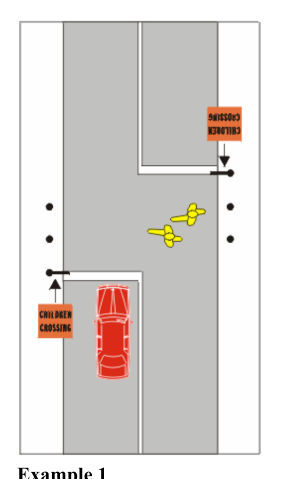
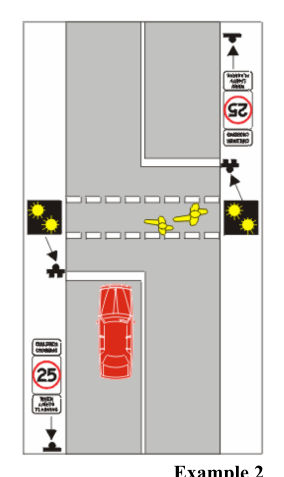
- (6)A children’s crossing is an area of a road—
- (a)at a place with stop lines marked on the road, and—
- (i)children crossing flags; or
- (ii)children’s crossing signs and twin yellow lights; and
- (b)indicated by—
- (i)2 red and white posts erected on each side of the road; or
- (ii)2 parallel continuous or broken lines on the road surface from 1 side of the road completely or partly across the road; and
- (c)extending across the road between the posts or lines.
Maximum penalty—20 penalty units.
Maximum penalty—20 penalty units.
Maximum penalty—20 penalty units.
Maximum penalty—20 penalty units.
Examples—
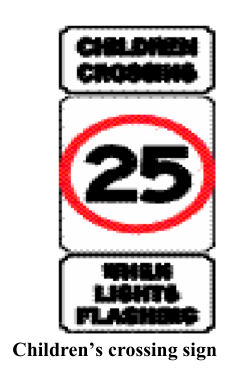
Children crossing flag · Children’s crossing sign · Hand-held stop signs
Example 2 · Example 1 · Driver stopped at stop line for pedestrians on a children’s crossing with children crossing flags · Driver stopped at stop line for pedestrians on a children’s crossing with children’s crossing signs and twin yellow lights · In each of these examples, the driver must stop at the stop line because there are pedestrians on the children’s crossing.
81Giving way at a pedestrian crossing#
- (1)A driver approaching a pedestrian crossing must drive at a speed at which the driver can, if necessary, stop safely before the crossing.
- (2)A driver must give way to any pedestrian, or any rider of a bicycle or a personal mobility device, on or entering a pedestrian crossing.
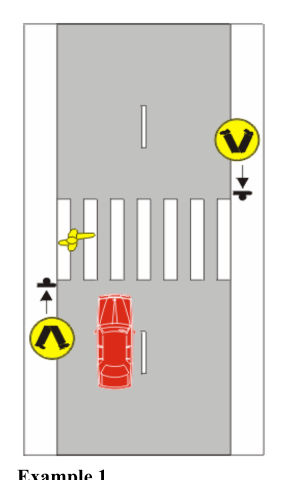
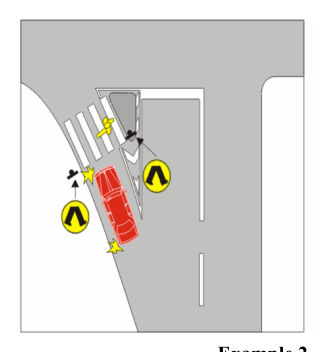
- (3)A pedestrian crossing is an area of a road—
- (a)at a place with white stripes on the road surface that—
Maximum penalty—20 penalty units.
Maximum penalty—20 penalty units. run lengthwise along the road; and
- (ii)are of approximately the same length; and
- (iii)are approximately parallel to each other; and
- (iv)are in a row that extends completely, or partly, across the road; and
- (b)with or without either or both of the following—
- (i)a pedestrian crossing sign;
- (ii)alternating flashing twin yellow lights.
In each of these examples, the driver must give way to the pedestrian on the crossing.
82Overtaking or passing a vehicle at a children's crossing or pedestrian crossing#
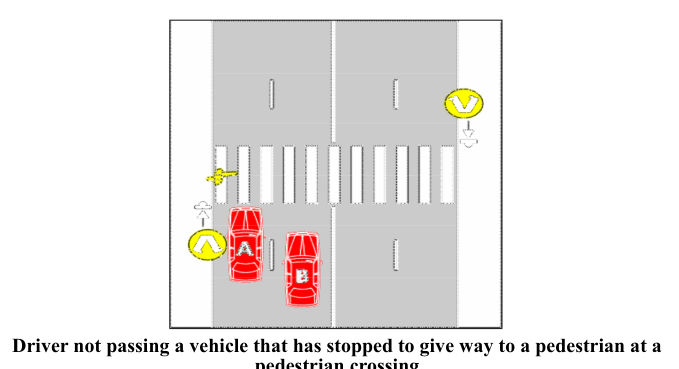
A driver approaching a children's crossing, or pedestrian crossing, must not overtake or pass a vehicle that is travelling in the same direction as the driver and is stopping, or has stopped, to give way to a pedestrian, or a rider of a bicycle or a personal mobility device, on or entering the crossing.
Maximum penalty—20 penalty units.
In the example, vehicle A has stopped to give way to a pedestrian on the crossing. Vehicle B must not overtake or pass vehicle A.
83Giving way to pedestrians in a shared zone#
A driver driving in a shared zone must give way to any pedestrian in the zone.
Maximum penalty—20 penalty units.