Part 13Lights and warning devices#
Division 1Lights on vehicles (except bicycles, personal mobility devices, animals and animal-drawn vehicles)#
214Division does not apply to riders of bicycles, personal mobility devices, animals or animal-drawn vehicles#
This division does not apply to the rider of a bicycle, a personal mobility device, an animal or animal-drawn vehicle.
215Using lights when driving at night or in hazardous weather conditions#
- (1)A driver must not drive at night, or in hazardous weather conditions causing reduced visibility unless—
- (a)the headlights, tail-lights and number plate light fitted to the driver's vehicle are operating effectively and are clearly visible; and
- (b)if the vehicle is fitted with clearance lights or side marker lights—those lights are operating effectively and are clearly visible.
- (2)However, this section does not apply to a driver if—
- (a)the driver's vehicle is stopped or parked at a place on a length of road, or in an area, to which a parking control sign applies; and
- (b)the driver is permitted to stop or park at that place under this regulation.
- (3)Also, a driver driving during the day in fog, or other hazardous weather conditions causing reduced visibility, may drive without the headlights of the driver's vehicle operating if the vehicle is fitted with front fog lights and those lights are operating effectively and are clearly visible.
Maximum penalty—20 penalty units.
- (4)In subsection (1), a reference to a kind of light fitted to a vehicle is a reference to a light of that kind required to be fitted under—
- (a)the heavy vehicle standards under the Heavy Vehicle National Law (Queensland); or
- (b)the Transport Operations (Road Use Management—Vehicle Standards and Safety) Regulation 2021.
216Towing a vehicle at night or in hazardous weather conditions#
- (1)A driver must not tow a vehicle at night, or in hazardous weather conditions causing reduced visibility, unless—
- (a)if the towed vehicle is being towed from the front of the vehicle—
- (i)the tail-lights of the vehicle are operating effectively and are clearly visible; or
- (ii)the vehicle has portable rear lights that are operating; or
- (b)if the towed vehicle is being towed from the rear of the vehicle—the vehicle has portable rear lights that are operating.
- (2)However, this section does not apply to the driver of a tow truck if—
- (a)the driver is towing a disabled vehicle carrying a placard load of dangerous goods to a place that is safely off the road; and
- (b)a vehicle carrying a warning to other traffic is following immediately behind the disabled vehicle.
- (3)In this section—
Maximum penalty—20 penalty units.
- dangerous goods
- means goods that are dangerous goods under the Transport Operations (Road Use Management—Dangerous Goods) Regulation 2018, section 32.
- placard load
- placard load has the meaning given by the Transport Operations (Road Use Management—Dangerous Goods) Regulation 2018.
- portable rear lights
- portable rear lights means—
- road
- road does not include a road-related area, but includes any shoulder of the road.
- (a) for a vehicle being towed from the front of the vehicle—a pair of lights attached to the rear of the vehicle that, when operating, show a red light that is clearly visible for at least 200m from the rear of the vehicle; or
- (b) for a vehicle being towed from the rear of the vehicle—a pair of lights attached to the front of the vehicle that, when operating, show a red light that is clearly visible for at least 200m from the front of the vehicle.
217Using fog lights#
- (1)The driver of a vehicle fitted with a front fog light or rear fog light must not operate the fog light unless the driver is driving in fog or other hazardous weather conditions causing reduced visibility.
- (2)In this section—
Maximum penalty—20 penalty units.
- front fog light
- front fog light means a light (other than a headlight) fitted to the front of a vehicle to improve illumination of the road in fog, snowfall, heavy rain or dust clouds.
- rear fog light
- rear fog light means a light (other than a brake light, a tail-light, a number plate light or a reversing light) fitted to the rear of a vehicle to make the vehicle more easily visible from the rear in fog, snowfall, heavy rain or dust clouds.
218Using headlights on high-beam#
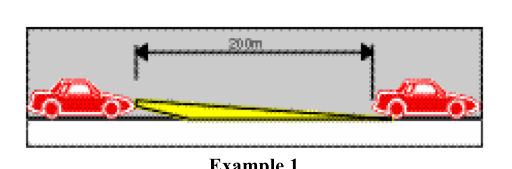
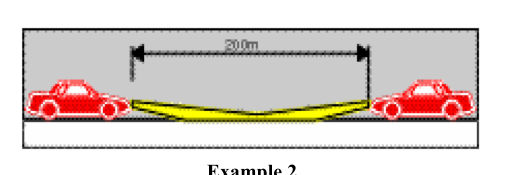
- (1)The driver of a vehicle must not use the vehicle’s headlights on high-beam, or allow the vehicle’s headlights to be used on high-beam, if the driver is driving—
- (2)However, if the driver is overtaking a vehicle, the driver may briefly switch the headlights from low-beam to high-beam immediately before the driver begins to overtake the vehicle.
- (a) less than 200m behind a vehicle travelling in the same direction as the driver; or
- (b) less than 200m from an oncoming vehicle.
Maximum penalty—20 penalty units.
219Lights not to be used to dazzle other road users#
A driver must not use, or allow to be used, any light fitted to or in the driver’s vehicle to dazzle, or in a way that is likely to dazzle, another road user.
Maximum penalty—20 penalty units.
220Using lights on vehicles that are stopped#
- (1)A driver must not stop on a road at night unless—
- (2)This section does not apply to a driver if the driver stops on a length of road, or in an area, with street lighting and the driver’s vehicle is visible for at least 200m in all directions from the vehicle.
- (3)In subsection (1), a reference to a kind of light fitted to a vehicle is a reference to a light of that kind required to be fitted under—
- (4)In this section—
- (a) if the driver’s vehicle is 2.2m wide, or wider—the clearance and side marker lights fitted to the vehicle are operating effectively and are clearly visible; or
- (b) in any other case—the parking lights fitted to the driver’s vehicle are operating effectively and are clearly visible.
Maximum penalty—20 penalty units.
- (a) the heavy vehicle standards under the Heavy Vehicle National Law (Queensland); or
- (b) the Transport Operations (Road Use Management—Vehicle Standards and Safety) Regulation 2021.
- road
- road does not include a road-related area, but includes any shoulder of the road.
221Using hazard warning lights#
The driver of a vehicle fitted with hazard warning lights must not use the hazard warning lights, or allow them to be used, unless—
- (a) the vehicle is stopped and is obstructing, or is likely to obstruct, the path of other vehicles or pedestrians; or
- (b) the vehicle is a slow-moving vehicle and is obstructing, or is likely to obstruct, the path of other vehicles or pedestrians; or
- (c) the vehicle is stopped in an emergency stopping lane; or
- (d) the driver stops the vehicle to sell a product (for example, ice creams) that may attract children onto the road; or
- (e) the driver is driving in hazardous weather conditions (for example, fog or smoke); or
- (f) the hazard warning lights are operating as part of an anti-theft device, or an alcohol ignition interlock, fitted to the vehicle.
Maximum penalty—20 penalty units.
222School bus not to be driven without warning lights and warning signs#
- (1)A person must not drive a school bus unless it is fitted with warning signs and warning lights under the Transport Operations (Road Use Management—Vehicle Standards and Safety) Regulation 2021, schedule 1, part 7, division 19.
- (2)Subsection (1) does not apply to a school bus that is a heavy vehicle.
- (3)A person does not commit an offence under subsection (1) if the person drives a school bus that is a relevant vehicle to which the Transport Operations (Road Use Management—Vehicle Standards and Safety) Regulation 2021, section 130 or 131 applies.
- (4)In this section—
Maximum penalty—20 penalty units.
- relevant vehicle
- relevant vehicle see the Transport Operations (Passenger Transport) Regulation 2018, schedule 9.
222AUse of warning lights—picking up or setting down children#
- (1)This section applies to the driver of a vehicle, whether or not a school bus—
- (a)fitted with warning lights under the Heavy Vehicle (Vehicle Standards) National Regulation, schedule 2, section 76; or
- (b)fitted with warning lights under the Transport Operations (Road Use Management—Vehicle Standards and Safety) Regulation 2021, schedule 1, section 111; or
- (c)fitted with warning lights in compliance with the repealed Transport Operations (Passenger Transport) Standard 2010, schedule 1, section 19 or 25 as in force from time to time before the commencement of the amendment regulation; or
- (d)that has warning lights consisting of flashing yellow lamps mounted in compliance with the Traffic Regulation 1962, schedule 1, section 18B(a) as it was in force immediately before 1 October 1999.
- (2)Subsection (3) applies if—
- (a)the vehicle is fitted with warning lights that operate automatically; and
- (b)the driver of the vehicle intends to stop to pick up or set down children.
- (3)The driver may use a switch that allows the driver, from the driver’s normal driving position, to turn on the warning lights before the vehicle stops for a period that is no longer than is reasonably necessary in the circumstances.
- (4)Subsection (5) applies if—
- (a)the vehicle is not fitted with warning lights that operate automatically; and
- (b)the vehicle is fitted with a switch that allows the driver, from the driver’s normal driving position, to turn on simultaneously all warning lights fitted to the vehicle; and
- (c)the driver of the vehicle intends to stop to pick up or set down children.
- (5)The driver must—
- (a)turn on the warning lights at least 5 seconds before the vehicle stops; and
- (b)keep the warning lights on for at least 5 seconds after the vehicle has started to move off after stopping.
- (6)The driver must ensure the warning lights are not operating, other than under subsection (3) or (5), or in compliance with a relevant law, while the vehicle is on a road, unless the driver has a reasonable excuse.
- (7)For a vehicle mentioned in subsection (1)(c), a reference in subsection (6) to a relevant law is taken to include a reference to the repealed Transport Operations (Passenger Transport) Standard 2010, schedule 1, section 24(3) as if the amendment regulation had not been made and that section were still in force.
- (8)In this section—
Maximum penalty—20 penalty units.
Example of a reasonable excuse—
The driver is testing the lights to ensure their satisfactory operation.
Maximum penalty—20 penalty units.
- amendment regulation
- means the Transport and Other Legislation Amendment Regulation 2026.
- relevant law
- means—
- (a)for a vehicle mentioned in subsection (1)(a)—the Heavy Vehicle (Vehicle Standards) National Regulation, schedule 2, section 77(3); or
- (b)for a vehicle mentioned in subsection (1)(b)—the Transport Operations (Road Use Management—Vehicle Standards and Safety) Regulation 2021, schedule 1, section 112(3).
Division 2Lights on animal-drawn vehicles#
223Using lights when riding an animal-drawn vehicle at night or in hazardous weather conditions#
A person must not ride an animal-drawn vehicle at night, or in hazardous weather conditions causing reduced visibility, unless the vehicle is fitted with, and displays—
- (a)a white light fitted at or towards the front of each side of the vehicle that is clearly visible for at least 200m from the front of the vehicle; and
- (b)a red light fitted at or towards the rear of each side of the vehicle that is clearly visible for at least 200m from the rear of the vehicle; and
- (c)a red reflector fitted at or towards the rear of each side of the vehicle that is—
- (i)not over 1.5m above ground level; and
- (ii)clearly visible for at least 50m from the rear of the vehicle when light is projected onto it by another vehicle’s headlight on low-beam.
Maximum penalty—20 penalty units.
Division 3Horns and radar detectors#
224Using horns and similar warning devices#
A driver must not use, or allow to be used, a horn, or similar warning device, fitted to or in the driver’s vehicle unless—
- (a)it is necessary to use the horn, or warning device, to warn other road users or animals of the approach or position of the vehicle; or
- (b)the horn, or warning device, is being used as part of an anti-theft device, or an alcohol ignition interlock, fitted to the vehicle.
Maximum penalty—20 penalty units.
225Using radar detectors and similar devices#
- (1)A person must not drive a vehicle if the vehicle, or a trailer being towed by the vehicle, has in or on it—
- (a)a device for preventing the effective use of a speed measuring device; or
- (b)a device for detecting the use of a speed measuring device.
- (2)A person who is travelling in or on a vehicle or trailer must not have in the person’s possession a device for preventing the effective use of a speed measuring device, or a device for detecting the use of a speed measuring device.
- (3)Subsections (1) and (2) apply whether or not the device is operating or in working order.
Maximum penalty—40 penalty units.
Maximum penalty—40 penalty units.
Division 4Portable warning triangles for heavy vehicles#
226Heavy vehicles to be equipped with portable warning triangles#
A person must not drive a vehicle with a GVM over 12t unless the vehicle is equipped with at least 3 portable warning triangles.
227Using portable warning triangles#
- (1)This section applies to a driver if the GVM of the driver's vehicle is over 12t.
- (2)If the driver stops on a road, or if some or all of any load being carried by the vehicle falls onto a road, at a place where the speed limit is 80km/h or more and the vehicle is not visible at any time for at least 300m in all directions from that place, the driver must use at least 3 portable warning triangles, placed in accordance with subsection (4), to warn other road users of the vehicle or load.
- (3)If the driver stops on a road, or if some or all of any load being carried by the vehicle falls onto a road, at a place where the speed limit is less than 80km/h and the vehicle is not visible at any time for at least 200m in all directions from that place, the driver must use at least 3 portable warning triangles, placed in accordance with subsection (5), to warn other road users of the vehicle or load.
- (4)For subsection (2), the driver must—
- (a)place 1 triangle at least 200m, but not over 250m, behind the vehicle or fallen load; and
- (b)if the vehicle or fallen load is on a one-way road or divided road, place 1 triangle between the triangle mentioned in paragraph (a) and the vehicle or fallen load; and
- (c)if the vehicle or fallen load is not on a one-way road or divided road, place 1 triangle at least 200m, but not over 250m, in front of the vehicle or fallen load; and
- (d)place 1 triangle at the side of the vehicle, or fallen load, in a position that gives sufficient warning to other road users of the position of the vehicle or fallen load.
- (5)For subsection (3), the driver must—
- (a)place 1 triangle at least 50m, but not over 150m, behind the vehicle or fallen load; and
- (b)if the vehicle or fallen load is on a one-way road or divided road, place 1 triangle between the triangle mentioned in paragraph (a) and the vehicle or fallen load; and
- (c)if the vehicle or fallen load is not on a one-way or divided road, place 1 triangle at least 50m, but not over 150m, in front of the vehicle or fallen load; and
- (d)place 1 triangle at the side of the vehicle, or fallen load, in a position that gives sufficient warning to other road users of the position of the vehicle or fallen load.
- (6)In this section—
- divided road
- means any length of a two-way road that has a median strip that is a structure.
- road
- does not include a road-related area, but includes any shoulder of a road.
Division 5Signs for oversize vehicles#
227ADo not overtake turning vehicle signs for long vehicles#
A person must not drive a vehicle displaying a do not overtake turning vehicle sign if the vehicle, together with any load or projection, is not 7.5m long, or longer.
227BWarning sign not to be displayed if not required by law#
A person must not drive a vehicle displaying an oversize warning sign unless—
- (a)the person is required under the Act or another Act to display the sign; or
- (b)the vehicle is temporarily in Queensland on a journey from another State and the sign must be displayed on the vehicle under the law of the other State.