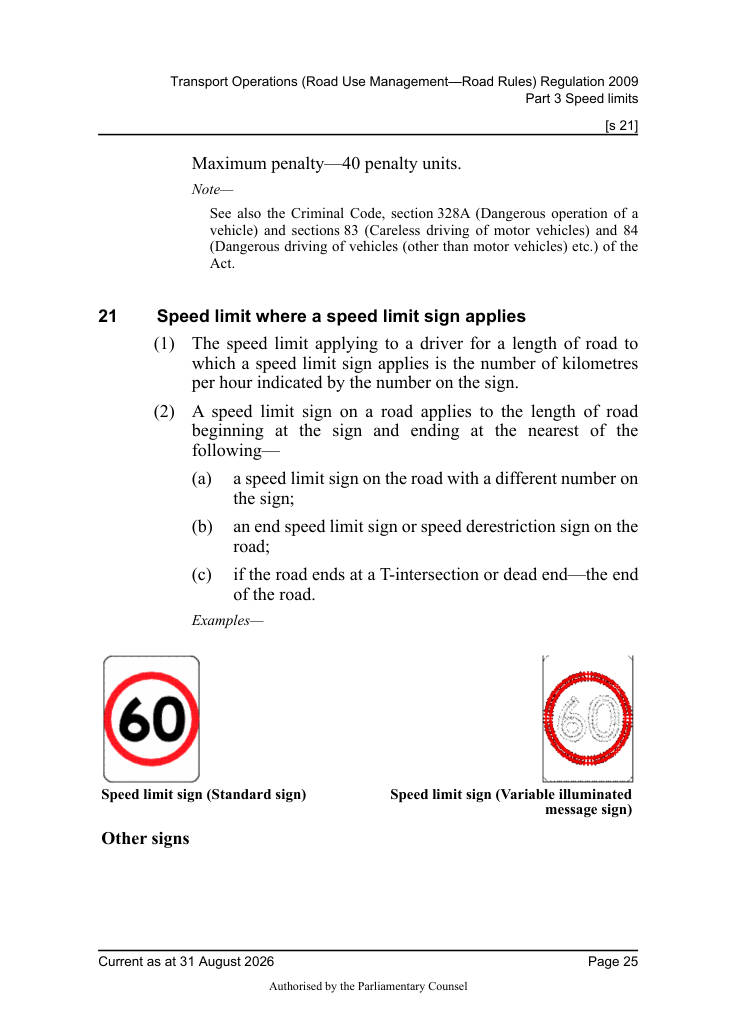
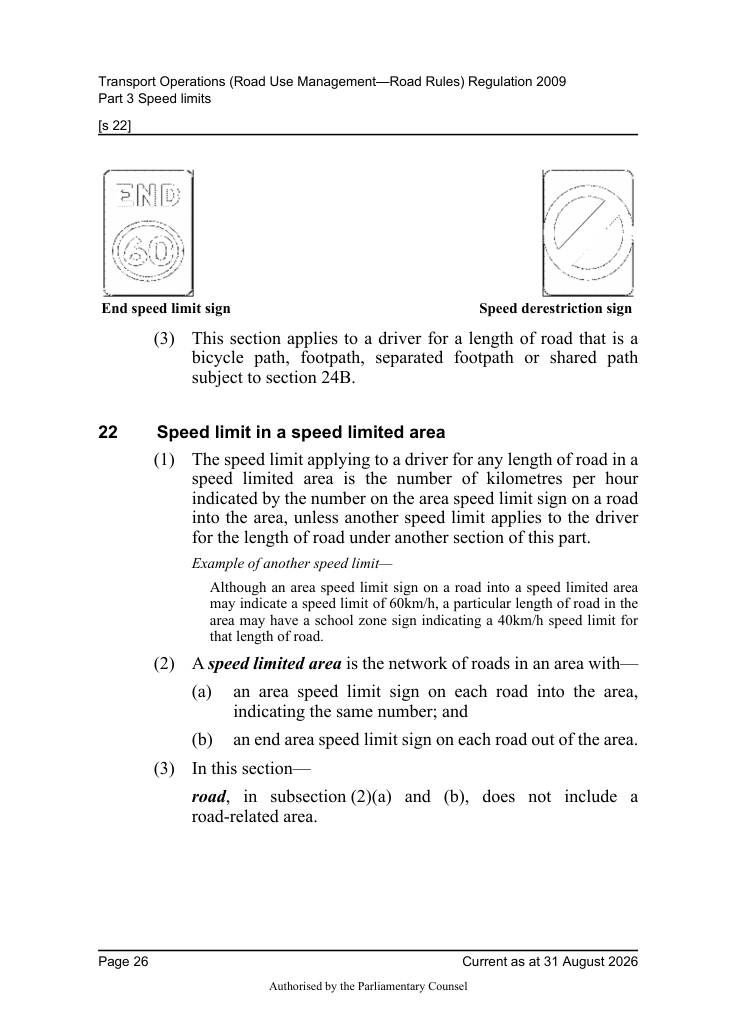
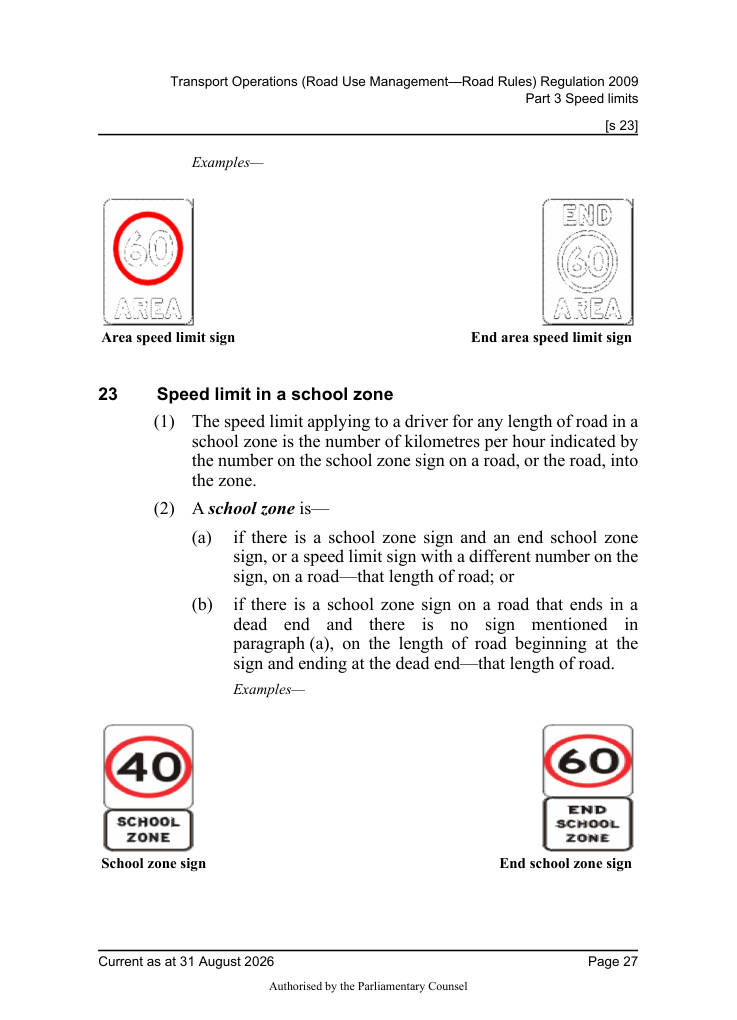
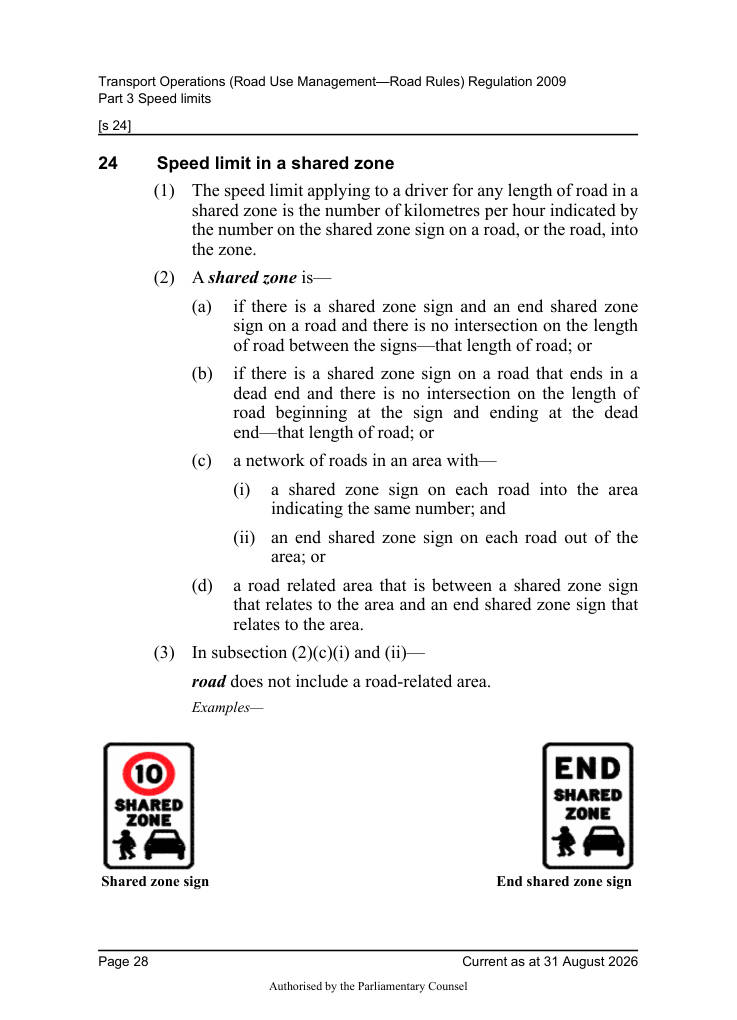
Part 3Speed limits#
20Obeying the speed limit#
A driver must not drive at a speed over the speed limit applying to the driver for the length of road where the driver is driving.
Maximum penalty—40 penalty units.
21Speed limit where a speed limit sign applies#
- (1)The speed limit applying to a driver for a length of road to which a speed limit sign applies is the number of kilometres per hour indicated by the number on the sign.
- (2)A speed limit sign on a road applies to the length of road beginning at the sign and ending at the nearest of the following—
- (a)a speed limit sign on the road with a different number on the sign;
- (b)an end speed limit sign or speed derestriction sign on the road;
- (c)if the road ends at a T-intersection or dead end—the end of the road.
- (3)This section applies to a driver for a length of road that is a bicycle path, footpath, separated footpath or shared path subject to section 24B.
22Speed limit in a speed limited area#
- (1)The speed limit applying to a driver for any length of road in a speed limited area is the number of kilometres per hour indicated by the number on the area speed limit sign on a road into the area, unless another speed limit applies to the driver for the length of road under another section of this part.
- (2)A speed limited area is the network of roads in an area with—
- (a)an area speed limit sign on each road into the area, indicating the same number; and
- (b)an end area speed limit sign on each road out of the area.
- (3)In this section—
- road
- in subsection (2)(a) and (b), does not include a road-related area.
23Speed limit in a school zone#
- (1)The speed limit applying to a driver for any length of road in a school zone is the number of kilometres per hour indicated by the number on the school zone sign on a road, or the road, into the zone.
- (2)A school zone is—
- (a)if there is a school zone sign and an end school zone sign, or a speed limit sign with a different number on the sign, on a road—that length of road; or
- (b)if there is a school zone sign on a road that ends in a dead end and there is no sign mentioned in paragraph (a), on the length of road beginning at the sign and ending at the dead end—that length of road.
24Speed limit in a shared zone#
- (1)The speed limit applying to a driver for any length of road in a shared zone is the number of kilometres per hour indicated by the number on the shared zone sign on a road, or the road, into the zone.
- (2)A shared zone is—
- (a)if there is a shared zone sign and an end shared zone sign on a road and there is no intersection on the length of road between the signs—that length of road; or
- (b)if there is a shared zone sign on a road that ends in a dead end and there is no intersection on the length of road beginning at the sign and ending at the dead end—that length of road; or
- (c)a network of roads in an area with—
- (i)a shared zone sign on each road into the area indicating the same number; and
- (ii)an end shared zone sign on each road out of the area; or
- (d)a road related area that is between a shared zone sign that relates to the area and an end shared zone sign that relates to the area.
- (3)In subsection (2)(c)(i) and (ii)—
- road
- does not include a road-related area.
24ASpeed limit for certain vehicles#
- (1)This section applies to a driver despite a higher speed limit that would otherwise apply to the driver under this part.
- (2)The speed limit applying to the following drivers for a length of road where the driver is driving is—
- (a)for a driver driving a tractor towing a sugar cane trailer—50km/h;
- (b)for a driver driving an oversize vehicle that is required to travel with a pilot or escort vehicle—80km/h;
- (c)for a driver driving a road train, other than a B-triple or an oversize vehicle mentioned in paragraph (b)—90km/h;
- (d)for a driver driving a bus with a GVM over 5t, a B-triple, or another vehicle with a GVM over 12t, other than an oversize vehicle mentioned in paragraph (b) or a road train mentioned in paragraph (c)—100km/h.
- (3)In this section—
- B-triple
- means a B-triple under the Heavy Vehicle National Law (Queensland).
- sugar cane trailer
- means a trailer—
- (a)
- with an ATM within the meaning of the Transport Operations (Road Use Management—Vehicle Standards and Safety) Regulation 2021 of not more than 20t; and
- (b)
- designed for carrying sugar cane.
- tractor
- does not include a motor vehicle built to tow a semitrailer.
24BSpeed limit on particular signed or marked paths#
- (1)This section applies in relation to a length of bicycle path, footpath, separated footpath or shared path to which a path speed limit sign or speed limit path marking applies.
- (2)The speed limit applying to a driver for the length of the path is the number of kilometres per hour indicated by the number on the path speed limit sign or speed limit path marking.
- (3)The path speed limit sign or speed limit path marking applies to the length of the path beginning at the sign or marking and ending at the nearest of the following—
- (a)a path speed limit sign or speed limit path marking on the path with a different number on the sign or marking;
- (b)an end path speed limit sign or end speed limit path marking on the path;
- (c)the place where the path meets, or is intersected by, a road or another path.
- (4)This section applies despite a higher speed limit that would otherwise apply to a driver for a length of bicycle path, footpath, separated footpath or shared path under another section of this part.
- (5)This section applies to a rider of a personal mobility device subject to section 24C.
- (6)In this section—
- end path speed limit sign
- means a path speed limit sign that includes the word ‘end’.
- end speed limit path marking
- means a speed limit path marking that includes the word ‘end’.
- path speed limit sign
- means a speed limit sign that—
- (a)
- applies to a bicycle path, footpath, separated footpath or shared path; but
- (b)
- does not apply to a road.
- road
- does not include a road-related area.
- speed limit path marking
- means a road marking on the surface of a bicycle path, footpath, separated footpath or shared path consisting of a number indicating the speed limit in kilometres per hour in a red circle.
24CSpeed limit for personal mobility devices#
- (1)The speed limit applying to the rider of a personal mobility device is—
- (a)for a rider riding across a road using a crossing on the road—12km/h; or
- (b)for a rider riding on a length of bicycle path, footpath, separated footpath or shared path to which a path speed limit sign or speed limit path marking applies—the lesser of the following—
- (i)the speed limit applying under section 24B;
- (ii)25km/h; or
- (c)for a rider riding on a length of footpath, other than a separated footpath, to which no path speed limit sign or speed limit path marking applies—12km/h; or
- (d)if paragraphs (a), (b) and (c) do not apply—25km/h.
- (2)Subsection (1)(a), (b), (c) or (d) applies to a rider of a personal mobility device despite a higher speed limit that would otherwise apply to the rider under this part.
- (3)Subsection (1)(d) does not apply to a rider of a personal mobility device if the rider is, under another provision of this regulation, required to ride the mobility device at a lower speed than 25km/h.
24DSpeed limit for electrically power-assisted cycles on crossings or particular paths#
- (1)The speed limit applying to the rider of an electrically power-assisted cycle is—
- (a)for a rider riding across a road using a crossing on the road—12km/h; or
- (b)for a rider riding on a length of bicycle path, footpath, separated footpath or shared path to which a path speed limit sign or speed limit path marking applies—the speed limit applying under section 24B; or
- (c)for a rider riding on a length of footpath, other than a separated footpath, to which no path speed limit sign or speed limit path marking applies—12km/h.
- (2)Subsection (1)(a), (b) or (c) applies to a rider of a electrically power-assisted cycle despite a higher speed limit that would otherwise apply to the rider under this part.
25Speed limit elsewhere#
- (1)If a speed limit sign does not apply to a length of road and the length of road is not in a speed limited area, school zone or shared zone, the speed limit applying to a driver for the length of road is the default speed limit.
- (2)The default speed limit applying to a driver for a length of road is—
- (a)for a road in a built-up area—50km/h; or
- (b)for a road that is not in a built-up area—100km/h.