Part 6Traffic lights, traffic arrows and twin red lights#
Division 1Obeying traffic lights and traffic arrows#
56Stopping on a red traffic light or arrow#
- (1)A driver approaching or at traffic lights showing a red traffic light—
- (a)must stop—
- (i)if there is a stop line at or near the traffic lights—as near as practicable to, but before reaching, the stop line; or if there is a stop here on red signal sign at or near the traffic lights, but no stop line—as near as practicable to, but before reaching, the sign; or
if there is no stop line or stop here on red signal sign at or near the traffic lights—as near as practicable to, but before reaching, the nearest or only traffic lights; and
must not proceed until—
the traffic lights change to green or flashing yellow or show no traffic light; or
a green or flashing yellow traffic arrow is showing, if the driver is turning in the direction indicated by the arrow.
Maximum penalty—20 penalty units.
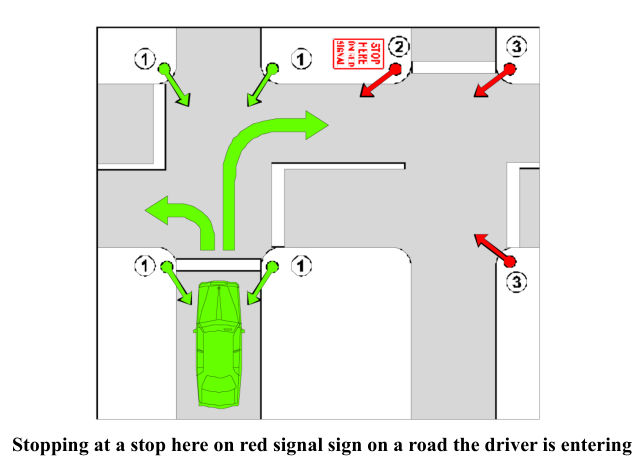
Stopping at a stop here on red signal sign on a road the driver is entering
However, if the traffic lights are at an intersection with a left turn on red after stopping sign and the driver is turning left at the intersection, the driver may turn left after stopping.
Subsection (2) applies to a driver—
approaching or at traffic arrows showing a red traffic arrow who is turning in the direction indicated by the arrow; or
approaching or at traffic arrows showing a red traffic arrow, in a marked lane with a traffic lane arrow applying to the lane indicating a single direction that is the same direction as the red traffic arrow.
The driver—
must stop—
if there is a stop line at or near the traffic arrows—as near as practicable to, but before reaching, the stop line; or
if there is a stop here on red arrow sign at or near the traffic arrows, but no stop line—as near as practicable to, but before reaching, the sign; or
if there is no stop line or stop here on red arrow sign at or near the traffic arrows—as near as practicable to, but before reaching, the nearest or only traffic arrows; and
must not proceed until—
the traffic arrows change to green or flashing yellow; or
the traffic lights show a green or flashing yellow traffic light and there is no red or yellow traffic arrow showing.
Maximum penalty—20 penalty units.
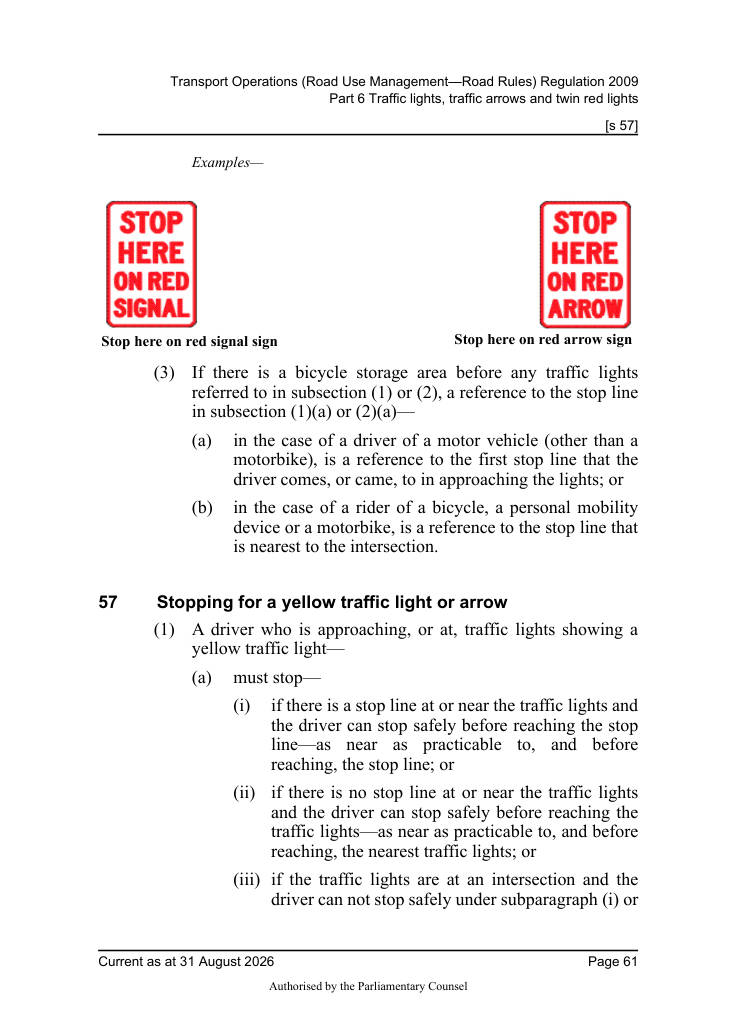
Stop here on red signal sign
Stop here on red arrow sign
If there is a bicycle storage area before any traffic lights referred to in subsection (1) or (2), a reference to the stop line in subsection (1)(a) or (2)(a)—
in the case of a driver of a motor vehicle (other than a motorbike), is a reference to the first stop line that the driver comes, or came, to in approaching the lights; or
in the case of a rider of a bicycle, a personal mobility device or a motorbike, is a reference to the stop line that is nearest to the intersection.
57Stopping for a yellow traffic light or arrow#
A driver who is approaching, or at, traffic lights showing a yellow traffic light—
must stop—
if there is a stop line at or near the traffic lights and the driver can stop safely before reaching the stop line—as near as practicable to, and before reaching, the stop line; or
if there is no stop line at or near the traffic lights and the driver can stop safely before reaching the traffic lights—as near as practicable to, and before reaching, the nearest traffic lights; or
if the traffic lights are at an intersection and the driver can not stop safely under subparagraph (i) or (ii), but can stop safely before entering the intersection—before entering the intersection; and
must not proceed until the traffic lights—
change to green or flashing yellow; or
show no traffic light.
Maximum penalty—20 penalty units.
A driver who is approaching, or at, traffic arrows showing a yellow traffic arrow, and turning in the direction indicated by the arrow—
must stop—
if there is a stop line at or near the traffic arrows and the driver can stop safely before reaching the stop line—as near as practicable to, and before reaching, the stop line; or
if there is no stop line at or near the traffic arrows and the driver can stop safely before reaching the traffic arrows—as near as practicable to, and before reaching, the nearest traffic arrows; or
if the traffic arrows are at an intersection and the driver can not stop safely under subparagraph (i) or (ii), but can stop safely before entering the intersection—before entering the intersection; and
must not proceed until the traffic arrows—
change to green or flashing yellow; or
show no traffic arrow.
Maximum penalty—20 penalty units.
If the traffic lights or arrows are at an intersection and the driver can not stop safely under subsection (1) or (2) and enters the intersection, the driver must leave the intersection as soon as the driver can do so safely.
Maximum penalty—20 penalty units.
If there is a bicycle storage area before any traffic lights referred to in subsection (1) or (2), a reference to the stop line in subsection (1)(a) or (2)(a)—
- (a)in the case of a driver of a motor vehicle (other than a motorbike), is a reference to the first stop line that the driver comes, or came, to in approaching the lights; or
- (b)in the case of a rider of a bicycle, a personal mobility device or a motorbike, is a reference to the stop line that is nearest to the intersection.
58Exceptions to stopping for a red or yellow traffic light#
- (1)A driver approaching or at traffic lights showing a red or yellow traffic light does not have to stop if a green traffic arrow is also showing and the driver is turning in the direction indicated by the arrow.
- (2)A driver turning at an intersection with traffic lights who approaches, or is at, a red traffic light on the road that the driver is entering does not have to stop for the red traffic light if there is no stop line or stop here on red signal sign at or near the traffic light.
59Proceeding through a red traffic light#
- (1)If traffic lights at an intersection, bicycle crossing or marked foot crossing are showing a red traffic light, a driver facing the red traffic light must not enter the intersection, bicycle crossing or marked foot crossing.
- (2)However, if the traffic lights are at an intersection with a left turn on red after stopping sign and the driver is turning left at the intersection, the driver may turn left before the traffic lights change to green or flashing yellow.
Subsection (1) does not apply to a driver if section 58(1) applies to the driver.
60Proceeding through a red traffic arrow#
If traffic arrows at an intersection or marked foot crossing are showing a red traffic arrow, and a driver is turning in the direction indicated by the arrow, the driver must not enter the intersection or marked foot crossing.
60AProceeding through a bicycle storage area before a red traffic light or arrow#
- (1)If there is a bicycle storage area before traffic lights that are showing a red traffic light, a driver of a motor vehicle (other than the rider of a motorbike) must not allow any part of the vehicle to enter the bicycle storage area.
- (2)If there is a bicycle storage area before traffic arrows that are showing a red traffic arrow, and a driver of a motor vehicle (other than the rider of a motorbike) is turning in the direction indicated by the arrow, the driver must not allow any part of the vehicle to enter the bicycle storage area.
61Proceeding when traffic lights or arrows at an intersection change to red or yellow#
This section applies to a driver—
- (a)at an intersection with traffic lights showing a green traffic light who has stopped after the stop line, stop here on red signal sign, or nearest or only traffic lights, at the intersection and is not making a hook turn at the intersection; or
- (b)at an intersection with traffic arrows showing a green traffic arrow who is turning in the direction indicated by the arrow and has stopped after the stop line, stop here on red arrow sign, or nearest or only traffic arrows, at the intersection.
- (2)If the traffic lights or arrows change to red or yellow while the driver is stopped and the driver has not entered the intersection, the driver must not enter the intersection.
- (3)However, if the traffic lights are at an intersection with a left turn on red after stopping sign and the driver is turning left at the intersection, the driver may turn left after stopping.
- (4)Also, subsection (2) does not apply to a driver if section 58(1) applies to the driver.
- (5)If the traffic lights or arrows change to red or yellow while the driver is stopped and the driver has entered the intersection, the driver must leave the intersection as soon as the driver can do so safely.
Division 2Giving way at traffic lights and traffic arrows#
62Giving way when turning at intersection with traffic lights#
A driver turning at an intersection with traffic lights must give way to—
- (a)any pedestrian, or any rider of a bicycle or a personal mobility device, at or near the intersection who is crossing the road the driver is entering; and
- (b)if the driver is turning left at a left turn on red after stopping sign at the intersection—
- (i)any vehicle approaching from the right, turning right at the intersection into the road the driver is entering, or making a U-turn at the intersection; and
- (ii)any pedestrian, or any rider of a bicycle or a personal mobility device, at or near the intersection who is on the road the driver is leaving; and
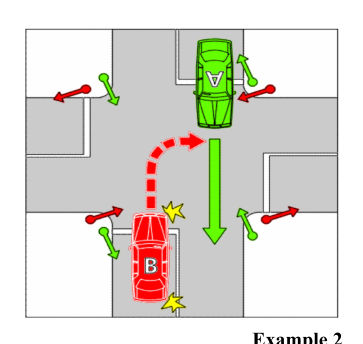
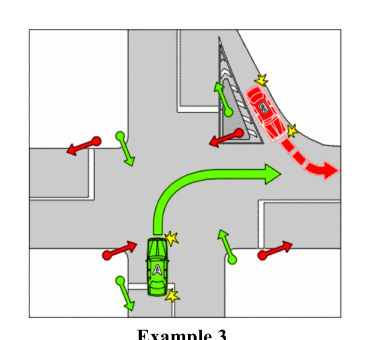
- (c)if the driver is turning right—any oncoming vehicle that is going straight ahead or turning left at the intersection (except a vehicle turning left using a slip lane).
However, a driver who is turning at an intersection with traffic arrows showing a green traffic arrow need not give way to an oncoming vehicle if the driver is turning in the direction indicated by the green traffic arrow.
Examples—
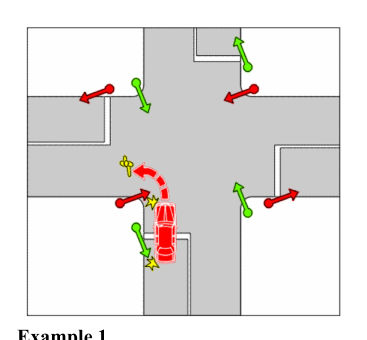
Giving way to a pedestrian crossing the road the driver is entering
Driver turning right giving way to an oncoming vehicle going straight ahead
Driver turning right does not have to give way to an oncoming vehicle that is turning left into the road the driver is entering using a slip lane
In example 1, the vehicle must give way to the pedestrian. In examples 2 and 3, vehicle B must give way to vehicle A.
63Giving way at an intersection with traffic lights not operating or only partly operating#
- (1)This section applies to a driver at an intersection if—
- (a)traffic lights at the intersection are not operating; or
- (b)the traffic lights are showing only a flashing yellow traffic light.
- (2)If there is a traffic light-stop sign at the intersection, the driver must comply with section 67 as if the sign were a stop sign at an intersection without traffic lights.
- (3)If there is no traffic light-stop sign at the intersection, the driver must give way to vehicles and pedestrians at or near the intersection in accordance with section 72 or 73 as if the intersection were an intersection without traffic lights or a stop sign, stop line, give way sign or give way line.
- (4)Subsection (3) does not apply if the intersection is a roundabout.
- (5)If the intersection is a roundabout, the driver must comply with section 114.
Maximum penalty—20 penalty units.
Maximum penalty—20 penalty units.
Example—
Traffic light-stop sign
64Giving way at a flashing yellow traffic arrow at an intersection#
A driver turning in the direction indicated by a flashing yellow traffic arrow at an intersection with traffic lights must give way to—
- (a)any vehicle travelling on the road the driver is entering; and
- (b)any pedestrian, or any rider of a bicycle or a personal mobility device, at or near the intersection who is crossing the road the driver is entering; and
- (c)if the driver is turning right—any oncoming vehicle that is going straight ahead or turning left at the intersection (except a vehicle turning left using a slip lane).
Maximum penalty—20 penalty units.
65Giving way at a marked foot crossing (except at an intersection) with a flashing yellow traffic light#
- (1)This section applies to a driver approaching or at a marked foot crossing (except at or near an intersection) with a flashing yellow traffic light at the crossing.
- (2)The driver must—
- (a)give way to any pedestrian, or any rider of a bicycle or a personal mobility device, on or entering the crossing; and
- (b)not obstruct any pedestrian, or any rider of a bicycle or a personal mobility device, on the crossing; and
- (c)not overtake or pass a vehicle that is travelling in the same direction as the driver and is stopping, or has stopped, to give way at the crossing.
- (3)If there is no pedestrian or rider of a bicycle or a personal mobility device on or entering the crossing, and no other vehicle travelling in the same direction as the driver that is stopping, or has stopped, to give way at the crossing, the driver may proceed through the crossing.
Maximum penalty—20 penalty units.
Division 3Twin red lights (except at level crossings)#
66Stopping for twin red lights (except at level crossings)#
- (1)A driver approaching or at twin red lights on a road (except at a level crossing) must stop in accordance with subsections (2) and (3).
- (2)If there is a stop line at or near the lights and the driver can stop safely before reaching the stop line, the driver must stop as near as practicable to, but before reaching, the stop line.
- (3)If there is no stop line at or near the lights and the driver can stop safely before reaching the lights, the driver must stop as near as practicable to, but before reaching, the lights.
- (4)If the driver stops for the lights, the driver must not proceed until the lights are not showing.
Maximum penalty—20 penalty units.
Maximum penalty—20 penalty units.