Part 14Rules for pedestrians#
Division 1General#
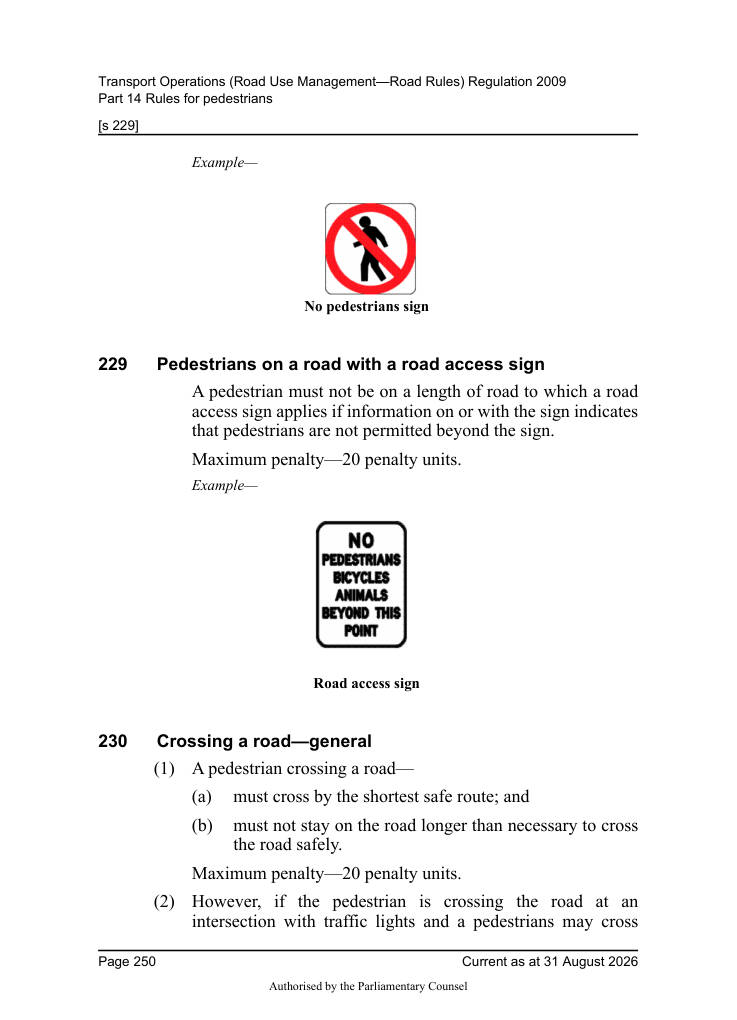
228No pedestrian signs#
A pedestrian must not travel past a no pedestrians sign.
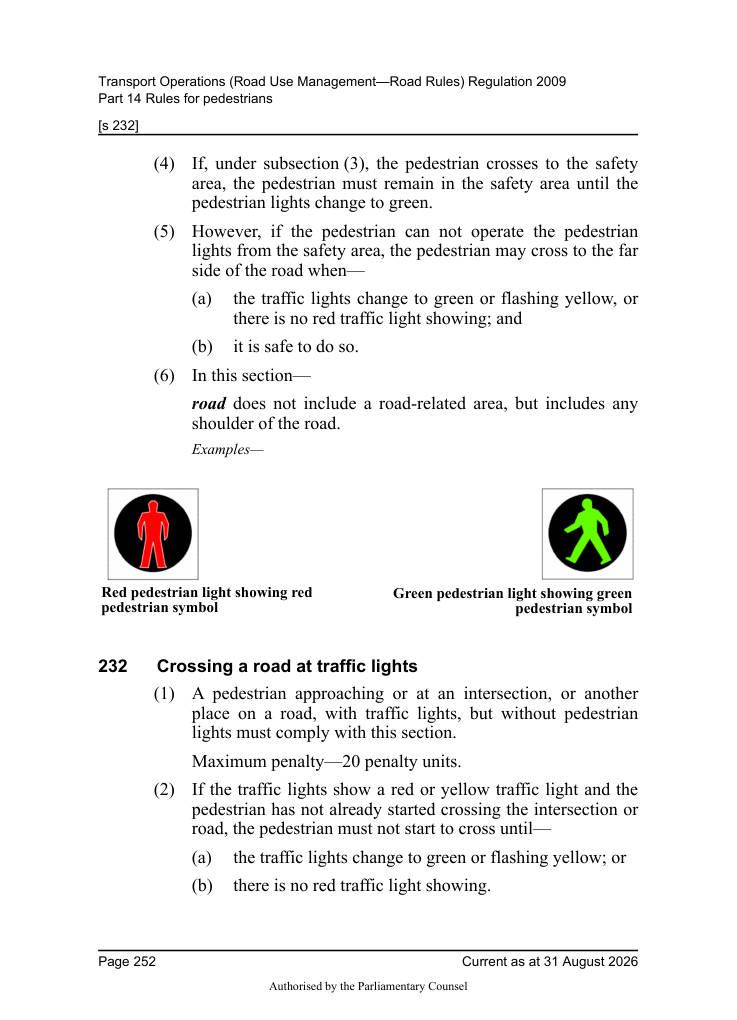
229Pedestrians on a road with a road access sign#
A pedestrian must not be on a length of road to which a road access sign applies if information on or with the sign indicates that pedestrians are not permitted beyond the sign.
230Crossing a road—general#
- (1)A pedestrian crossing a road—
- (a)must cross by the shortest safe route; and
- (b)must not stay on the road longer than necessary to cross the road safely.
- (2)However, if the pedestrian is crossing the road at an intersection with traffic lights and a pedestrians may cross
231Crossing a road at pedestrian lights#
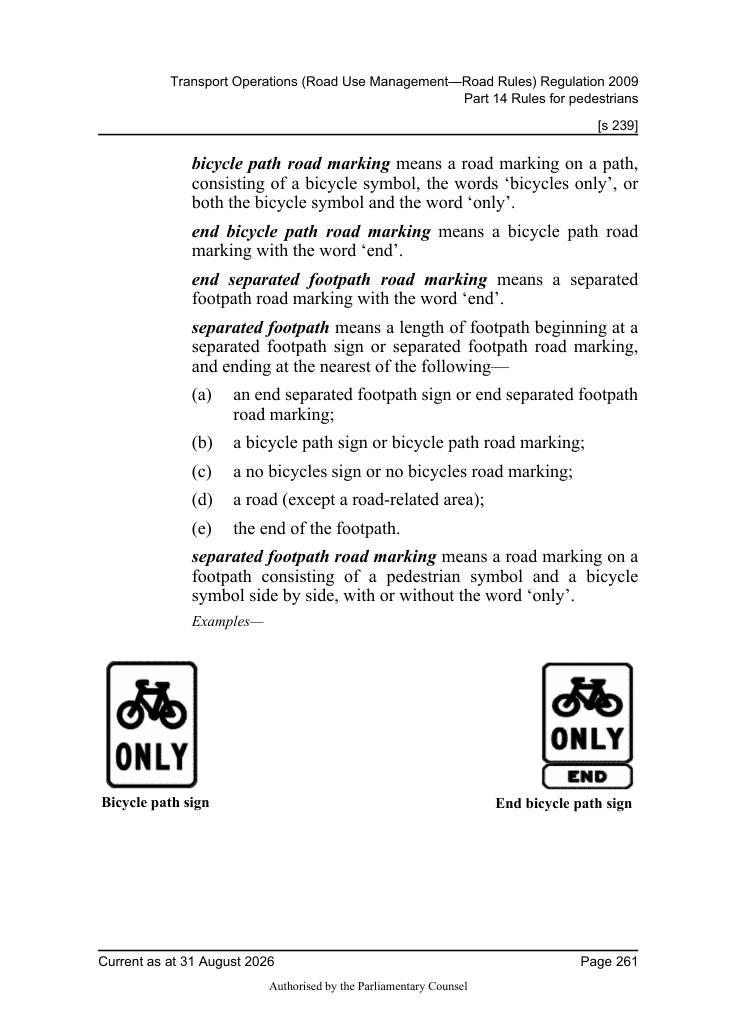
- (1)A pedestrian approaching or at an intersection, or another place on a road, with pedestrian lights and traffic lights must comply with this section.
- (2)If the pedestrian lights show a red pedestrian light and the pedestrian has not already started crossing the intersection or road, the pedestrian must not start to cross until the pedestrian lights change to green.
- (3)If, while the pedestrian is crossing the road, the pedestrian lights change to flashing red or red, the pedestrian must not stay on the road for longer than necessary to cross safely to the nearer (in the direction of travel of the pedestrian) of the following— (a) a dividing strip, safety zone, or traffic island, forming part of the area set aside or used by pedestrians to cross the road at the intersection or place (the safety area); (b) the nearest side of the road.
- (4)If, under subsection (3), the pedestrian crosses to the safety area, the pedestrian must remain in the safety area until the pedestrian lights change to green.
- (5)However, if the pedestrian can not operate the pedestrian lights from the safety area, the pedestrian may cross to the far side of the road when— (a) the traffic lights change to green or flashing yellow, or there is no red traffic light showing; and (b) it is safe to do so.
- (6)In this section— road does not include a road-related area, but includes any shoulder of the road.
232Crossing a road at traffic lights#
- (1)A pedestrian approaching or at an intersection, or another place on a road, with traffic lights, but without pedestrian lights must comply with this section.
- (2)If the traffic lights show a red or yellow traffic light and the pedestrian has not already started crossing the intersection or road, the pedestrian must not start to cross until— (a) the traffic lights change to green or flashing yellow; or (b) there is no red traffic light showing.
- (3)If, while the pedestrian is crossing the road, the traffic lights change to yellow or red, the pedestrian must not stay on the road for longer than necessary to cross safely to the nearer (in the direction of travel of the pedestrian) of the following— (a) a dividing strip, safety zone, or traffic island, forming part of the area set aside or used by pedestrians to cross the road at the intersection or place (a safety area); (b) the far side of the road.
- (3A)Despite subsection (3), the pedestrian may instead return to the side of the road, or a safety area, that the pedestrian has just left, but only if— (a) at the time the lights change, that side or safety area is closer to the pedestrian than the side or safety area the pedestrian was approaching at the time; and (b) the pedestrian does not stay on the road for longer than is necessary to return to that side or safety area.
- (4)If, under subsection (3) or (3A), the pedestrian crosses, or returns, to a safety area, the pedestrian must remain in the safety area until— (a) the traffic lights change to green or flashing yellow; or (b) there is no red traffic light showing.
- (5)In this section— road does not include a road-related area, but includes any shoulder of the road.
233Crossing a road to or from a tram#
- (1)A pedestrian must not cross a road to get on a tram at a tram stop until the tram has stopped at the tram stop.
- (2)A pedestrian crossing a road after getting off a tram— (a) must cross to the nearest footpath by the shortest safe route or, if there is no footpath, cross the road by the shortest safe route; and (b) must not stay on the road for longer than necessary to cross the road safely.
- (3)This section does not apply to a pedestrian— (a) on a safety zone; or (b) crossing a road to or from a safety zone.
- (4)Subsection (2) does not apply to— (a) a pedestrian in a shared zone; or (b) an employee of a public transport operator who is in uniform and engaged in carrying out the employee’s duties.
- (5)In this section— road does not include a road-related area, but includes any shoulder of the road. tram includes a bus travelling along tram tracks.
234Crossing a road on or near a crossing for pedestrians#
- (1)A pedestrian must not cross a road, or part of a road, within 20m of a crossing on the road, except at the crossing or another crossing, unless the pedestrian is— (a) crossing, or helping another pedestrian to cross, an area of the road between tram tracks and the far left side of the road to get on, or after getting off, a tram or bus; or (b) crossing to or from a safety zone; or (c) crossing at an intersection with traffic lights and a pedestrians may cross diagonally sign; or (d) crossing in a shared zone; or (e) crossing a road, or a part of a road, from which vehicles are excluded, either permanently or temporarily.
A pedestrian must not stay on a crossing on a road for longer than necessary to cross the road safely.
Subsection (2) does not apply to a person who is a crossing supervisor under the Act.
In this section—
- crossing
- crossing means a children’s crossing, marked foot crossing or pedestrian crossing.
235Crossing a level crossing#
A pedestrian must not cross a railway line, or tram tracks, at a level crossing unless—
- (a) there is a pedestrian facility at the crossing and the pedestrian uses the facility; or
- (b) there is no pedestrian facility at, or within 20m of, the crossing.
A pedestrian must not cross a railway line, or tram tracks, at a level crossing if—
- (a) warning lights (for example, twin red lights or rotating red lights) are flashing or warning bells are ringing; or
- (b) a gate, boom or barrier at the crossing is closed or is opening or closing; or
- (c) a train or tram is on or entering the crossing; or
- (d) a train or tram approaching the crossing can be seen from the crossing or is sounding a warning, and there would be a danger of the pedestrian being struck by the train or tram if the pedestrian entered the crossing; or
- (e) the crossing, or a road beyond the crossing, is blocked.
If any of the following events occurs after a pedestrian has started to cross a railway line, or tram tracks, at a level crossing, the pedestrian must finish crossing the line or tracks without delay—
- (a) warning lights start flashing, or warning bells start ringing;
- (b) a gate, boom or barrier starts to close;
- (c) a train or tram approaches the crossing.
In this section—
- pedestrian facility
- pedestrian facility means a footpath, bridge or other structure designed for the use of pedestrians.
235ACrossing a pedestrian level crossing that has a red pedestrian light#
A pedestrian level crossing is an area where a footpath or shared path crosses a railway or tram tracks at substantially the same level.
If a pedestrian approaches a pedestrian level crossing that has a red pedestrian light, the pedestrian must not start to cross the crossing while the light is red.
If a red pedestrian light at a pedestrian level crossing appears after a pedestrian has started to cross the crossing, the pedestrian must finish crossing the crossing without delay.
236Pedestrians not to cause a traffic hazard or obstruction#
A pedestrian must not cause a traffic hazard by moving into the path of a driver.
A pedestrian must not unreasonably obstruct the path of any driver or another pedestrian.
For subsection (2), a pedestrian does not unreasonably obstruct the path of another pedestrian only by travelling more slowly than other pedestrians.
A pedestrian must not stand on, or move onto, a road—
- (a) to solicit contributions, employment or business from an occupant of a vehicle; or
- (b) to hitchhike; or
- (c) to display an advertisement; or
- (d) to sell things or offer things for sale; or
- (e) to wash or clean, or offer to wash or clean, a vehicle’s windscreen.
A driver, or a passenger, in or on a vehicle must not buy, or offer to buy, an article or service from a person standing on the road.
Subsections (4)(a), (c) and (d) and (5) do not apply to a pedestrian who is engaged in roadside vending under a permit or other authority given to the person under a local law.
In this section—
- road
- road includes a shoulder of a road, a median strip, a painted island or a traffic island, but does not include another road-related area.
237Getting on or into a moving vehicle#
A person must not get on, or into, a moving vehicle unless—
- (a) the person is—
- (i) engaged in the door-to-door delivery or collection of goods, or in the collection of waste or garbage; and
- (ii) required to get in or out of the vehicle, or on or off the vehicle, at frequent intervals; and
- (b) the vehicle is not travelling at a speed over 5km/h.
This section does not apply to a person who is getting on or off a bicycle, a personal mobility device or an animal.
238Pedestrians travelling along a road (except if using a wheeled recreational device or wheeled toy)#
- (1)A pedestrian must not travel along a road if there is a footpath or nature strip adjacent to the road, unless it is impracticable to travel on the footpath or nature strip.
- (2)A pedestrian travelling along a road—
- (a)must keep as far to the left or right side of the road as is practicable; and
- (ab)must, when moving forward, face approaching traffic that is moving in the direction opposite to which the pedestrian is travelling, unless it is impracticable to do so; and
- (b)must not travel on the road alongside more than 1 other pedestrian or vehicle travelling on the road in the same direction as the pedestrian, unless the pedestrian is overtaking other pedestrians.
- (3)In this section—
- pedestrian
- pedestrian does not include a person travelling in or on a wheeled recreational device or a wheeled toy.
- road
- road—
- (a)includes any shoulder of the road; but
- (b)does not include a road-related area or a road in a shared zone.
239Pedestrians on a bicycle path or separated footpath#
- (1)A pedestrian must not be on a bicycle path, or a part of a separated footpath designated for the use of bicycles, unless the pedestrian—
- (a)is crossing the bicycle path or separated footpath by the shortest safe route; and
- (b)does not stay on the bicycle path or separated footpath for longer than necessary to cross the bicycle path or separated footpath safely.
- (2)However, a pedestrian may be on a bicycle path, or a part of a separated footpath designated for the use of bicycles, if—
- (a)the pedestrian is—
- (i)in or pushing a wheelchair; or
- (ii)on rollerblades, rollerskates or a similar wheeled recreational device; or
- (iii)operating a motorised mobility device; and
- (b)there is no traffic control device, or information on or with a traffic control device, applying to the bicycle path or separated footpath indicating that the pedestrian is not permitted to be on the bicycle path or the part of the separated footpath designated for the use of bicycles.
- (3)A pedestrian who is crossing a bicycle path, or a part of a separated footpath designated for the use of bicycles, must keep out of the path of any bicycle or personal mobility device, or any pedestrian who is permitted under subsection (2) to be on the bicycle path, or the part of the separated footpath designated for the use of bicycles.
- (4)In this regulation—
- bicycle path
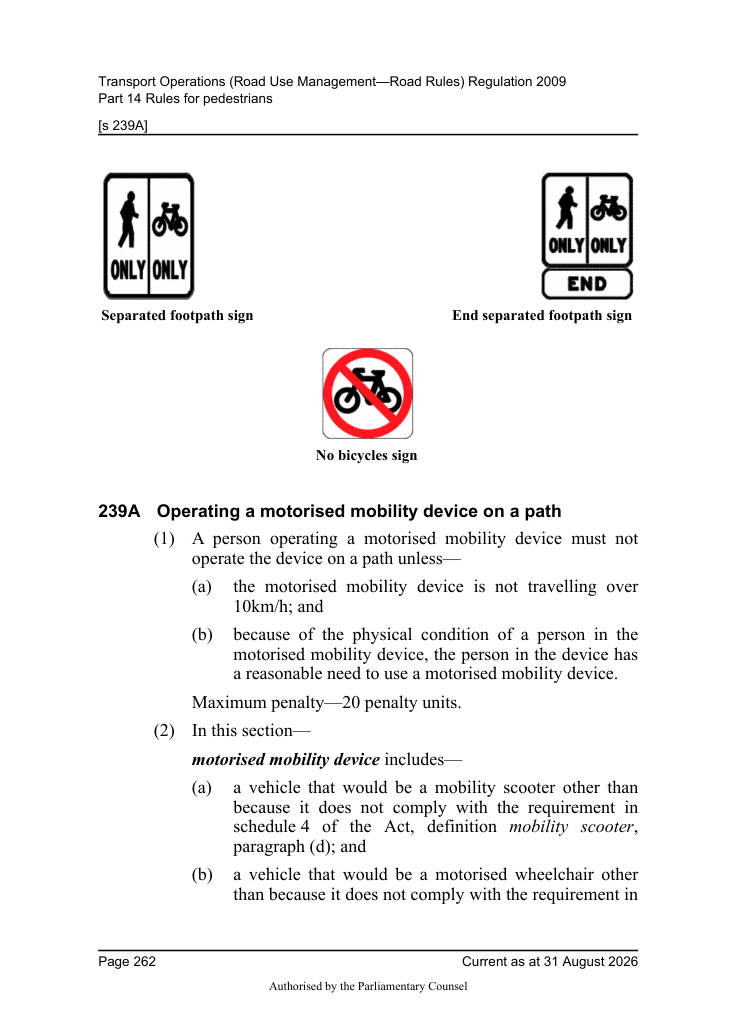
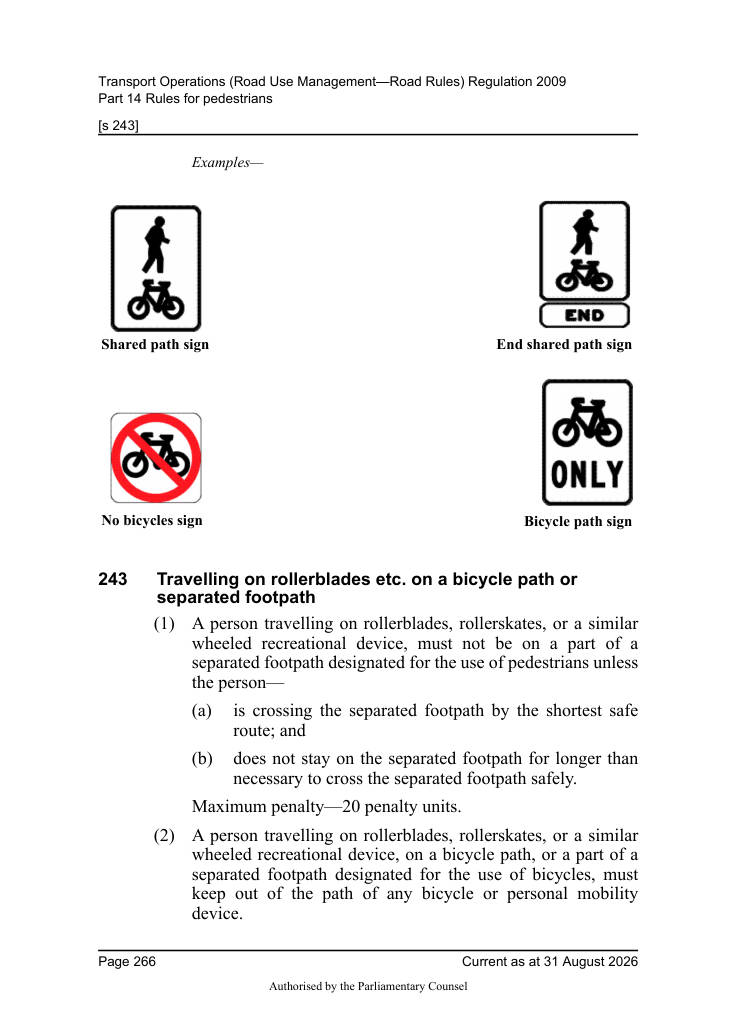
- bicycle path means a length of path beginning at a bicycle path sign or bicycle path road marking, and ending at the nearest of the following—
- (a)an end bicycle path sign or end bicycle path road marking;
- (b)a separated footpath sign or separated footpath road marking;
- (c)a road (except a road-related area);
- (d)the end of the path.
- bicycle path road marking
- bicycle path road marking means a road marking on a path, consisting of a bicycle symbol, the words 'bicycles only', or both the bicycle symbol and the word 'only'.
- end bicycle path road marking
- end bicycle path road marking means a bicycle path road marking with the word 'end'.
- end separated footpath road marking
- end separated footpath road marking means a separated footpath road marking with the word 'end'.
- separated footpath
- separated footpath means a length of footpath beginning at a separated footpath sign or separated footpath road marking, and ending at the nearest of the following—
- (a)an end separated footpath sign or end separated footpath road marking;
- (b)a bicycle path sign or bicycle path road marking;
- (c)a no bicycles sign or no bicycles road marking;
- (d)a road (except a road-related area);
- (e)the end of the footpath.
- separated footpath road marking
- separated footpath road marking means a road marking on a footpath consisting of a pedestrian symbol and a bicycle symbol side by side, with or without the word 'only'.
239AOperating a motorised mobility device on a path#
- (1)A person operating a motorised mobility device must not operate the device on a path unless—
- (a)the motorised mobility device is not travelling over 10km/h; and
- (b)because of the physical condition of a person in the motorised mobility device, the person in the device has a reasonable need to use a motorised mobility device.
- (2)In this section—
- motorised mobility device
- motorised mobility device includes—
- (a)a vehicle that would be a mobility scooter other than because it does not comply with the requirement in schedule 4 of the Act, definition mobility scooter, paragraph (d); and
- (b)a vehicle that would be a motorised wheelchair other than because it does not comply with the requirement in schedule 4 of the Act, definition motorised wheelchair, paragraph (a)(iii).
path means a bicycle path, footpath or shared path.
Division 2#
Rules for persons travelling in or on wheeled recreational devices and wheeled toys#
240Wheeled recreational devices and toys not to be used on certain roads#
- (1)A person must not travel in or on a wheeled recreational device or wheeled toy on—
- (a)a road with a dividing line or median strip; or
- (b)a road on which the speed limit is more than 50km/h; or
- (c)a one-way road with more than 1 marked lane; or
- (d)a road at night.
- (2)Subsection (1) does not apply to a person who is crossing a road in or on a wheeled recreational device or wheeled toy, if the person—
- (a)crosses the road by the shortest safe route; and
- (b)does not stay on the road longer than necessary to cross the road safely.
- (3)In this section—
Maximum penalty—20 penalty units.
road does not include a road-related area, but includes any shoulder of the road.
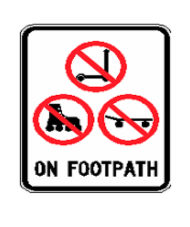
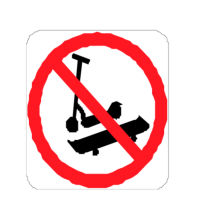
240ANo wheeled recreational devices or toys sign#
A person on a road who is travelling in or on a wheeled recreational device or wheeled toy must not travel past a no wheeled recreational devices or toys sign.
Maximum penalty—20 penalty units.
241Travelling in or on a wheeled recreational device or toy on a road#
- (1)A person travelling in or on a wheeled recreational device or wheeled toy on a road—
- (a)must keep as far to the left side of the road as is practicable; and
- (b)must not travel alongside more than 1 other pedestrian or vehicle travelling on the road in the same direction as the person, unless the person is overtaking other pedestrians.
- (2)In this section—
Maximum penalty—20 penalty units.
road does not include a road-related area, but, in subsection (1)(b), includes any shoulder of the road.
242Travelling in or on a wheeled recreational device or toy on a footpath or shared path#
- (1)Subject to subsection (1A), a person travelling in or on a wheeled recreational device or wheeled toy on a footpath or shared path must—
- (a)keep to the left of the footpath or shared path unless it is impracticable to do so; and
- (b)give way to any pedestrian (except a person travelling in or on a wheeled recreational device or wheeled toy) who is on the footpath or shared path.
- (1A)Subsection (1) does not apply to a person travelling in or on a wheeled recreational device or wheeled toy on a footpath if a local law prohibits the travelling.
- (2)A shared path is an area open to the public (except a separated footpath) that is designated for, or has as 1 of its main uses, use by both the riders of bicycles and pedestrians, and includes a length of path for use by both bicycles and pedestrians beginning at a shared path sign, or shared path road marking, and ending at the nearest of the following—
- (a)an end shared path sign or end shared path road marking;
- (b)a no bicycles sign or no bicycles road marking;
- (c)a bicycle path sign or bicycle path road marking;
- (d)a road (except a road-related area);
- (e)the end of the path.
- (3)In this section—
Maximum penalty—20 penalty units.
end shared path road marking means a shared path road marking that includes the word 'end'.
shared path road marking means a road marking consisting of a pedestrian symbol above a bicycle symbol.
243Travelling on rollerblades etc. on a bicycle path or separated footpath#
- (1)A person travelling on rollerblades, rollerskates, or a similar wheeled recreational device, must not be on a part of a separated footpath designated for the use of pedestrians unless the person—
- (a)is crossing the separated footpath by the shortest safe route; and
- (b)does not stay on the separated footpath for longer than necessary to cross the separated footpath safely.
- (2)A person travelling on rollerblades, rollerskates, or a similar wheeled recreational device, on a bicycle path, or a part of a separated footpath designated for the use of bicycles, must keep out of the path of any bicycle or personal mobility device.
Maximum penalty—20 penalty units.
Maximum penalty—20 penalty units.
244Wheeled recreational devices or wheeled toys being towed etc.#
- (1)A person must not travel in or on a wheeled recreational device or wheeled toy that is being towed by a vehicle.
- (2)A person travelling in or on a wheeled recreational device or wheeled toy must not hold onto a vehicle while the vehicle is moving.
- (3)A person travelling in or on a wheeled recreational device or wheeled toy must not travel within 2m of the rear of a moving motor vehicle continuously for more than 200m.
Maximum penalty—20 penalty units. Maximum penalty—20 penalty units. Maximum penalty—20 penalty units.
244ASection number not used#
244BWearing of helmets by users of low powered toy scooters#
- (1)A person who is travelling on a low powered toy scooter on a road or road-related area must wear an approved bicycle helmet or approved motorbike helmet securely fitted and fastened on the person’s head.
- (2)A person is exempt from wearing a helmet under subsection (1) if the person is carrying a current doctor’s certificate stating that, for a stated period—
- (a)the person can not wear a helmet for medical reasons; or
- (b)because of a physical characteristic of the person, it would be unreasonable to require the person to wear a helmet.
Maximum penalty—20 penalty units.
- (3)A person is also exempt from wearing a helmet under subsection (1) if—
- (a)the person is a member of a religious group; and
- (b)the person is wearing a type of headdress customarily worn by members of the group; and
- (c)the wearing of the headdress makes it impractical for the person to wear a helmet.
- (4)If, for any reason, a person can not wear an approved motorbike helmet, the person is not exempt from the requirement to wear an approved bicycle helmet under subsection (1) unless subsection (2) or (3) also applies to the person in relation to a bicycle helmet.