Part 9Roundabouts#
109What is a roundabout#
A roundabout is an intersection—
- (a) with either—
- (i) 1 or more marked lanes, all of which are for the use of vehicles travelling in the same direction around a central traffic island; or
- (ii) room for 1 or more lines of traffic travelling in the same direction around a central traffic island; and
- (b) with or without a roundabout sign at each entrance.
110Meaning of halfway around a roundabout#
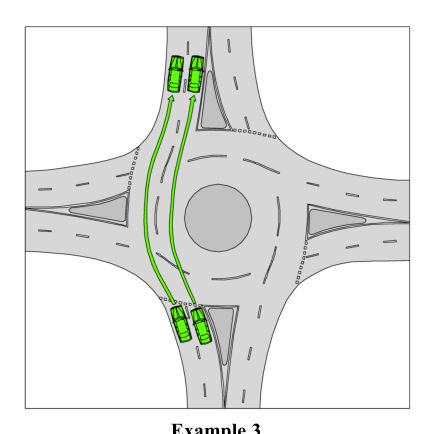
A driver leaves a roundabout halfway around the roundabout if the driver leaves the roundabout on a road that is straight ahead, or substantially straight ahead, from the road on which the driver enters the roundabout.
111Entering a roundabout from a multi-lane road or a road with 2 or more lines of traffic travelling in the same direction#
- (1)A driver entering a roundabout from a multi-lane road, or a road with room for 2 or more lines of traffic (other than animals, bicycles, personal mobility devices or motorbikes) travelling in the same direction as the driver, must enter the roundabout in accordance with this section.
Maximum penalty—20 penalty units.
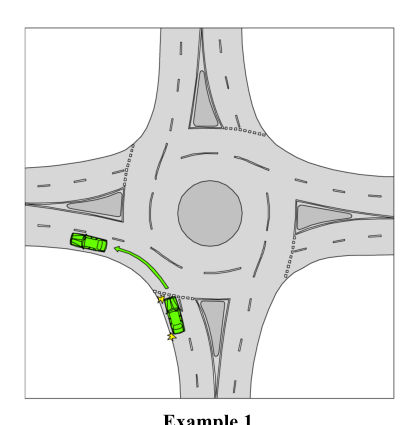
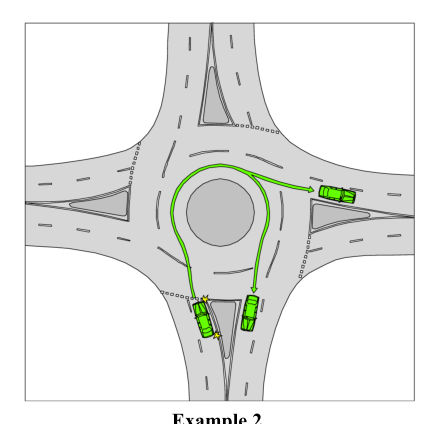
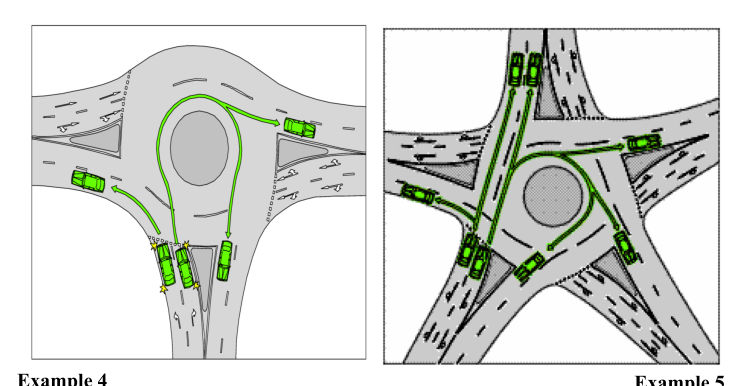
- (2)If the driver is to leave the roundabout less than halfway around it, the driver must enter the roundabout—
- (a)from the left marked lane; or
- (b)if the road is not a multi-lane road—as near as practicable to the left side of the road.
- (3)If the driver is to leave the roundabout more than halfway around it, the driver must enter the roundabout from—
- (a)the right marked lane; or
- (b)if the road is not a multi-lane road—the left of, parallel to, and as near as practicable to, the dividing line or median strip of the road.
- (4)If the driver is to leave the roundabout halfway around it, the driver may enter the roundabout from—
- (a)any marked lane; or
- (b)if the road is not a multi-lane road—any part of the road on which vehicles travelling in the same direction as the driver may travel.
- (5)Despite subsections (2) to (4), if the driver is entering the roundabout from a marked lane and there are traffic lane arrows applying to the lane, the driver must—
- (a)if the arrows indicate a single direction—drive in that direction after entering the roundabout; or
- (b)if the arrows indicate 2 or more directions—drive in 1 of those directions after entering the roundabout.
- (5A)Subsection (2)(b) does not apply to the rider of a bicycle or a personal mobility device.
- (6)Subsection (3) does not apply to the rider of a bicycle, a personal mobility device or an animal.
- (7)Subsection (5) does not apply to the rider of a bicycle, a personal mobility device or an animal if the rider is to leave the roundabout more than halfway around it.
- (8)Despite subsection (2), a driver may approach and enter the roundabout from the marked lane next to the left lane as well as, or instead of, the left lane if—
- (a)the driver's vehicle, together with any load or projection, is at least 7.5m long; and
- (b)the vehicle displays a do not overtake turning vehicle sign; and
- (c)any part of the vehicle is within 50m of the nearest point of the roundabout; and
- (d)it is not practicable for the driver to leave the roundabout less than halfway around it from within the left lane; and
- (e)the driver can safely occupy the next marked lane and can safely leave the roundabout less than halfway around it by occupying the next marked lane or both lanes.
- (9)Despite subsection (3), a driver may approach and enter the roundabout from the marked lane next to the right lane as well as, or instead of, the right lane if—
- (a)the driver's vehicle, together with any load or projection, is at least 7.5m long; and
- (b)the vehicle displays a do not overtake turning vehicle sign; and
- (c)any part of the vehicle is within 50m of the nearest point of the roundabout; and
- (d)it is not practicable for the driver to leave the roundabout more than halfway around it from within the right lane; and
- (e)the driver can safely occupy the next marked lane and can safely leave the roundabout more than halfway around it by occupying the next marked lane or both lanes.
- (10)In this section—
- left lane
- means— (a) the marked lane nearest to the far left side of the road; or (b) if there is an obstruction, including, for example, a parked car or roadworks in that marked lane—the marked lane nearest to that marked lane that is not obstructed.
- marked lane, for a driver,
- does not include a special purpose lane in which the driver is not permitted to drive.
- right lane
- means— (a) the marked lane nearest to the dividing line or median strip of the road; or (b) if there is an obstruction, including, for example, a parked car or roadworks in that marked lane—the marked lane nearest to that marked lane that is not obstructed.
112Giving a left change of direction signal when entering a roundabout#
- (1)This section applies to a driver entering a roundabout if—
- (a)the driver is to leave the roundabout at the first exit after entering the roundabout; and
- (b)the exit is less than halfway around the roundabout.
- (2)Before entering the roundabout, the driver must give a left change of direction signal for long enough to give sufficient warning to other drivers and pedestrians.
- (3)The driver must continue to give the change of direction signal until the driver has left the roundabout.
- (4)This section does not apply to a driver if the driver's vehicle is not fitted with direction indicator lights.
Maximum penalty—20 penalty units.
Maximum penalty—20 penalty units.
113Giving a right change of direction signal when entering a roundabout#
- (1)This section applies to a driver entering a roundabout if the driver is to leave the roundabout more than halfway around it.
- (2)Before entering the roundabout, the driver must give a right change of direction signal for long enough to give sufficient warning to other drivers and pedestrians.
- (3)The driver must continue to give the change of direction signal while the driver is driving in the roundabout, unless—
- (a)the driver is changing marked lanes, or entering another line of traffic; or
- (b)the driver's vehicle is not fitted with direction indicator lights; or
- (c)the driver is about to leave the roundabout.
Maximum penalty—20 penalty units.
Maximum penalty—20 penalty units.
114Giving way when entering or driving in a roundabout#
- (1)A driver entering a roundabout must give way to—
- (a)any vehicle in the roundabout; and
- (b)a tram that is entering or approaching the roundabout.
- (2)A driver driving in a roundabout must give way to a tram that is in, entering or approaching the roundabout.
- (3)In this section—
Maximum penalty—20 penalty units.
Maximum penalty—20 penalty units.
- tram
- includes a bus travelling along tram tracks.
115Driving in a roundabout#
- (1)A driver driving in a roundabout must drive—
- (a)to the left of the central traffic island in the roundabout; or
- (b)if subsection (2) applies to the driver—on the edge of the central traffic island, to the left of the centre of the island; or
- (c)if subsection (3) applies to the driver—over the central traffic island, as near as practicable to the left of the centre of the island.
Maximum penalty—20 penalty units.
- (2)This subsection applies to a driver if—
- (a)the driver's vehicle is too large to drive in the roundabout without driving on the edge of the central traffic island; and
- (b)the driver can safely drive on the edge of the central traffic island.
- (3)This subsection applies to a driver if—
- (a)the driver's vehicle is too large to drive in the roundabout without driving over the central traffic island; and
- (b)the central traffic island is designed to allow a vehicle of that kind to be driven over it; and
- (c)the driver can safely drive over the central traffic island.
116Obeying traffic lane arrows when driving in or leaving a roundabout#
If a driver is driving in a marked lane in a roundabout and there are traffic lane arrows applying to the lane, the driver must—
- (a)if the arrows indicate a single direction—drive in or leave the roundabout in that direction; or
- (b)if the arrows indicate 2 or more directions—drive in or leave the roundabout in 1 of those directions.
Maximum penalty—20 penalty units.
117Giving a change of direction signal when changing marked lanes or lines of traffic in a roundabout#
- (1)A driver driving in a roundabout must give a left change of direction signal before the driver changes marked lanes to the left, or enters a part of the roundabout where there is room for another line of traffic to the left, in the roundabout, unless the driver's vehicle is not fitted with direction indicator lights.
Maximum penalty—20 penalty units.
- (2)A driver driving in a roundabout must give a right change of direction signal before the driver changes marked lanes to the right, or enters a part of the roundabout where there is room for another line of traffic to the right, in the roundabout.
Maximum penalty—20 penalty units.
118Giving a left change of direction signal when leaving a roundabout#
- (1)If practicable, a driver driving in a roundabout must give a left change of direction signal when leaving the roundabout.
Maximum penalty—20 penalty units.
- (2)The driver must stop giving the change of direction signal as soon as the driver has left the roundabout.
Maximum penalty—20 penalty units.
- (3)This section does not apply to a driver if the driver's vehicle is not fitted with direction indicator lights.
119Giving way by the rider of a bicycle, personal mobility device or animal to a vehicle leaving a roundabout#
The rider of a bicycle, a personal mobility device or an animal who is riding in the far left marked lane of a roundabout with 2 or more marked lanes, or the far left line of traffic in a roundabout with room for 2 or more lines of traffic (other than animals, bicycles, personal mobility devices or motorbikes) must give way to any vehicle leaving the roundabout.
Maximum penalty—20 penalty units.