Division 4Driving in marked lanes or lines of traffic#
146Driving within a single marked lane or line of traffic#
(1) A driver on a multi-lane road must drive so the driver’s vehicle is completely in a marked lane, unless the driver is—
- (a) entering a part of the road of 1 kind from a part of the road of another kind (for example, moving to or from a service road or a shoulder of the road); or
- (b) entering or leaving the road; or
- (c) moving from 1 marked lane to another marked lane; or
- (d) avoiding an obstruction; or
- (e) obeying a traffic control device applying to the marked lane; or
- (f) permitted to drive in more than 1 marked lane under this regulation; or
- (g) passing the rider of a bicycle or a personal mobility device that is travelling in the same direction as the driver and the driver’s vehicle is not completely in a marked lane in order to comply with section 144A(1) for the passing of the rider; or
- (h) lane filtering in compliance with section 151A; or
- (i) passing an emergency response vehicle under section 78A(2).
Maximum penalty—20 penalty units.
(2) A driver on a road with 2 or more lines of traffic travelling in the same direction as the driver, but without marked lanes, must drive so the driver’s vehicle is completely in a single line of traffic unless—
- (a) it is not practicable to drive completely in a single line of traffic; or
- (b) the driver is entering a part of the road of 1 kind from a part of the road of another kind (for example, moving to or from a service road or a shoulder of the road); or
- (c) the driver is entering or leaving the road; or
- (d) the driver is moving from 1 line of traffic to another line of traffic; or
- (e) the driver is avoiding an obstruction; or
- (f) the driver is passing a bicycle or a personal mobility device that is travelling in the same direction as the driver and the driver’s vehicle is not completely in a single line of traffic in order to comply with section 144A(1) for the passing of the rider; or
- (g) the driver is lane filtering in compliance with section 151A; or
- (h) the driver is passing an emergency response vehicle under section 78A(2) or (4).
Maximum penalty—20 penalty units.
147Moving from 1 marked lane to another marked lane across a continuous line separating the lanes#
(1) A driver on a multi-lane road must not move from 1 marked lane to another marked lane by crossing a continuous line separating the lanes unless—
- (a) the driver is avoiding an obstruction; or
- (b) the driver is obeying a traffic control device applying to the first marked lane; or
- (c) the driver is permitted to drive in both marked lanes under subsection (2); or
- (d) either of the marked lanes is a special purpose lane in which the driver is permitted to drive under this regulation and the driver is moving to or from the special purpose lane; or
- (e) either of the marked lanes is a special purpose lane during specified times only and the driver—
- (i) is moving to or from the lane when it is not a special purpose lane; and
- (ii) is permitted to drive in the lane when it is not a special purpose lane under this regulation; or
- (f) the driver is lane filtering in compliance with section 151A; or
- (g) the driver is passing an emergency response vehicle under section 78A(2).
Maximum penalty—20 penalty units.
(2) A driver on a multi-lane road may move from 1 marked lane to another marked lane by crossing a continuous line separating the lanes if—
- (a) the driver makes the move to approach or enter an intersection from the multi-lane road and section 28(2) or 32(2) applies to the driver for the purpose of making the move; or
- (b) the driver makes the move to approach or enter a roundabout from the multi-lane road and section 111(8) or (9) applies to the driver for the purpose of making the move; or
- (c) both of the following apply—
- (i) the driver is passing the rider of a bicycle or a personal mobility device that is travelling in the same direction as the driver and the movement is necessary to comply with section 144A(1) for the passing of the rider;
- (ii) the driver can perform the movement safely.
148Giving way when moving from 1 marked lane or line of traffic to another marked lane or line of traffic#
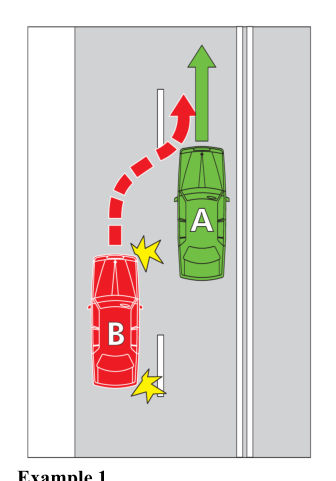
(1) A driver who is moving from 1 marked lane (whether or not the lane is ending) to another marked lane must give way to any vehicle travelling in the same direction as the driver in the marked lane to which the driver is moving.
Maximum penalty—20 penalty units.
148AGiving way when moving within a single marked lane#
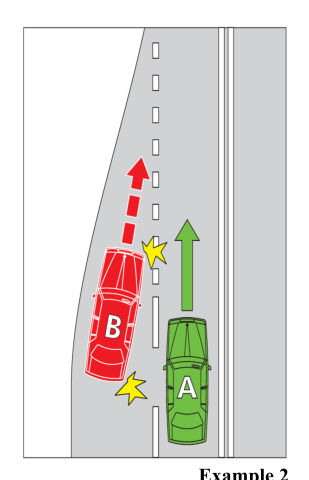
A driver on a road with 2 or more lines of traffic travelling in the same direction as the driver, and who is moving from 1 line of traffic to another line of traffic, must give way to any vehicle travelling in the same direction as the driver in the line of traffic to which the driver is moving.
Maximum penalty—20 penalty units.
Subsection (2) does not apply to a driver if the line of traffic in which the driver is driving is merging with the line of traffic to which the driver is moving.
If a driver diverges to the left or right within a marked lane, the driver must give way to any vehicle that is in the lane.
Maximum penalty—20 penalty units.
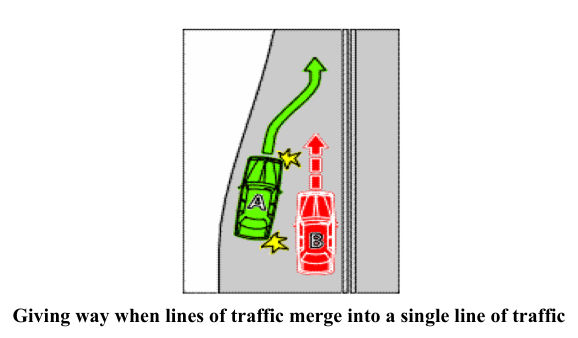
149Giving way when lines of traffic merge into a single line of traffic#
A driver in a line of traffic that is merging with 1 or more lines of traffic travelling in the same direction as the driver must give way to a vehicle in another line of traffic if any part of the vehicle is ahead of the driver’s vehicle.
Maximum penalty—20 penalty units.
150Driving on or across a continuous white edge line#
A driver must not drive on or over a continuous white edge line on a road unless subsection (1A), (1B) or (1C) applies to the driver.
Maximum penalty—20 penalty units.
A driver may drive on or over a continuous white edge line on a road if the driver is—
- (a) overtaking a vehicle that is turning right, or making a U-turn from the centre of the road, and is giving a right change of direction signal; or
- (b) driving a slow-moving vehicle, and it is necessary for the driver to drive on or over the edge line to allow the vehicle to be overtaken or passed by another vehicle; or
- (c) driving a vehicle that is too wide, or too long, to drive on the road without driving on or over the edge line; or
- (d) avoiding an obstruction; or
- (e) passing an emergency response vehicle under section 78A(2) or (4).
A driver may drive on or over a continuous white edge line on a road for up to 100m if the driver is—
- (a) turning at an intersection; or
- (b) entering or leaving the road; or
- (c) entering a part of the road of 1 kind from a part of the road of another kind (for example, moving to or from a service road, a shoulder of the road or an emergency stopping lane); or
- (d) stopping at the side of the road (including any shoulder of the road).
The rider of a motorbike may ride on or over a continuous white edge line on a road if the rider is edge filtering in compliance with section 151B.
This section does not apply to the rider of a bicycle, a personal mobility device or an animal.
For this section, a driver drives over a continuous white edge line on a road if—
- (a) for a line on the far left side of the road—the driver’s vehicle is completely or partly to the left of the line; or
- (b) for a line on the far right side of the road—the driver’s vehicle is completely or partly to the right of the line.
151Riding a motorbike, bicycle or personal mobility device alongside more than 1 other rider#
The rider of a motorbike, a bicycle or a personal mobility device must not ride on a road that is not a multi-lane road alongside more than 1 other rider, unless subsection (3) applies to the rider.
Maximum penalty—20 penalty units.
The rider of a motorbike, a bicycle or a personal mobility device must not ride in a marked lane alongside more than 1 other rider in the marked lane, unless subsection (3) applies to the rider.
Maximum penalty—20 penalty units.
The rider of a motorbike, a bicycle or a personal mobility device may ride alongside more than 1 other rider if the rider is overtaking the other riders.
If the rider of a motorbike, a bicycle or a personal mobility device is riding on a road that is not a multi-lane road alongside another rider, or in a marked lane alongside another rider in the marked lane, the rider must ride not over 1.5m from the other rider.
Maximum penalty—20 penalty units.
In this section—
road does not include a road-related area, but includes a bicycle path, a shared path and any shoulder of the road.
151ALane filtering between slow or stationary vehicles on a motorbike#
The rider of a motorbike is lane filtering along a length of road if the rider rides the motorbike between—
- (a) two adjacent lines of traffic travelling in the same direction as the motorbike; or
- (b) two vehicles (regardless of whether the rider remains within a single marked lane), each vehicle travelling in— the same direction as the motorbike; and
the same direction as the motorbike; and separate, but adjacent, marked lanes.
- (2)The rider of a motorbike must not unlawfully lane filter along a length of road.
- (3)For subsection (2), if 1 or more of the following circumstances apply while a rider is lane filtering along a length of road, the rider is taken to have unlawfully lane filtered along the length of road—
- (a)the rider does not hold an O type licence for the class of the motorbike;
- (b)the rider rides at a speed of more than 30km/h;
- (c)the rider rides in a school zone;
- (d)a no filtering sign applies to the length of road;
- (e)it is not safe to lane filter.
- (4)A no filtering sign on a road applies to a length of road starting at the sign and ending at the nearer of the following—
- (a)if the length of road ends at a T-intersection or dead end—the end of the length of road;
- (b)the next end no filtering sign that is on the road.
- (5)In this section—
- end no filtering sign
- means a traffic sign— (a) with a symbol displaying a motorbike positioned between two vehicles with a black diagonal line across the symbol; and (b) with a symbol positioned below the symbol mentioned in paragraph (a) displaying the word 'END' in black letters.
- no filtering sign
- means— (a) a traffic sign with a symbol displaying a motorbike positioned between two vehicles with a red diagonal line across the symbol; or (b) a traffic sign displaying the words 'no filtering'.
- school zone
- means a school zone under section 23(2) but only during the times when a lower speed limit applies to a driver in the school zone than the speed limit that applies to a driver for a length of road immediately outside the school zone.
151BEdge filtering past slow or stationary vehicles on a motorbike#
- (1)The rider of a motorbike is edge filtering along a length of road if the motorbike enters the edge of the road while the rider is passing 1 or more vehicles on the road.
- (2)The rider of a motorbike must not unlawfully edge filter along a length of road.
- (3)For subsection (2), if 1 or more of the following circumstances apply while a rider is edge filtering along a length of road, the rider is taken to have unlawfully edge filtered along the length of road—
- (a)the rider does not hold an O type licence for the class of the motorbike;
- (b)the speed limit for the length of road, other than indicated by a variable illuminated message sign, is less than 90km/h;
- (c)the rider rides at a speed of more than 30km/h;
- (d)the length of road is in a tunnel;
- (e)there are roadworks on the length of road;
- (f)the rider rides on any unsealed part of the road;
- (g)it is not safe to edge filter.
- (4)In this section—
- edge, of a length of road
- means the part of the road that is— (i) to the left of the left edge line on the road; or (ii) to the right of the right edge line on the road; and includes an emergency stopping lane along the road.