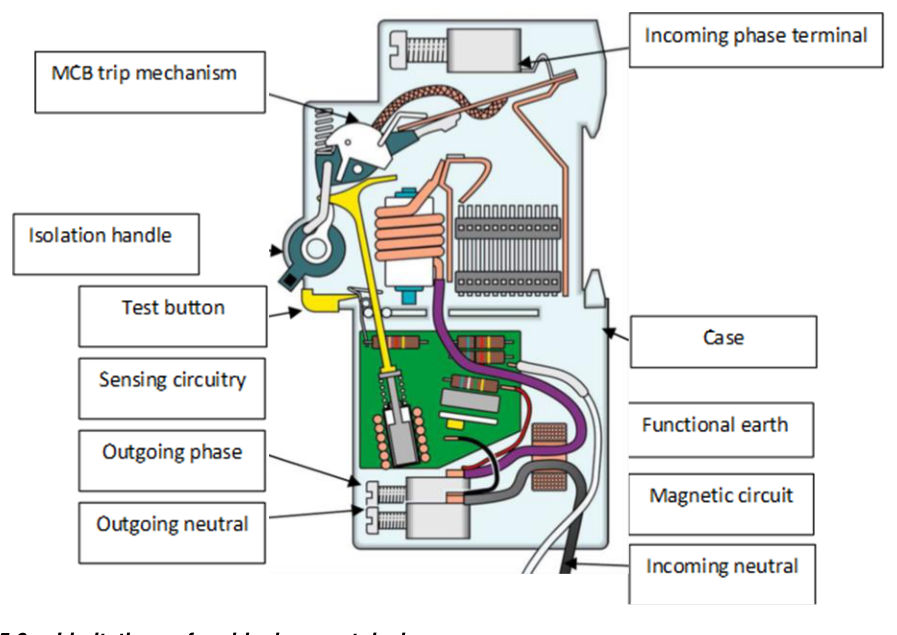
5.5How residual current devices work#
In simple terms, the RCD is a circuit breaker that continuously compares the active current to the neutral current. The residual current will be the difference between the two. This residual current will be flowing to earth, because it has left the phase part of the circuit and has not returned in the neutral (in the MEN system, there are multiple earth return paths available for this current). There will always be some residual current due to the insulation resistance and capacitance to earth, but in a healthy circuit, this current will generally be low, seldom exceeding 2 mA. The main contacts are closed against the pressure of a spring, which provides the energy to open them when the device trips. Phase and neutral currents pass through identical coils wound in opposing directions on a magnetic circuit, so that each coil will provide equal but opposing numbers of ampere turns when there is no residual current. The opposing ampere turns will cancel, and no magnetic flux will be set up in the magnetic circuit.
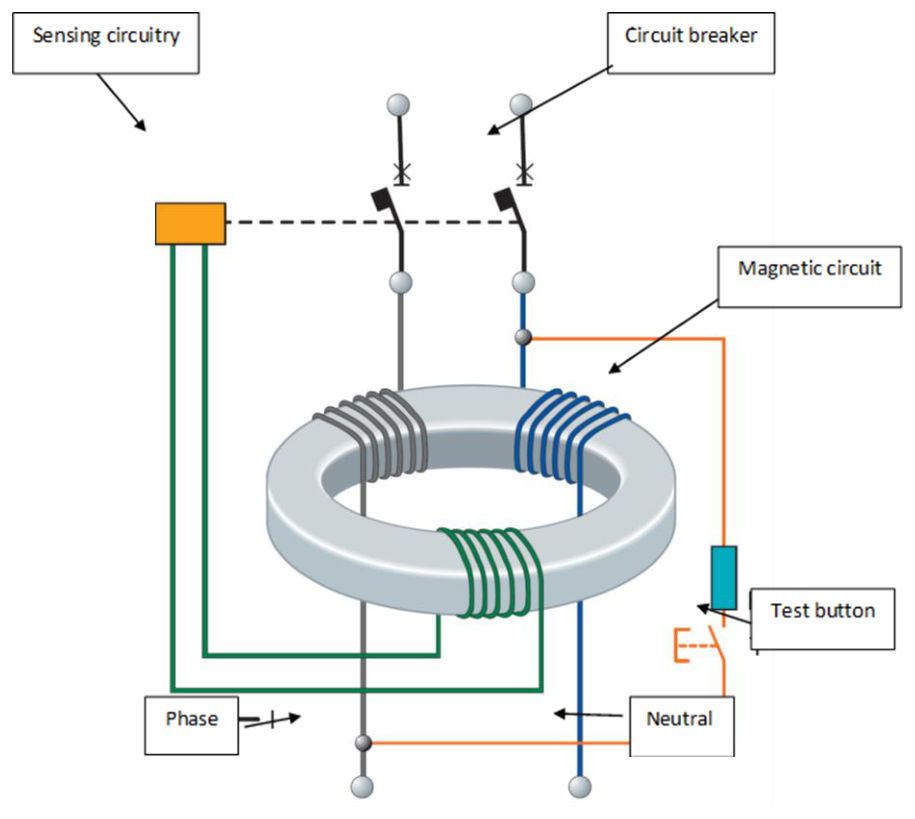
Residual earth current passes to the circuit through the phase coil but returns through the earth path, thus avoiding the neutral coil, which will therefore carry less current. This means that phase ampere turns exceed neutral ampere turns and an alternating magnetic flux results in the core. This flux links with the search coil, which is also wound on the magnetic circuit, inducing an electromotive force (e.m.f) into it. The value of this e.m.f depends on the residual current. It will drive a current to the tripping system dependent on the difference between phase and neutral currents. When the amount of residual current, and hence of tripping current, reaches a pre-determined level, the circuit breaker trips, opening the main contacts and interrupting the circuit.
For circuit breakers operating at low residual current values, an amplifier may be used in the trip circuit. Since the sum of the currents in the phases and neutral of a healthy three-phase supply is always balanced, the system can be used just as effectively with three-phase supplies. In high current circuits, it is more usual for the phase and neutral conductors to simply pass through the magnetic core instead of round coils wound on it (extracted from The Electricians Guide 5th edition by John Whitfield).
The device also has a test button which, when pressed, causes the rated level of residual current to flow through the phase coil but bypasses the neutral coil. This current results in an imbalance in the current through the detection circuit of sufficient amplitude to cause the breaker to open.
Modern devices have been designed to be insensitive to surge currents up to the limits specified by the manufacturer.
The following diagram (Figure 5.5(b)) from Schneider Electric shows the typical internal configuration of the RCD.