5.7Types of residual current devices#
The common RCDs come with or without overload protection, and with or without tripping for pulsating dc. For personnel protection, the 30 mA fixed time device is used.
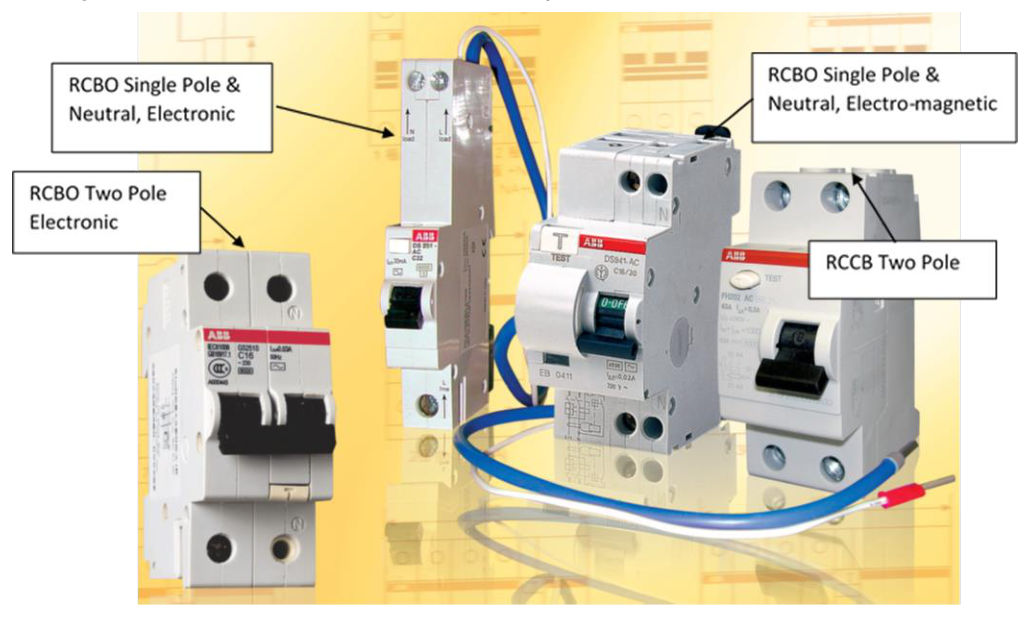
Without overload protection: RCCB – RCD without integral overcurrent protection which must be installed in series with and on load side of a fuse or miniature circuit breaker. A particular subset of the RCCB is the RCD protected socket outlet. These generally can also protect other outlets connected downstream.
With overload protection: RCBO – RCD with integral overcurrent protection generally in the form of a miniature circuit breaker. A particular subset of the RCBO is a circuit breaker and a separate residual current unit (commonly called RCD blocks) which are assembled together onsite to form one unit.
Without pulsating dc tripping: Type AC – Tripping is ensured for residual sinusoidal alternating currents, whether suddenly applied or slowly rising. This is the general type used in Australia.
With pulsating dc tripping: Type A – Tripping is ensured for residual sinusoidal alternating currents and for residual pulsating direct currents, whether suddenly applied or pulsating direct. This type is often used with computers and electronic equipment.
Note that Type S RCDs have a built-in time delay corresponding to a given value of residual current, to provide discrimination. As these devices, as specified in AS/NZS 61008.1 and 61009.1, are rated >30 mA, they are used for protection against fire and not for personnel protection.
Figure 5.7 shows some common RCD examples: