7.5Designing with circuit breakers#
Circuit breakers are used for the protection of cables and some circuit components. Breakers have a thermal element that will cause the unit to trip and open the circuit when overload occurs. They also have a magnetic component that will cause instantaneous tripping within a range specified for the particular type of breaker.
Because the five-second time will generally fall in the thermal part of the breaker's curve, and this will vary between manufacturers and with operating temperature, it is not a reliable point for operating current. Consequently, the five-second disconnect time is not used for circuit breakers. The 0.4 second disconnect time is located within the magnetic part of the breaker operating curve. Breakers can be manufactured to reliably operate within the specified range and hence, only the 0.4 second disconnect time is used for miniature circuit breakers. The design tripping current can be taken as the mean within the magnetic operating range.
There are three types of circuit breakers in AS/NZS 60898.1, each with its own operating range for the magnetic release part of the curve. These are:
| Curve | Low | Median | High | Typical use |
|---|---|---|---|---|
| B | 3I N | 4I N | 5I N | Protection for generators |
| C | 5I N | 7.5I N | 10I N | Normal use |
| D | 10I N | 15I N | 20I N | Protection for transformers |
where: IN is the rated current of the device. (Note that AS/NZS 3000 Appendix B4.5 uses a 12.5 x multiplier for Type D).
For circuit breakers up to 63 A, the circuit breaker will trip within one hour when passing a current of 1.45 x its rated current (IN). For circuit breakers above 63 A, the circuit breaker will trip within two hours when passing a current of 1.45 x its rated current (IN) (AS 60898.1 Table 7). This is called the conventional tripping current (I₂) and is the current ensuring effective operation of the device, hence:
𝐼2 = 1.45 𝐼𝑁#
The following is a typical miniature circuit breaker curve taken from the Schneider series with the curved thermal characteristic on the left and the magnetic characteristic within the vertical range on the right:
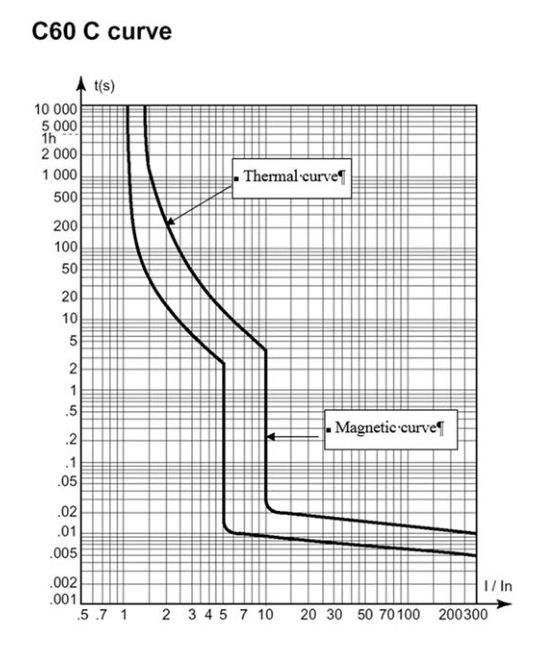
Unless otherwise stated, references to circuit breakers will mean type C as these are the most common and frequently used. For a typical 10 A breaker, the magnetic trip will operate somewhere within the 50 A to 100 A range with a mean of 75 A.
When designing with circuit breakers, the general rule of thumb is for the load current not to exceed 80% of the circuit breaker rating to allow for inrush current; for example, a 20 A mcb should have a design load current no greater than 16 A.
Discrimination between two circuit breakers of rating less than 250 A may be deemed to be provided for both overload and instantaneous operation if the upstream device rating is greater than or equal to twice the rating of the downstream device. 𝐶𝑢𝑝𝑠𝑡𝑟𝑒𝑎𝑚≥2 × 𝐶𝑑𝑜𝑤𝑛𝑠𝑡𝑟𝑒𝑎𝑚