7.4Designing for maximum demand#
Maximum demand for the installation can be determined by:
| Calculation | Add all the loads and allow for diversity (AS/NZS 3000 Appendix C) |
|---|---|
| Assessment | Applicable to intermittent / fluctuating loads, large installations, special type of occupancy |
| Measurement | Install a data recorder during time of highest demand |
| Limitation | Demand is limited by size of the circuit protection device |
Table in words
- Calculation: Add all the loads and allow for diversity (AS/NZS 3000 Appendix C).
- Assessment: Applicable to intermittent / fluctuating loads, large installations, special type of occupancy.
- Measurement: Install a data recorder during time of highest demand.
- Limitation: Demand is limited by size of the circuit protection device.
More than one of these methods can be used when determining the overall maximum demand for a particular in installation.
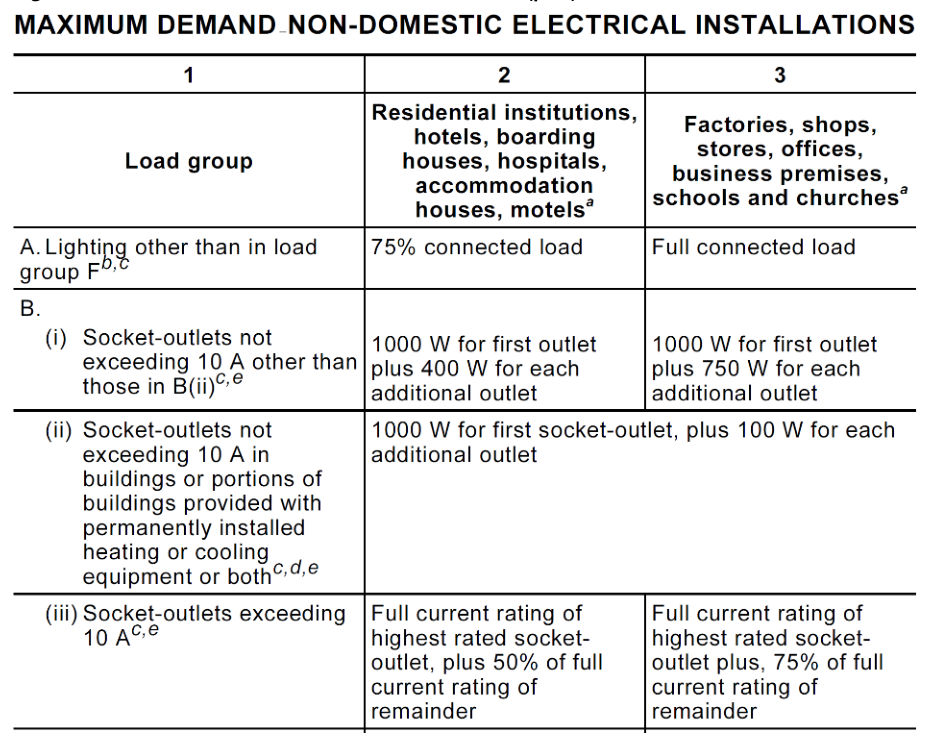
The following figure is a part of Table C2 from AS/NZS 3000 which can be used in the calculation method for determining maximum demand. Note that it does not specifically address Transport and Main Roads-type installations.
Particular regard should be made concerning Note (e) of the table: For the purpose of determining maximum demand, a multiple combination socket-outlet should be regarded as the same number of points as the number of integral socket-outlets in the combination; hence, the maximum demand for a double general purpose outlet in a field cabinet would be 1750 W (1000 W for the first outlet and 750 W for the additional outlet) or 7.6 A – however, this could lead to excessive overcapacity.
As the typical loads within a field cabinet are electronic and small, the conservative approach would be to add all the connected loads together and not allow for diversity as individual components cycle. Refer also to Section 4.3.3.