
7.13.4Touch voltage#
Touch voltage is the voltage appearing between simultaneously accessible parts; for example, where a metal pole or post has become alive, the touch voltage would be the voltage between the hand and the feet if a person were to touch the post while standing on the ground. Fault current would pass through the arm, torso, legs and feet on the way to the ground. Step voltage is the voltage difference between a person’s feet caused by the dissipation gradient of a fault entering the earth. Touch voltage is important because Ohm's Law states that the current flowing through a conductor is directly proportional to the applied voltage. The higher the touch voltage, the more current is likely to flow through the body of a person who comes into contact with the live part; therefore, to minimise this current and its electric shock effect, the touch voltage should be low. To gain a better understanding of touch voltage, consider a simple voltage divider circuit. Using Ohm’s Law to obtain two equations that can be solved simultaneously, the voltage at the point a (Va) can be determined (it is assumed that the source impedance is negligible and the circuit impedance is purely resistive).
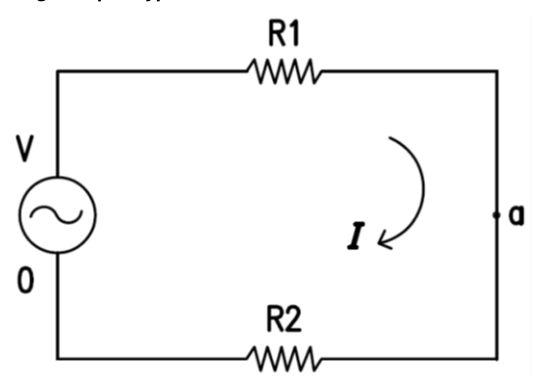
The voltage drop across R1 is
IR V V a Similarly for R2 0 IR Va
As the same current is flowing through both resistors
This is the voltage at the point a.
Considering R1 to be the impedance of the supply circuit, and R2 to be the impedance of the return circuit, Va could be compared with the touch voltage available at the point a.
There are some indications that, in a 230 V system, the prospective touch voltage typically varies between 69 V and 172 V.
Taking this a step further, several other impedances could be included in the return circuit.
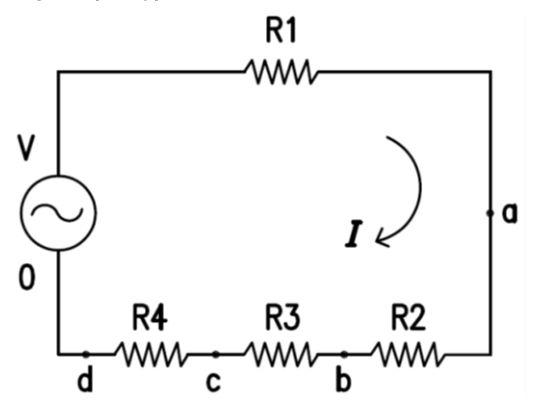
In a similar manner to this, using Ohm’s Law and the same current flowing through all the resistances, the voltages at a, b, and c can be calculated (it is assumed that the source impedance is negligible and the circuit impedance is purely resistive).
Voltage at a
therefore
Voltage at b
therefore
Voltage at c
therefore
Assuming that R2 = R3 = R4 = R and R1 is small compared to R:
The potential difference between points a and b is 0.33 V.
The potential difference between points a and c is 0.67 V.
The potential difference between points a and d is V.
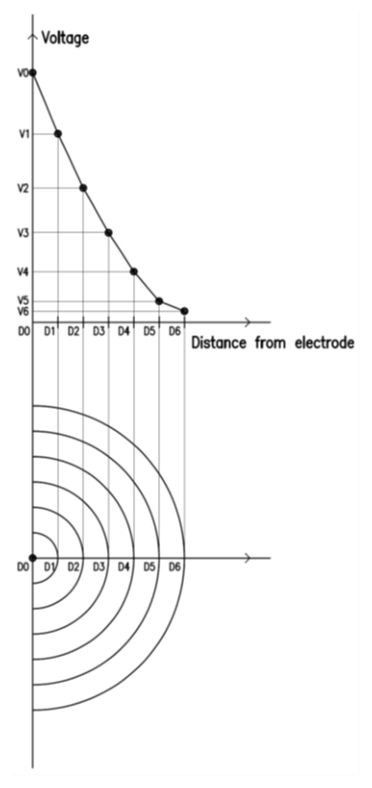
Therefore, the further a point is away from a, the greater the potential difference with respect to a. This is shown following as the typical voltage gradient in the ground at various distances from a ‘live’ pole.
As can be seen, if a person is walking away from the pole, there will be a maximum voltage difference between his or her two feet due to the voltage gradient in the ground. The voltage difference between the feet is the step voltage.
Further information can be obtained in:
- ENA EG1
- IEC 61200 413