
7.13.10Distribution cable impedances#
The necessary distribution cable characteristics for the particular cable installed can be determined from the following Standards or manufacturer’s data:
- AS 1222.1 Steel conductors and stays – Bare overhead – Galvanized (SC / GZ)
- AS 1222.2 Steel conductors and stays – Bare overhead – Aluminium clad (SC / AC)
- AS 1531 Conductors – Bare overhead – Aluminium and aluminium alloy
- AS 1746 Conductors – Bare overhead – Hard drawn copper
- AS 3607 Conductors – Bare overhead, aluminium and aluminium alloy – Steel reinforced
- AS/NZS 3008.1.1 Electrical installations – Selection of cables Part 1.1: Cables for alternating voltages up to and including 0.6 / 1 kV – Typical Australian installation conditions
- AS/NZS 3560.1 Electric cables – Cross linked polyethylene insulated – Aerial bundled – For working voltages up to and including 0.6 / 1 (1,2) kV Part 1 Aluminium conductors
- AS/NZS 3560.2 Electric cables – Cross linked polyethylene insulated – Aerial bundled – For working voltages up to and including 0.6 / 1 (1,2) kV Part 2: Copper conductors
- AS/NZS 4026 Electric cables – For underground residential distribution systems
- AS/NZS 4961 Electric cables – Polymeric insulated – For distribution and service applications (Supplements AS/NZS 4026).
Typically, the following will provide most of the common data:
| Standard | Table | Cable type |
|---|---|---|
| AS/NZS 3008.1.1 | Tables 33,39 | single core aerial cables |
| AS/NZS 3560.1 | Table E2 | aerial bundled cable (ABC) |
| AS/NZS 4026 | Table A5 | distribution cables |
| AS/NZS 4026 | Table A6 | service cables |
As an example of manufacturers’ data, the following has been extracted from Olex Aerial catalogue for bare AAC conductors:
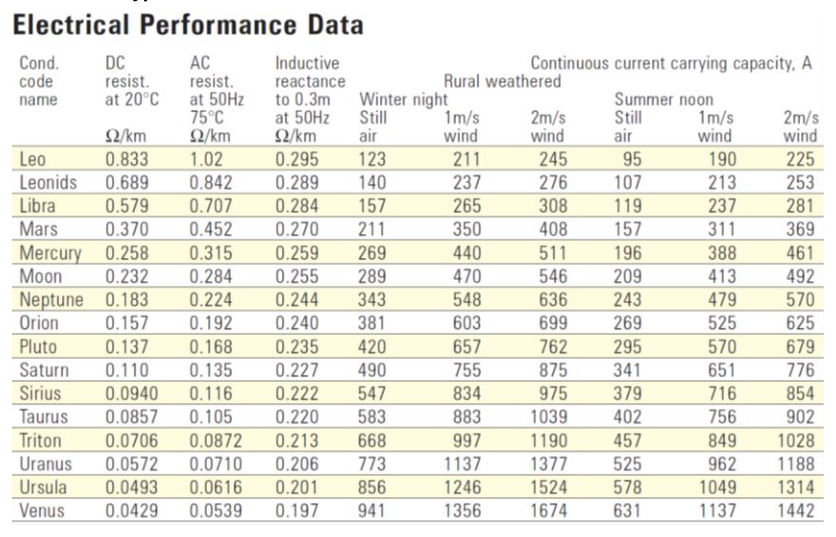
The third column is the resistance value (R) and the fourth column is the reactance value (X) both in Ω / km. The R and X values for the distribution cables can be calculated by multiplying the Ω / km values by the cable length in km.