7.13.3Body impedance#
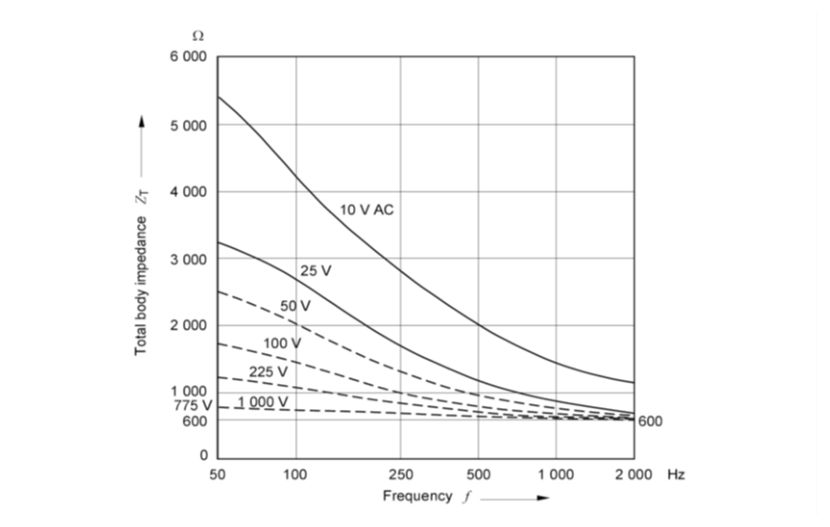
The values of body impedance depend on a number of variable factors including the current path through the body (hand to hand, hand to foot, hand to both feet), the surface area of contact, the part of the body in contact, the degree of moisture of the part of the body in contact, the pressure on the point of contact, the temperature of the skin, type and condition of skin, the touch voltage, the frequency of the electricity, and duration of the current flow. Body impedance decreases with increased frequency and decreases with increased voltage. These relationships are not linear. The following figure is taken from AS/NZS 60479.1 Effects of current on human beings and livestock. It shows how the body impedance varies with different voltages and frequencies. Taking the standard mains frequency of 50 Hz, the graph shows pictorially how the body impedance decreases rapidly with increasing applied voltage.
The following figure, also from AS/NZS 60479.1, provides numerical values of the body resistance for various touch voltages for a cross-section of the population. Again, it clearly shows the decrease in body resistance as the touch voltage increases.
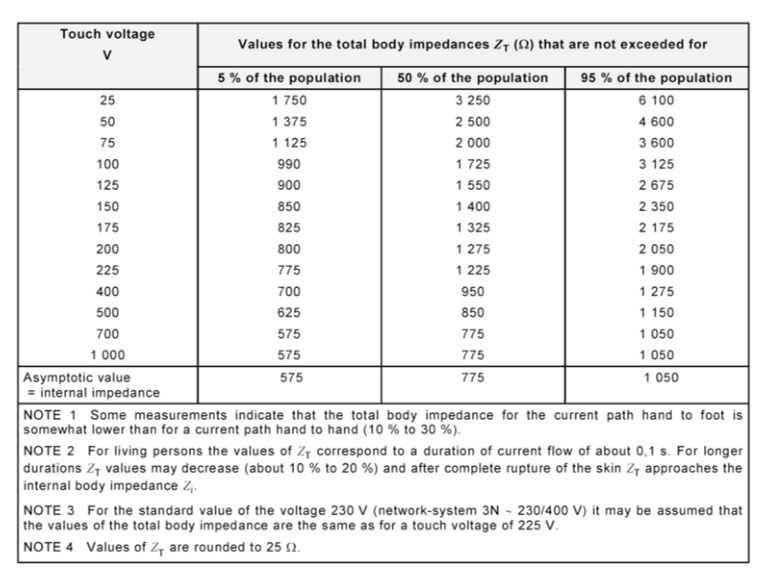
This table is for a current path from one hand to the other. The note indicates that the path from hand to foot could be 10–30% lower than the tabulated values. Using a touch voltage of 50 V ac and 50% of the population, the impedance is 2500 Ω for the hand to hand path. Assuming the path is hand to foot and the body resistance for this path is 20% lower, the value of 2000 Ω as a typical body impedance for 50 V ac and 1380 Ω for 100 V ac could be used. By Ohm’s Law, the current through the body is inversely proportional to the body impedance and directly proportional to the applied or touch voltage.