
7.11Designing for cable short circuit protection#
The cable and protection device must be selected so that, under short circuit conditions, the cable insulation is not damaged by the heat generated in the conductor during the time the circuit protection takes to activate and clear the fault.
For typical situations, the generalised form of the adiabatic temperature rise equation can be used to calculate the minimum cable cross-sectional area for a cable under short circuit conditions. It neglects heat loss and is accurate for calculating permissible conductor and metallic sheath short circuit currents up to five seconds in duration. It is applicable to any starting temperature.
S² = I² t / K²
Rearranging:
S = I √t / K
where
- S
- minimum cross sectional area of the conductor in mm²
- I
- short circuit current in amperes (from protection curves typically at 0.4 s)
- t
- duration of short circuit in seconds (typically 0.4 s)
- K
- constant from AS / NZS 3008.1.1 Table 52
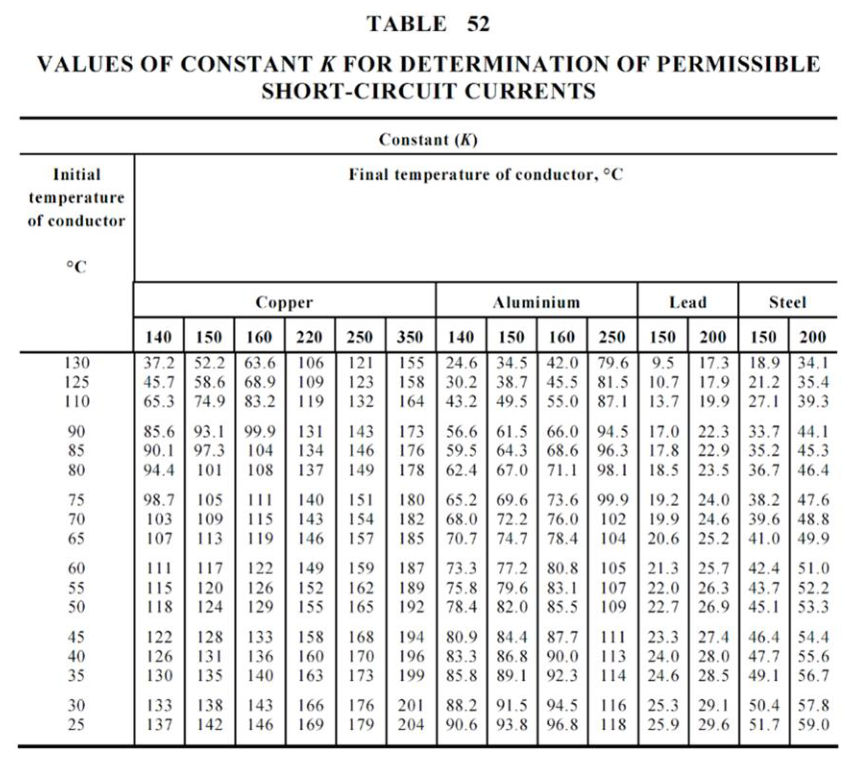
Typically, the initial conductor temperature is taken as the operating temperature of the conductors during normal use or the maximum permissible operating temperature of the conductors.
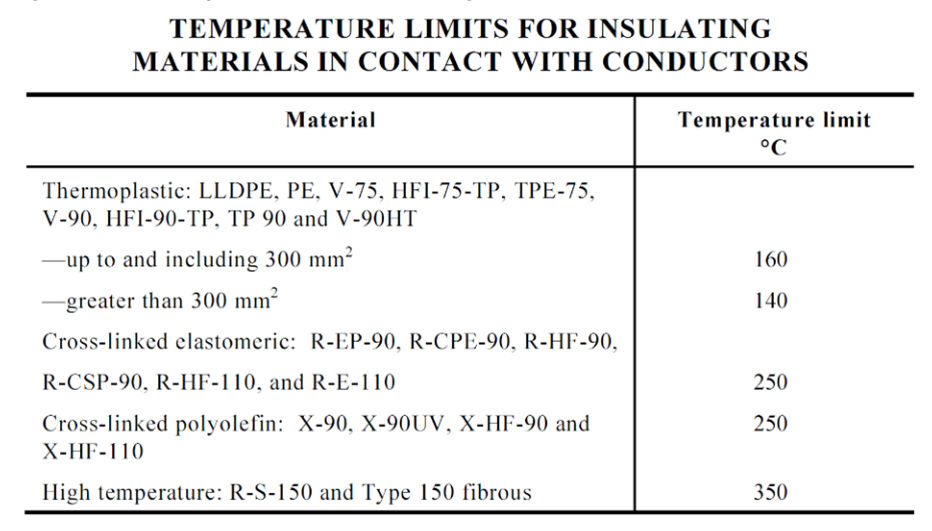
The final temperature is the limiting temperature for the insulator. The time taken to clear the fault is also critical in whether the insulation will degrade and to what degree.
The final temperatures are given in Table 53 of AS/NZS 3008.1.1 as follows:
Examples#
For a 16 mm² XLPE / PVC consumers’ mains cable with a 75°C initial temperature, 80 A fuse and five-seconds disconnect time:
The fuse iT curve indicates a 338 A current at 5 seconds rupture time.
From the previous table for copper conductor, initial temperature 75°C and final temperature 250°C (for XLPE) the K value is 151.
I = 338
t = 5
K= 151
S = I √t / K = 338 √5 / 151 = 5 mm²
Similarly, for the 16 mm² XLPE / PVC submains cable with a 75⁰C initial temperature, 32 A fuse and five-seconds disconnect time:
I = 105
t = 5
K = 151
S min = 1.55 mm²
For the 2.5 mm² PVC / PVC sub-circuit cable with a 75⁰C initial temperature, 10 A fuse and 400 ms disconnect time:
I = 42 t = 0.4 K = 111 Smin = 0.24 mm²
Therefore, operation under short circuit conditions is not a major consideration when designing with Transport and Main Roads standard sized cables and protection.