6.15Earthing and bonding#
The purpose of the SPD is to dissipate to earth the high voltage and current energy of a surge to minimise the potential damaging effects of this energy on downstream equipment; therefore, a surge protection system is only as good as the earthing system to which it is connected. Any part of the earthing system that adds resistance or impedance to the circuit reduces the effectiveness of the surge protector. It is critical to keep the connection to earth short, as straight as possible and correctly terminated to the protection device. In areas where the ground has high impedance, it may be necessary to consider ground enhancing compounds and deep or long earth electrodes.
Where power and telecommunications systems are in close proximity and require surge protection, the earth of the telecommunications device should be connected to the power device earth or main earth bar with as short a lead as practicable.
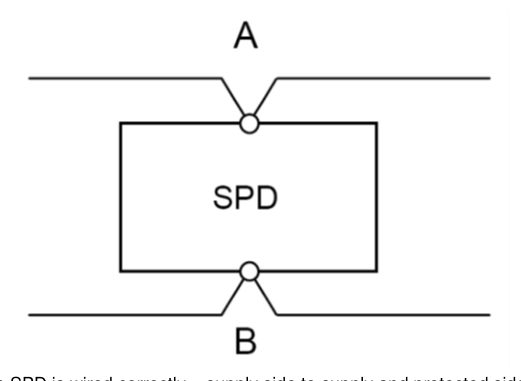
Total length of minimum 6 mm² wire from main switch to SPD fuse to SPD to neutral bar which is close to MEN link should be no more than 1000 mm and as straight as possible (ideally 300 mm-600 mm).
When carrying a lightning surge, the voltage drop across a conductor can be 1 kV / m. If the let-through voltage of the SPD is 600 V and the 1000 mm interconnecting cable had a volt drop of 1000 V, the effective protection offered by the SPD is 1600 V.
The main earth bar should be connected to the electrical installation earth electrode with as short a conductor as possible. Earthing system resistance should generally be less than 10 Ω and less than 5 Ω for installations with primarily telecommunications or sensitive electronic equipment. The objective of equipotential bonding is to reduce the potential difference between various parts of the structure and the main earth bar. A bonding bar can be used for the bonding of the various bonding conductors. The bar should be bonded to the main earth bar with a short bonding conductor, preferably less than 500 mm long, which includes a disconnect link. All other bonding conductors should be kept short, preferably less than 1 m, and bonded to the bonding bar.