
7.13.2Effects of current through the body#
To gain a better appreciation of the topic of EFLI and why it is important in electrical design, it is necessary to address some of the underlying principles.
An electric shock is the pathophysiological effect of an electric current as it passes through the body.
As the majority of the body is an aqueous electrolyte, any external electric current can flow relatively easily through the body once it has passed the skin barrier. The muscular, circulatory and respiratory systems are mostly affected by this current, but serious burns can also result. If the effects are sufficiently severe, death by electrocution could be the end result.
The degree of danger that a person may be subjected to depends on a number of parameters, including:
- the magnitude of the current
- the duration of the current
- the current path through the body
- the age and health of the person
- the skin condition and area of contact with current source
- the body impedance
- the touch voltage
- the frequency of the current
- the occurrence of the shock in relation to the cardiac cycle.
A person who comes into contact with live metal risks getting an electric shock.
The following figure taken from AS/NZS 60479.1 provides the conventional time / current zones of the effects of alternating currents (between 15 Hz and 100 Hz) on persons for a current path corresponding to left hand to both feet.
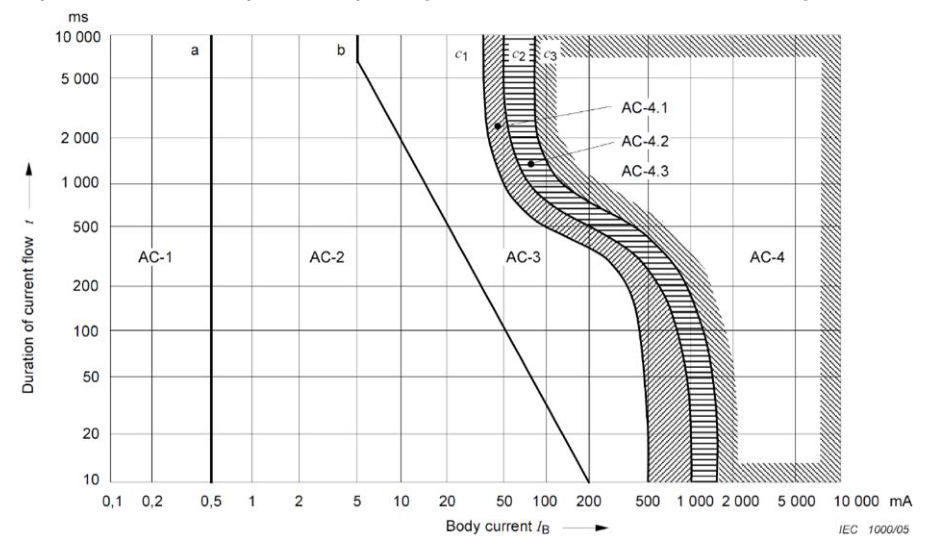
The figure is divided into four distinct parts, AC-1, AC-2, AC-3 and AC-4 with increasing severity of effect on the body as the magnitude of the current increases from left to right. The figure following, also from AS/NZS 60479.1, provides the explanation of the zones, their boundaries and the physiological effects that can be expected when various body currents flow for the specified time durations.
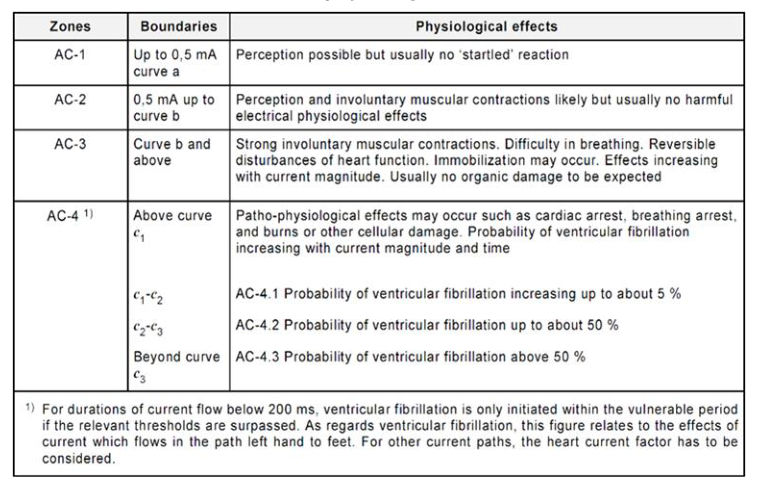
In the AC-1 region, for small currents through the body up to 0.5 mA, there is usually no reaction.
As the current and duration increase, in the region AC-2, a limit is reached at curve b up to which there is usually no harmful physiological effects. The AC-3 region is an area on the time / current graph where no organic damage to the body is to be expected but there is the possibility of muscular contractions and interference with the heart's operation. The curve c1, in the AC-4 region, was conventionally established for a current path left hand to both feet, below which fibrillation of the heart is unlikely to occur. For currents and duration in excess of the upper limit of this c1 area, cardiac arrest, breathing arrest and severe burns are likely to occur. To reduce the potential for cardiac arrest and damage to the body, it is imperative that any current that could potentially pass through the body and the duration of the current flow are both minimised. Generally then, AC-1 and AC-2 zones are expected to have little harmful effect, while AC-4 is expected to have major, if not fatal, effects on the body. Zone AC-3 provides what is considered to be the limits of acceptable body current and duration.