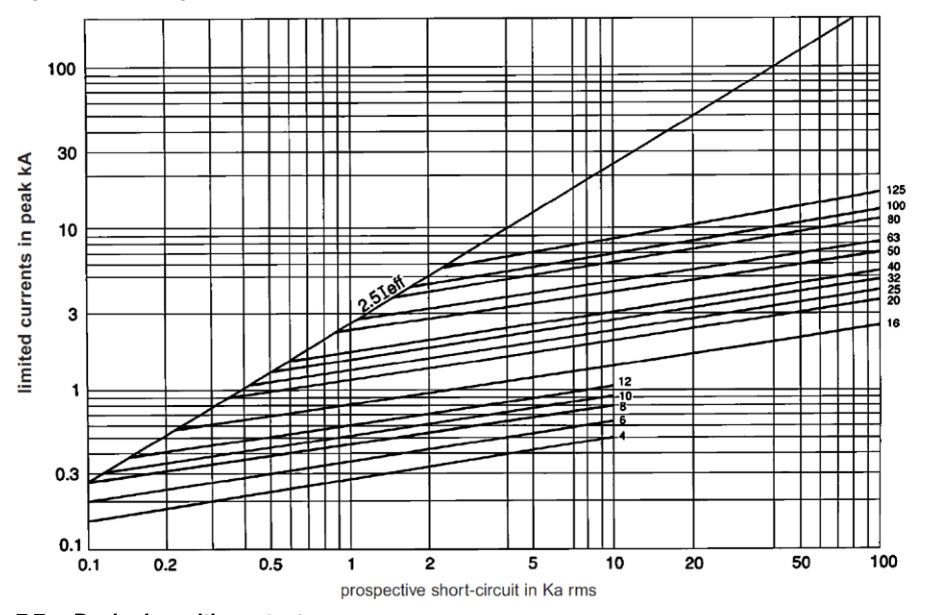
7.7Designing with contactors#
Contactors must be rated for the particular application for reliability and to minimise the likelihood of premature failure. The following table summarises the contactor category, along with typical applications for the particular category (adapted from Sprecher + Schuh Technical Information CA7 3-Pole Contactors)
Table 7.7 – Contactor category and typical application
| Category | Typical application |
|---|---|
| AC-1 | Non-inductive or slightly inductive loads |
| AC-2 | Slip ring motors: starting, plugging |
| AC-3 | Slip ring motors: starting, switching motor off during running |
| AC-4 | Squirrel cage motors: starting, plugging, inching |
| AC-5a | Switching of electric discharge lamps |
| AC-5b | Switching of incandescent lamps |
| AC-6a | Switching of transformers |
| AC-6b | Switching of capacitor banks |
| AC-12 | Control of resistive loads and solid state loads |
| AC-13 | Control of solid state loads with transformer isolation |
| AC-14 | Control of small electromagnetic loads |
| AC-15 | Control of electromagnetic loads |
| AC-20 | Connecting and disconnecting under no load conditions |
| AC-21 | Switching of resistive loads including moderate overloads |
| AC-22 | Switching of mixed resistive and inductive loads with moderate overload |
| AC-23 | Switching of motor loads or other highly inductive loads |
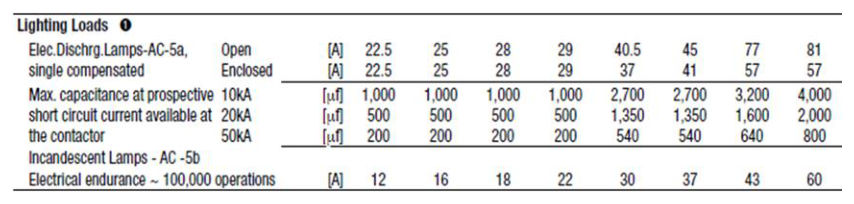
The following figure, also from Sprecher + Schuh provides data on contactors for switching HID luminaires:
The contactor and upstream protection must be suitably coordinated.