
6.7Causes of surge and surge modes#
6.7.1Surge generators#
A surge is a fast, very short duration electrical transient in voltage, current or transferred energy in an electrical circuit that is in excess of the normal operating system parameters. Surges are typically caused by:
6.7.1.1Lightning strikes#
Lightning is a major cause of electrical surges. Surges or lightning impulses can enter an electrical installation via:
- a direct lightning strike on the installation
- direct conduction of lightning current on the conductors entering the installation as a result of the distribution system being hit by lightning
- inductive electric and magnetic field coupling from the lightning strike to conductors in the proximity of the strike which enter the installation, and/or
- direct induction to the electrical installation when the lightning strike is nearby.
6.7.1.2Contact with high voltage#
While not a common occurrence, overvoltages can enter a low voltage installation via an insulation fault between the electrical installation and a circuit of higher voltage: for example, a high voltage (HV) line may fall onto an overhead low voltage (LV) line.
6.7.1.3Switching operations#
Load or capacitor switching in the distribution network and the operation of contactors and switches within an installation can be sources of voltage surges.
6.7.1.4Inductive spikes#
When an inductor discharges onto the line, a voltage spike can be generated.
6.7.1.5Resonant phenomena#
Resonance can occur within an electrical installation due to the interaction of capacitance, inductance and resistance causing voltages well in excess of the standard.
6.7.1.6Electromagnetic pulses#
Nuclear electromagnetic pulses distribute large energies in frequencies from 100 kHz into the gigahertz range through the atmosphere. These pulses can induce large surges into overhead lines and unprotected electrical and electronic equipment.
6.7.2Surge modes#
Two types of transients can occur in an electrical or signals system that use two lines and an earth:
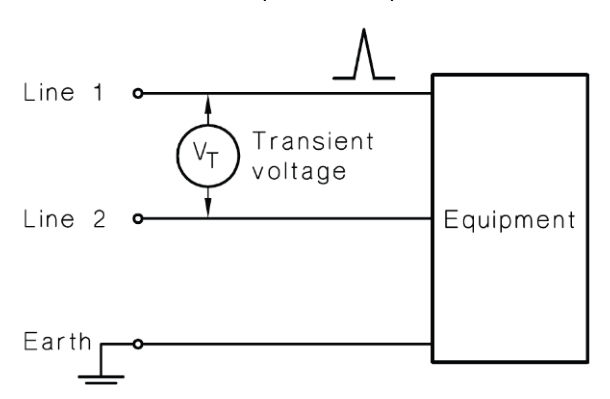
6.7.2.1Differential mode transients#
Also called transverse mode or normal mode, this type appears as a difference between the two lines and is independent of the potential difference to earth.
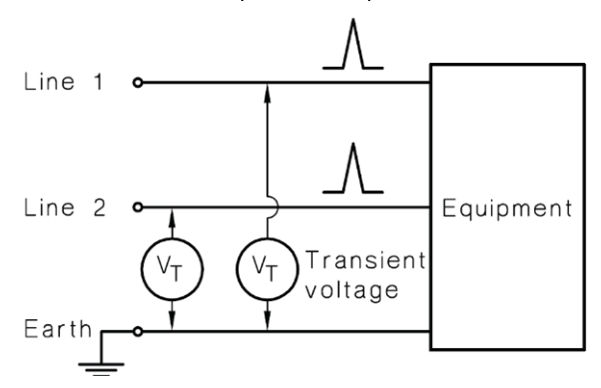
6.7.2.2Common mode transients#
This type appears as a difference between each line and earth. This is common on twisted pair circuits.
Electrical and electronic equipment are typically more easily damaged from line to-line or line-to-neutral transients than from line-to-earth. For telephone and signalling lines, a three-terminal gas SPD is often used as the primary protection for both common and differential mode transients.